Energy materials
3D-printed 8YSZ electrolytes: architectural design improves thermal-shock resistance
Patterned electrolytes withstand a 600 °C water-quench temperature difference in the reported rib-network regions, with approximately 90% more effective surface area and preserved ionic conductivity.
Translation of the supplied technical article reporting Jana et al. (2026), not a KUNWU product test. The crack-free observation concerns the tested thin-rib regions and conditions; it is not a universal no-cracking guarantee.
The research result
Solid oxide cell (SOC) electrolytes must conduct oxygen ions while surviving rapid temperature changes during startup and shutdown. The brittleness of 8YSZ—zirconia stabilized with 8 mol% yttria—makes thermal shock a serious limitation. A team at Montanuniversität Leoben, Austria, used ceramic vat photopolymerization to make surface-patterned 8YSZ electrolytes. In water-quench tests with a 600 °C temperature difference, the thin-rib network showed no observed cracks, whereas flat specimens developed extensive cracking. The architecture increased effective surface area by approximately 90%, while ionic conductivity remained comparable to conventional processing. The study was published in the Journal of the European Ceramic Society.
1 · Why 8YSZ is vulnerable to thermal shock
SOCs include solid oxide fuel cells (SOFCs) for electricity generation and solid oxide electrolysis cells (SOECs) for hydrogen production. They offer high efficiency, fuel flexibility and low emissions. Their dense ceramic electrolyte must combine high oxygen-ion conductivity, chemical stability in oxidizing and reducing atmospheres, and structural integrity during prolonged heating and thermal cycling. 8YSZ is widely used because it balances ionic conductivity and thermodynamic stability.
In electrolyte-supported cells, a zirconia layer approximately 90–250 μm thick carries the mechanical load of the entire cell. Its mechanical stability therefore largely determines cell integrity. Multilayer components have different thermoelastic properties; heating, cooling and emergency shutdown generate substantial thermal stresses. Slower startup and shutdown can help, but sudden thermal shocks still create incompatible thermal strains that can cause delamination or electrolyte cracking.
Two approaches address this problem: changing the material or changing its geometry. Material changes seek greater thermal conductivity, lower thermal expansion and higher fracture toughness. Geometric changes can reduce thickness. For example, a roughly 25 μm 3YSZ electrolyte has smaller internal temperature gradients and improved thermal-shock resistance, but 3YSZ conducts ions much less effectively than 8YSZ. Conventional ceramic processing also restricts geometric complexity, leaving the mechanical reliability of complex architectures under realistic thermal loads insufficiently explored.
2 · Dense material and a 520 MPa characteristic strength
The team printed dense 8YSZ using DLP vat photopolymerization and a slurry containing approximately 50 vol% solids. High solids loading improved green density and reduced interparticle distances, assisting sintering and limiting residual pores. Relative density reached 99.5%. Average sintered grain size was approximately 6.0 ± 3.0 μm—about three times that reported for other DLP 8YSZ systems. Larger grains reduce grain-boundary area and can benefit oxygen-ion transport. Only negligible residual porosity was observed at layer interfaces, indicating good bonding between printed layers.
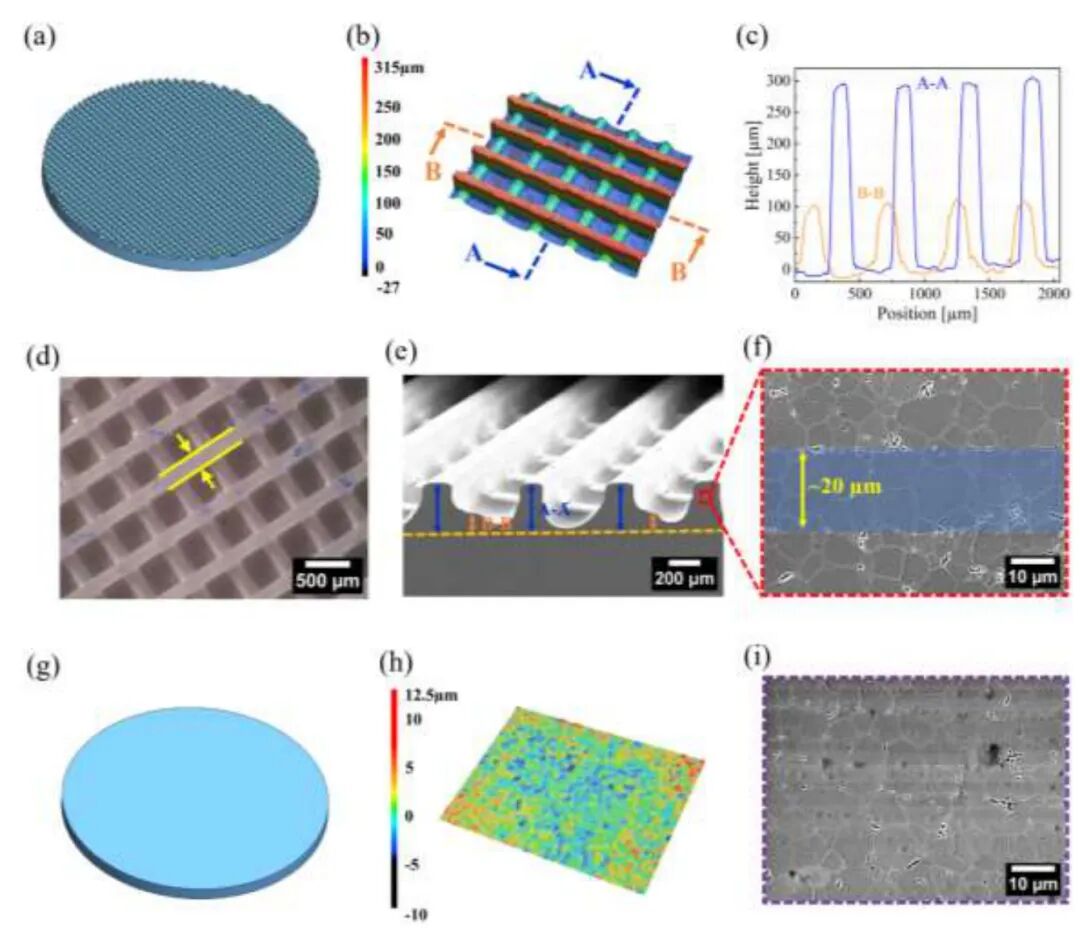
The measured baseline properties were comparable to conventional processing: Young’s modulus E = 197 ± 3 GPa, mean thermal expansion coefficient α = 10.5 × 10⁻⁶ K⁻¹ over 30–1000 °C, and fracture toughness KⅠc = 1.8 ± 0.2 MPa·m½. Ball-on-three-balls (B3B) tests on 30 discs gave a biaxial characteristic strength σ₀ = 520 MPa, with a 90% confidence interval of 492–548 MPa. The Weibull modulus was 6, with a confidence interval of 5–8. Reported strengths of conventionally processed 8YSZ often lie between 232 and 372 MPa, but the paper cautions that strength depends strongly on test configuration and effective stressed volume. Values should only be compared under matched testing conditions.
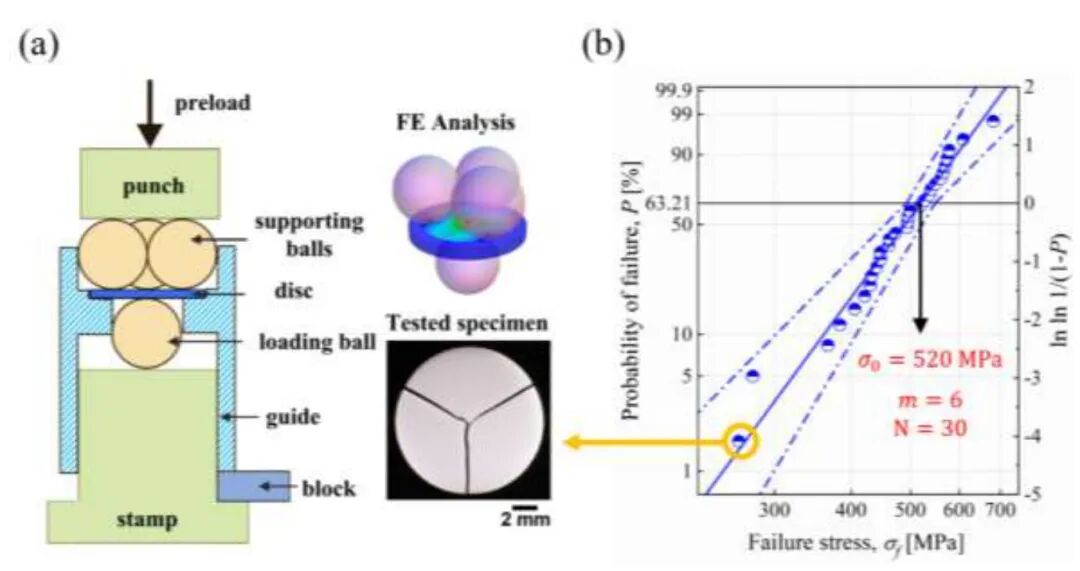
Fractography identified two typical defect populations: locally enlarged grains near the surface and large pores between adjacent printing layers. Similar defects have been reported in other DLP ceramics and point to slurry preparation, slicing, recoating and cleaning as relevant process variables. The paper also notes that sintering above 1450 °C could further reduce residual interlayer porosity.
3 · Ionic conductivity is retained
Electrochemical impedance spectroscopy (EIS) from 200 to 1000 °C compared printed electrolytes with conventionally uniaxially pressed and sintered specimens. At 200–500 °C, grain and grain-boundary conductivities were close. Small differences were attributed to residual porosity and grain size: the printed specimens had 99.5% relative density versus approximately 98% for the conventional material.
At 1000 °C, ionic conductivity was 0.14 S/cm for the printed electrolyte and 0.12 S/cm for the conventional reference. At 800 °C, approximately 0.05 S/cm was measured, comparable to dense 8YSZ made by other routes. The Arrhenius plots departed from a single straight line at lower temperatures, consistent with typical 8YSZ behavior associated with oxygen-vacancy dissociation from yttrium dopants at higher temperatures. Low-temperature activation energies were 104–107 kJ/mol, consistent with other 8YSZ reports.
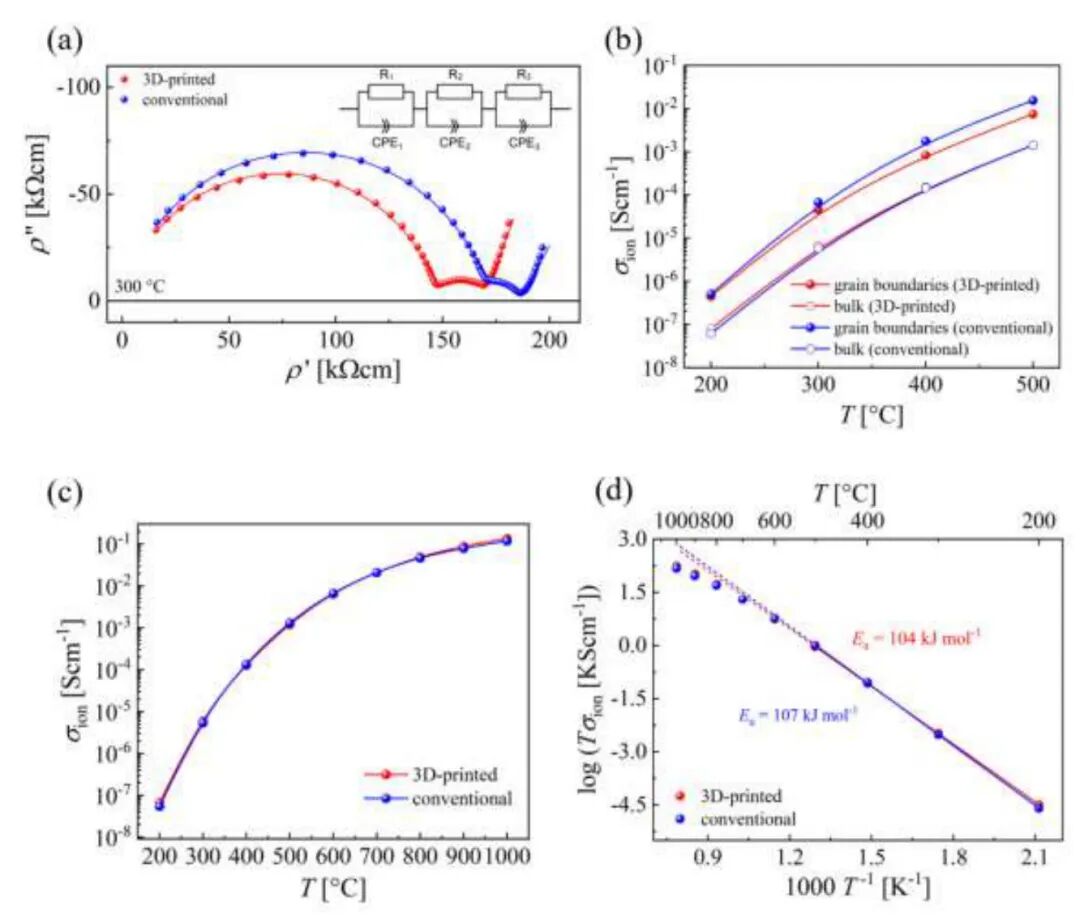
These results indicate that high density and controlled microstructure allow photopolymerization-based printing to retain the ion-transport performance of conventional 8YSZ. This removes an important functional obstacle to incorporating complex electrolyte architectures into cells.
4 · Why the thin-rib network survived a 600 °C quench
Water-quench tests followed EN 820-3. Flat and surface-patterned samples were heated to the target temperature, held for approximately 15 minutes, then immersed in water at approximately 20 °C, giving ΔT = 600 °C. Flat electrolytes developed extensive crack networks. No cracks were observed within the thinner rib-network regions of the patterned specimens under these test conditions.
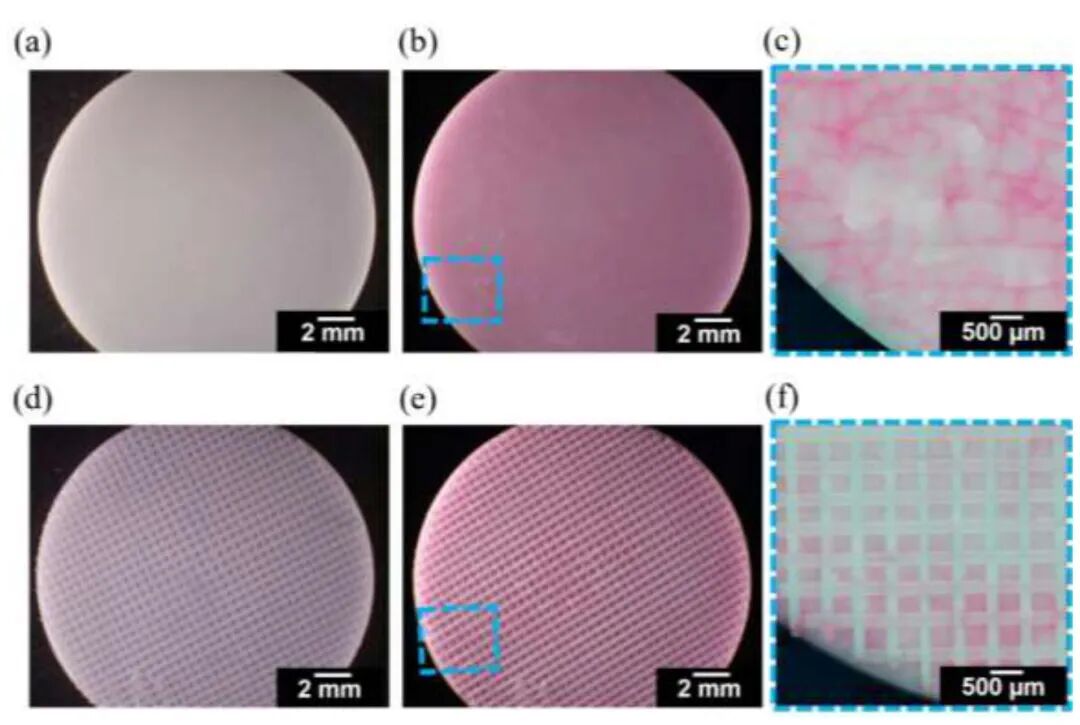
The paper interprets the result using the Biot concept. During quenching, the surface cools rapidly and is placed in tension while the hotter interior remains in compression. Cracks can initiate when tensile stress exceeds material strength. The characteristic dimension influences both the magnitude and distribution of thermal stress: larger dimensions create steeper surface-to-interior temperature gradients, while smaller dimensions reduce those gradients and raise the temperature difference required to initiate cracking.
Patterning reduces the local characteristic dimension—the rib thickness—well below that of the flat disc while increasing effective surface area. Thinner ribs experience lower surface tensile stress when first contacting the water. In addition, the roughly 300 μm spacing between ribs hinders immediate water penetration into the intervening flat regions, moderating the thermal-shock loading. Complex additive-manufactured geometry can therefore improve electrolyte thermomechanical reliability under the investigated severe thermal load.
5 · Double-sided patterning and future printed SOCs
The thermal-shock specimens were patterned on one side to simplify manufacturing. The process can nevertheless produce complex patterns on both electrolyte faces. SEM showed well-formed thin-walled periodic structures on both sides, a firmly bonded interface between the pattern and flat substrate, and an intact corrugated architecture on the fracture surface.
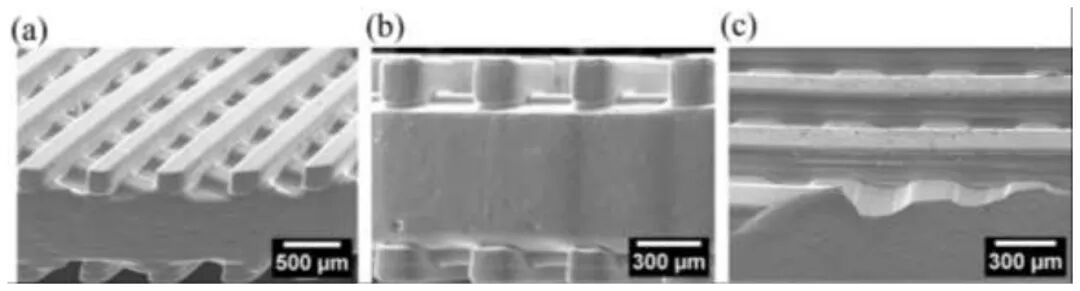
Double-sided patterns may improve thermal damage tolerance further by redistributing stress on both faces. The authors also identify the possibility of increasing the number of periodic unit cells per unit volume, enlarging effective surface area while retaining intrinsic material properties and potentially improving SOC volumetric power density. This provides a route toward application-specific electrolyte geometries and, eventually, fully printed solid oxide cells. These are development directions, not demonstrated performance specifications for a complete commercial cell.
Sources
Original paper · DOI
Jana A, Schlacher J, Kraleva I, Egger A, Schwentenwein M, Bucher E, Bermejo R. Enhanced thermal shock resistance of 8YSZ ceramic electrolytes through a 3D-printed architectural design. Journal of the European Ceramic Society (2026), 118838.