Applications
Additive ceramics for water treatment: a review
A review connects surface textures, graded channels and functional composites with higher flow, lower fouling and catalytic treatment in ceramic membranes.
This KUNWU editorial note is based on the supplied technical source. Reported results belong to the described study or sample and are not KUNWU equipment specifications.
Introduction
A revolution about “structure” and “functional” — without the need for moulds, without chemical modifications, can only make ceramic membranes resistant to pollution, with high fluxes, and even with the potential for self-healing “smartness” — when they are manufactured for water treatment ceramics.
Globally, more than 2 billion people face water shortages each year, with oil pollution, organic pollutants and high-salt wastewater in industrial wastewater straining traditional treatment technologies. The membrane separation technique is regarded as a “saviour”, but the traditional ceramic membrane faces two major “failures”: a sudden drop in flux due to contamination of the surface, and a huge cross-film pressure difference due to a pore mutation between the support and separation layers. Even more problematic is the need for multi-step sintering of the pore membranes of the gradients prepared by the traditional processes, which are extremely fragile.
The intervention in the production of materials (3D printing) provides a whole new solution to this dilemma. In particular, the technology of photo fixation (VPP) and straight-text crowding out (DIW) is reshaping the “genetics” of water treatment of ceramics, with the advantage of its high precision, non-module-free, complex and multi-grade structure.
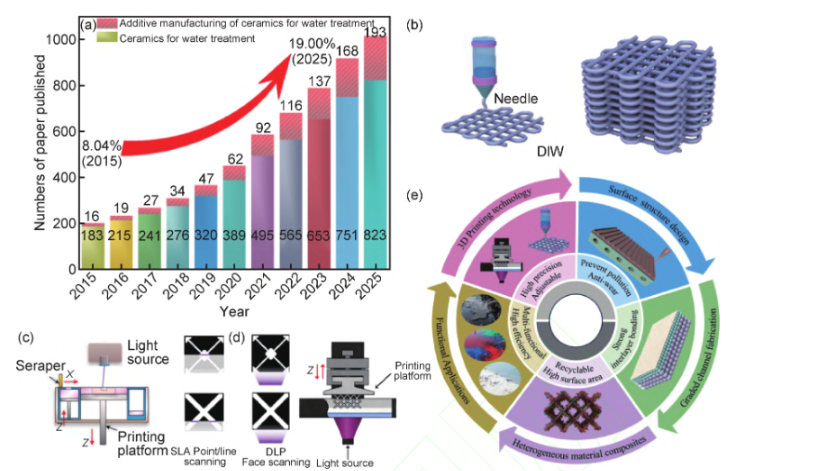
Surface function structure design: countering pollution with physical structure
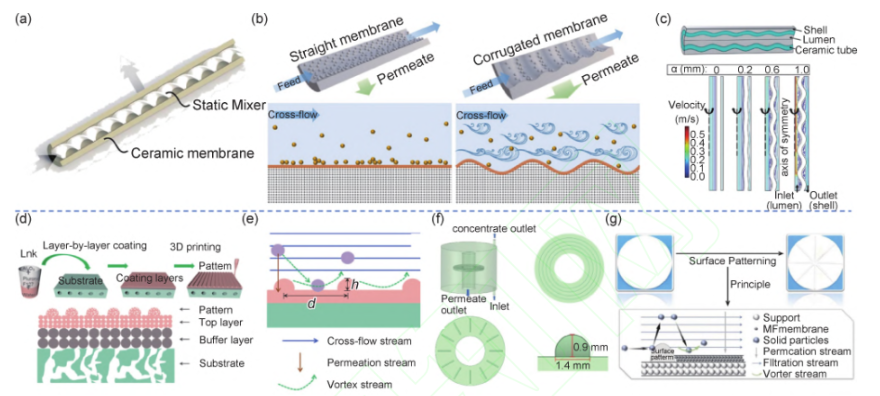
Traditional anti-pollution membranes depend on chemical modifications, which are costly and susceptible to failure. The 3D print-out of the Surface Functional Structure Design gives an elegant physical solution - the direct printing of a micro-metre-scale structure such as a ripple, spiral, line, ring, etc. on the membrane surface.
These structures work like the installation of a "microflow generator" on the membrane surface. When water flows pass, these condensed geometrical shapes induce local runoff and increase the membrane cut-off response, thereby destroying the boundary layer of the pollutant sediment.
Data speaking: - Membranes with Kenics shape flow boosters with an increase of 140 per cent in water fluxes; - bellow structures increase water fluxes by 1.7 times, contaminant deposition by 40 per cent and clean-up flux recovery by over 90 per cent;
Even more surprising is the fact that this structure can also be “one arrow and two” - a linear “armour belt” that, while anti-polluting, increases the membrane surface resistance to up to 92.9 per cent. This means that the membrane life will be significantly increased in highly sand-bearing wastewater treatment.
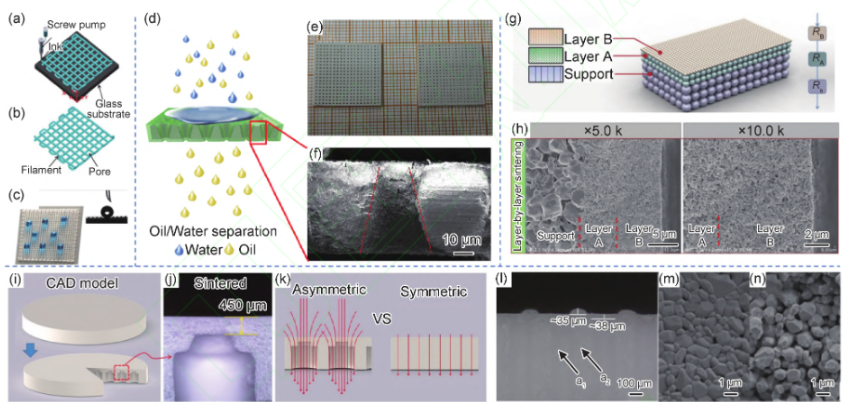
ii. Gradient pore structure design: reduction of cross-film pressure differentials
Traditional ceramic membranes consist of support, transition and separation layers, with a mutation of the pore from the micro-scale to the nanoscale, leading to a sharp increase in inter-film pressure differentials. The 3D-printed Gradient Hole Structure Design completely changed the situation.
For the first time, through photoresisting 3D printing techniques, researchers have integrated support, transition, separation and even surface containment structures. This step-by-step process not only eliminates the risk of break-ups in the traditional multistep sinter, but also accurately controls the pore gradients of each layer.
Performance verification: - Conesian gradients increase water flux by 40 per cent and separation efficiency of oil and water mixtures by more than 96.5 per cent;
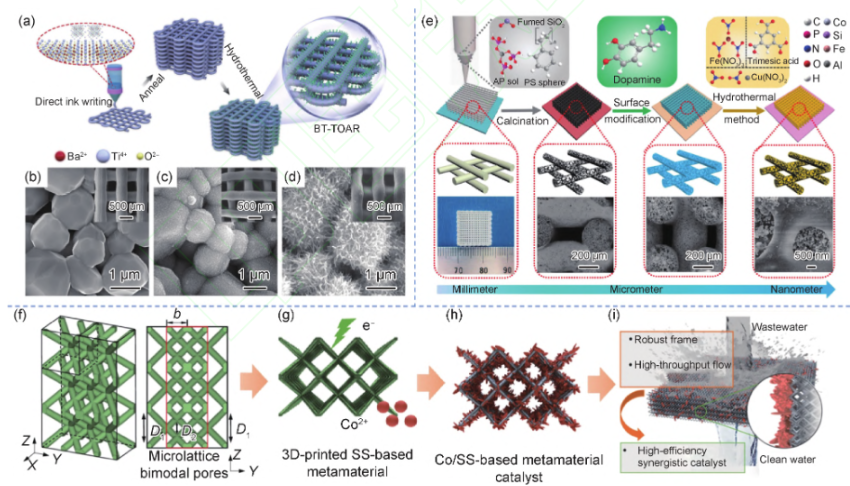
III. Isogenic composites: cactusization of ceramic membranes
If the first two techniques address “physical performance”, the “mixed heterogeneity” gives ceramic membrane chemical intelligence. Researchers use 3D-printed ceramic slabs as the basis for introducing light-catalytic or voltage function materials such as TiO2 and Batio3 on the surface of the slabs, through in situ growth and water thermal synthesis.
The essence of this complex structure is that the 3D-printed stand not only provides a high surface area for the catalyst, which is not vulnerable to loss, but also promotes photo-borne fluid separation through the construction of a heterogeneity interface, which significantly enhances catalytic degradation efficiency. The front line is the combination of the Batio3 voltage stand with the TiO2 nanometer line, which can be used to enhance catalytic activity - The charge from the voltage material further drives the catalytic reaction when the current shock or ultrasound vibration occurs.
Typical cases: - Polypolymers - Ceramic nanoclinic composite grid structures are effective in promoting photo-borne fluid separation through the heterogeneity interface and increasing photo-catalytic degradation efficiency; - Batio3-TiO2 composite frames display enhanced catalytic degradation under ultrasound.
IV. Engineering challenges and the way forward
Despite the amazing potential of 3D-printed water-treatment ceramics, there are still three “roadblocks” to large-scale industrialization:
But the outlook for the future is also encouraging: - Self-healing smart ceramics: developing intelligent materials capable of self-remediation of cracks, like biological tissues, significantly prolonging the useful life; - Machine learning enabling: accelerating the development of new materials and structures using AI to guide the synergetic design of “process-structure-performance”; - Industrialization breakthrough: working towards the industrial production of high-intensity, long-lived water-processing ceramics.
From surface tattoos to gradient holes, from physical resistance to chemical intelligence, 3D printing is redefining the boundary of water treatment ceramics. This is not only technological progress, but also an innovation in the way of thinking — when traditional processes are mired in the myth of “material modification”, “structural design” provides more elegant answers for the production of materials. Perhaps in the near future, we can really have a “thinking” ceramic membrane that not only filters water, but also cleans itself, repairs itself, and even uses currents to catalyse degradation pollutants.