Applications
Additive-manufactured ceramics for water treatment
How surface textures, graded pores and functional coatings can control flow, membrane fouling and catalytic activity.
This KUNWU editorial note is based on the supplied technical source. Reported results belong to the described study or sample and are not KUNWU equipment specifications.
When water treatment ceramics meet additive manufacturing, a new type of water treatment material that combines high precision, multi-function, and long life is being born.
Nearly 4 billion people around the world are facing serious water shortages, while industrial wastewater, oily sewage, and organic pollutants continue to aggravate water pollution. Although traditional water treatment technologies—chemical precipitation, biodegradation, and membrane separation—have their own merits, they generally face pain points such as high energy consumption, secondary pollution, and low treatment efficiency. Especially for ceramic membranes, although they have good chemical stability, high mechanical strength, and long life, there are three major "flaws" in traditional preparation processes (such as tape casting and extrusion sintering).
- Limited geometry makes complex graded channels difficult and can increase transmembrane pressure and energy use.
- Fouling covers the surface, reduces water flux and complicates cleaning.
- Weak bonding between layers can cause delamination failure.
The emergence of 3D printing (additive manufacturing) technology provides new ideas for these problems. Recently, a review paper "Research Status and Development Trends of Ceramics for Additive Manufacturing of Water Treatment" published in "Acta Ceramics" systematically sorted out the latest progress in this field.
Three design approaches for printed ceramic membranes
The paper points out that there are currently two main types of 3D printing technologies used for water treatment ceramics: light curing molding (VPP/DLP) and direct writing extrusion molding (DIW). They each have their own merits, but the core advantages are the same - high precision, no molds, and strong designability. Based on these technologies, researchers have developed three major innovation strategies:
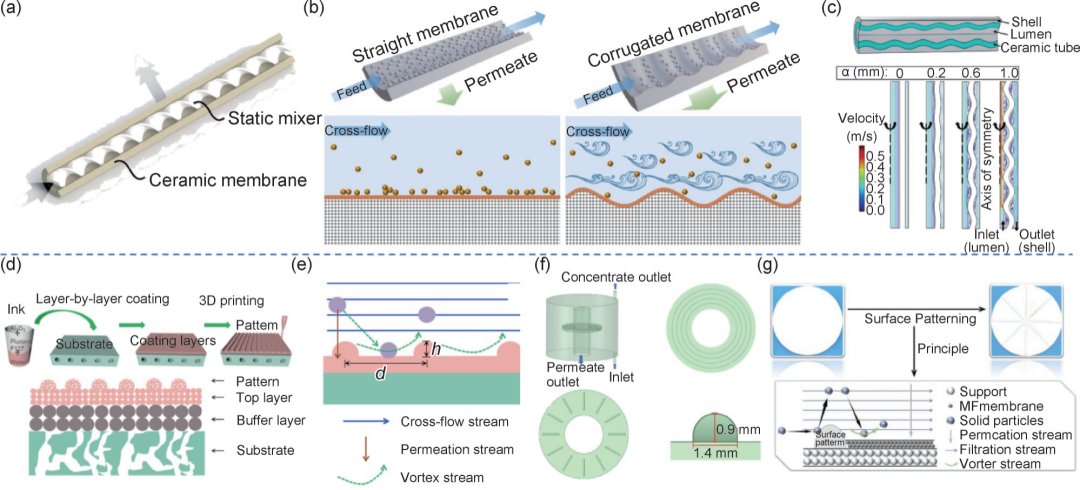
Surface patterning promotes membrane cleaning
The surface of traditional ceramic membranes is smooth, and pollutants are easy to "hang on". 3D printing can "carve" various micro-nano structures on the membrane surface - ripples, spirals, linear, ring, and even Kenics turbulence promoters.
Core mechanism: These structures can induce local turbulence, enhance membrane shear stress, and destroy the boundary layer of pollutant deposition. In layman's terms, it means letting the water flow "move on its own" and wash away the pollutants.
Experimental data: - The Kenics-shaped turbulence promoter designed by the Armbruster team increased the water flux by 140%. - On the corrugated structure membrane, Zhong Zhaoxiang's team increased the water flux by 1.7 times, reduced the deposition of pollutants by 40%, and the flux recovery rate after cleaning exceeded 90%. - Qin Hang's team found that the linear structure increased the membrane surface shear force by 55.8%, the water flux remained at 90% after 200 minutes (unstructured membrane was only 67%), and the wear resistance increased by up to 92.9%.
Graded pores connect different transport scales
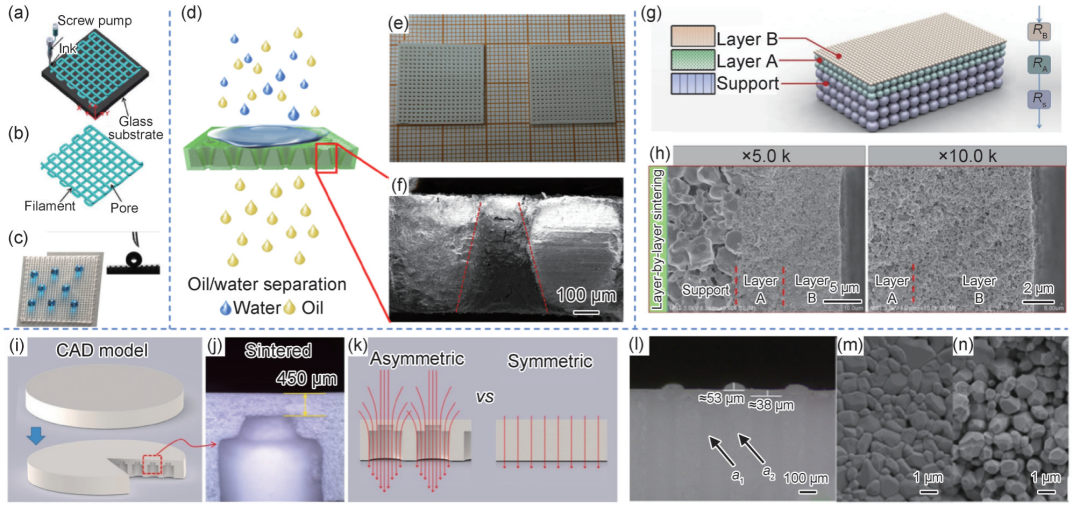
Traditional ceramic membranes usually only have one pore size, either with high flux but poor retention, or with good retention but low flux. 3D printing can build a continuous gradient channel from the support layer to the separation layer, just like an "overpass" from a highway to a residential road.
Core innovation: - It solves the problem of the inability to prepare continuous gradient pores with traditional processes, eliminates the brittle interface caused by sudden pore changes, and reduces the transmembrane pressure difference. - Achieve integrated molding of the support body, transition layer, separation layer and even antifouling structure, simplifying the multi-step preparation process.
Experimental data: - The tapered gradient hole prepared by Mei Hui's team increased the flux by 40%, and the separation efficiency of oil-water mixture was >96.5%. - The membrane prepared by Fan Yiqun's team through dip coating + co-sintering has a pure water flux of up to 0.0122 L/(m²·h·Pa) and can retain 100% of CeO₂/TiO₂.
Heterogeneous composites add functionality
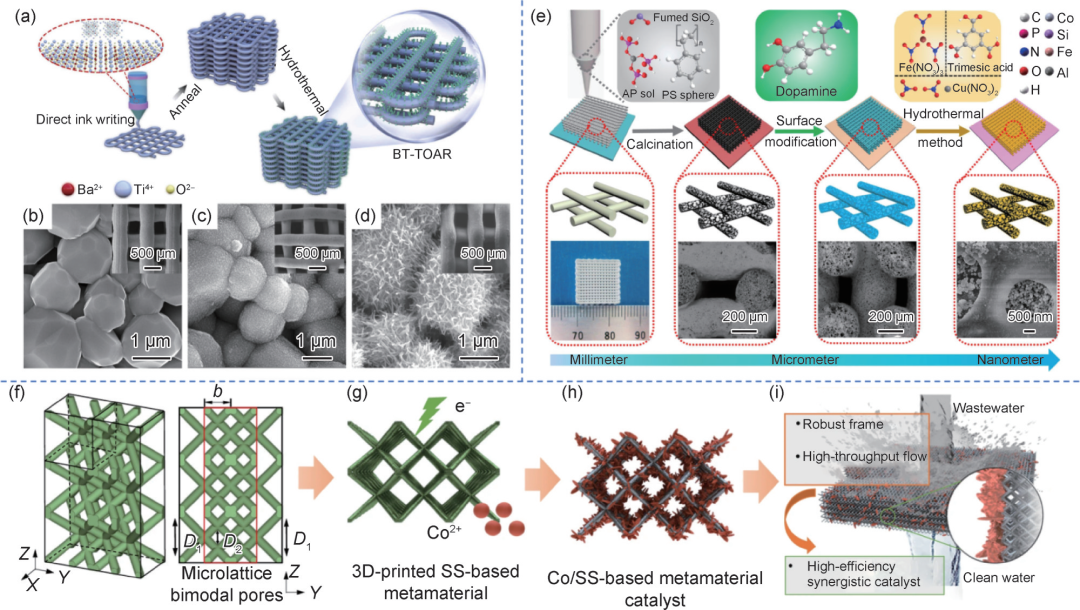
The 3D printed ceramic scaffold is not only a filter media, but also a high specific surface area catalytic carrier. Second-phase functional materials such as TiO₂, MOF, and BaTiO₃ can be introduced through in-situ growth, dip coating, electrochemical modification, etc.
Core innovation: - Solve the problem of easy loss and difficult recovery of powder catalyst. - By constructing heterojunctions or functional complexes, efficient catalytic degradation such as piezoelectric-photocatalytic synergistic enhancement and Fenton-like reaction can be achieved. - Break the "triangular trade-off" between mechanical strength, mass transfer efficiency and catalytic performance through bionic design (such as Douglas fir microlattice).
Experimental data: - The BaTiO₃-TiO₂ piezoelectric-photocatalysis prepared by Zhang Dou's team synergistically degrades indigo carmine, with a rate constant of 0.109 min⁻¹. - The MOF/ceramic scaffold composite material of Wang Xiaolong's team has a degradation efficiency of 99.68% for organic dyes, and is still >75% after 50 cycles.
Conclusion
Although 3D printing water treatment ceramics have made impressive progress, there are still "three mountains" to climb before large-scale industrial application:
- Nanoscale separation layers remain difficult to print directly at typical micrometre resolution; post-processing and hybrid routes are needed to control nanoscale pores.
- Structural stability and interface bonding still require validation under high temperature, high pressure and strong acids or alkalis.
- Equipment, slurry and post-processing costs remain barriers; commercialization needs low cost, high throughput and long service life together.
The paper finally puts forward three forward-looking directions: First, self-healing smart ceramics - develop smart ceramics that can repair cracks independently and significantly extend their service life. The second is machine learning-assisted optimization - using AI algorithms to guide the collaborative optimization of "process-structure-performance" to accelerate the design of new materials and new structures. The third is industrial application - promoting the large-scale, low-cost production of 3D printing technology in high-throughput, long-life water treatment ceramics, and truly bringing the technology to the market
Paper citation information: Sun Yunfei, Wang Zehao, Liu Yixin, et al. Research status and trends of additive manufacturing of ceramics for water treatment [J]. Materials Engineering, 2026, 54(5): 184-199. SUN Yunfei, WANG Zehao, LIU Yixin, et al. Research status and trends of additive manufacturing of ceramics for water treatment [J]. Journal of Materials Engineering, 2026, 54(5): 184-199.