Applications
Alumina lattice with aerogel for high-temperature absorption
A printed honeycomb skeleton and graded resistive aerogel are combined for broadband electromagnetic absorption at elevated temperature.
This KUNWU editorial note is based on the supplied technical source. Reported results belong to the described study or sample and are not KUNWU equipment specifications.
A multifunctional ceramic-based honeycomb sandwich superstructure that integrates electromagnetic wave absorption, thermal insulation and mechanical load-bearing. By filling gradient resistance aerogels in 3D printed alumina honeycombs, it achieved a record-breaking broadband absorption bandwidth of 14.18 GHz at a high temperature of 500°C, and also has a compressive strength of 31.76 MPa.
Research background
Modern radars, shipboard electronic systems and airborne communication equipment often face extreme thermal environment challenges when working. The casings of these electronic devices need to play three roles at the same time: electromagnetic wave absorber (to achieve radar stealth), thermal insulator (to prevent heat conduction) and load-bearing structure (to provide mechanical support).
However, existing absorbing materials have their own shortcomings: - Electrical loss materials (such as carbon-based, conductive polymers) are prone to oxidation and failure at high temperatures - Magnetic loss materials (such as ferrite) have low Curie temperatures, and their magnetism attenuates sharply at high temperatures - Dielectric loss materials (such as SiC fibers) have narrow absorption bandwidths and are difficult to cover wide frequencies
More importantly, most traditional solutions apply absorbing coatings to the surface of the structure. Although this "skin-type" design is simple, it has poor load-bearing capacity and is difficult to meet the needs of structural parts.
How to simultaneously achieve broadband wave absorption, high temperature stability, thermal insulation and mechanical load-bearing in an integrated structure? This problem has troubled the materials science community for many years.
Methods
Professor Li Weijie from Beijing Institute of Technology in Zhuhai led a team to publish a paper titled "Integrated fabrication of 3D-Printed ceramic Honeycombs with Gradient-Resistive aerogel fillers for High-Temperature broadband radar absorption" in "Composites Part A: Applied Science and Manufacturing", and provided an ingenious solution with the help of KUNWU industrial-grade ceramic 3D printer: honeycomb sandwich superstructure.
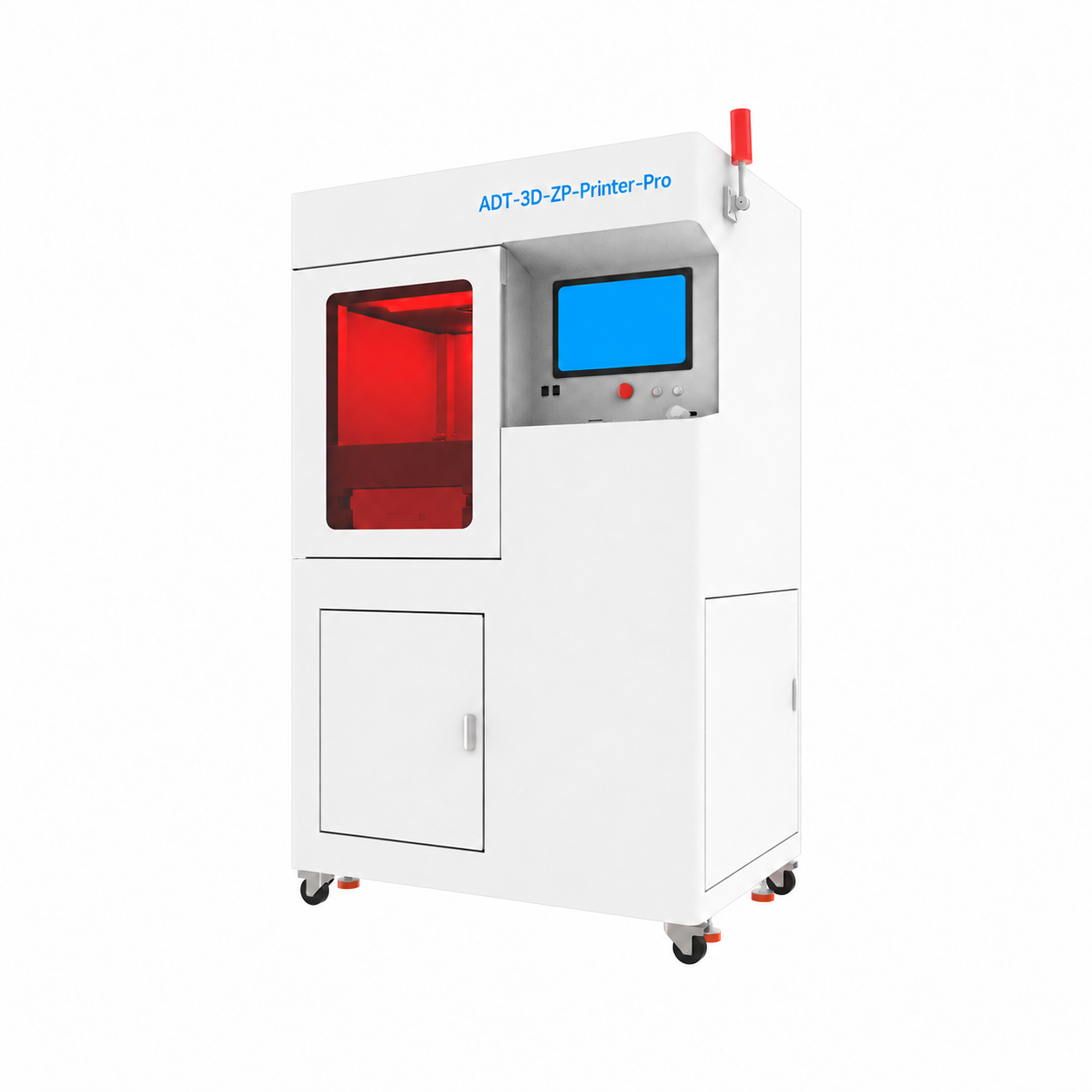
KUNWU industrial grade ceramic 3D printer (after appearance upgrade)
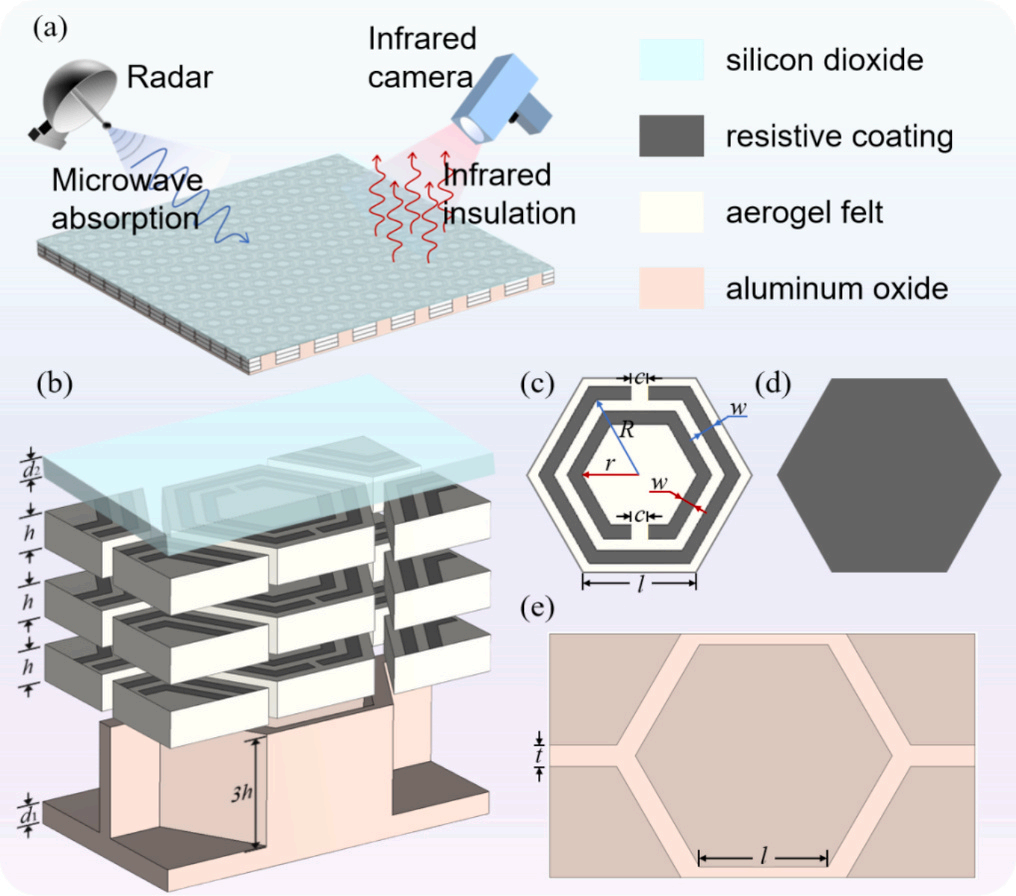
Schematic diagram of the overall configuration of the honeycomb sandwich superstructure and the layout of the gradient resistance coating
The core design concept of this structure is functional decoupling — with different groups assigned to their respective functions:
Load-bearing skeleton: 3D printed aluminum oxide (Al₂O₃) honeycomb. Alumina is a typical high-temperature structural ceramic, with a melting point exceeding 2000°C and a compressive strength as high as hundreds of MPa. 3D printing technology can precisely control the wall thickness, pore size and arrangement of honeycombs to optimize mechanical properties and electromagnetic response.
Functional filler: multi-layer silica airgel felt filled in honeycomb holes. Aerogel is known as "solid smoke". Its porosity is as high as more than 90% and its thermal conductivity is as low as 0.02 W/(m·K). It is an excellent thermal insulation material. What's more, the aerogel's porous structure provides an ideal base for subsequent coatings.
Absorbent coating: A gradient resistive coating built on the surface of an aerogel. Three patterned resistance layers (carbon-based materials) were designed, with different resistance values in each layer and a gradient change from the outside to the inside. This design achieves the synergistic effect of impedance matching and ohmic loss, causing the incident electromagnetic wave to gradually attenuate in the multi-layer structure, ultimately achieving broadband absorption.
Protective cover: Dense silicon dioxide (SiO₂) cover protects the internal structure from environmental erosion.
Why can gradient resistor design achieve broadband absorption? There is a core physical mechanism that needs to be understood here: impedance matching.
Electromagnetic waves will be reflected at the interface of two media, and the intensity of reflection depends on the impedance difference between the two media. If the impedances do not match, most electromagnetic waves will be reflected on the surface and cannot enter the interior of the material to be absorbed.
Traditional monolayer absorbents are usually matched with resistance in a narrow band, resulting in limited absorption bandwidth. Gradient resistance design is equivalent to building an anti-gravity layer within the material:
- The outer layer has lower resistance, approaching free-space impedance to admit electromagnetic waves.
- The intermediate layer has moderate resistance and begins dissipating energy through ohmic losses.
- The inner layer has higher resistance and works with the continuous resistive bottom coating to complete absorption.
This design enables the material to find suitable resistance matches at different frequencies and thus achieve effective absorption within a wide range.
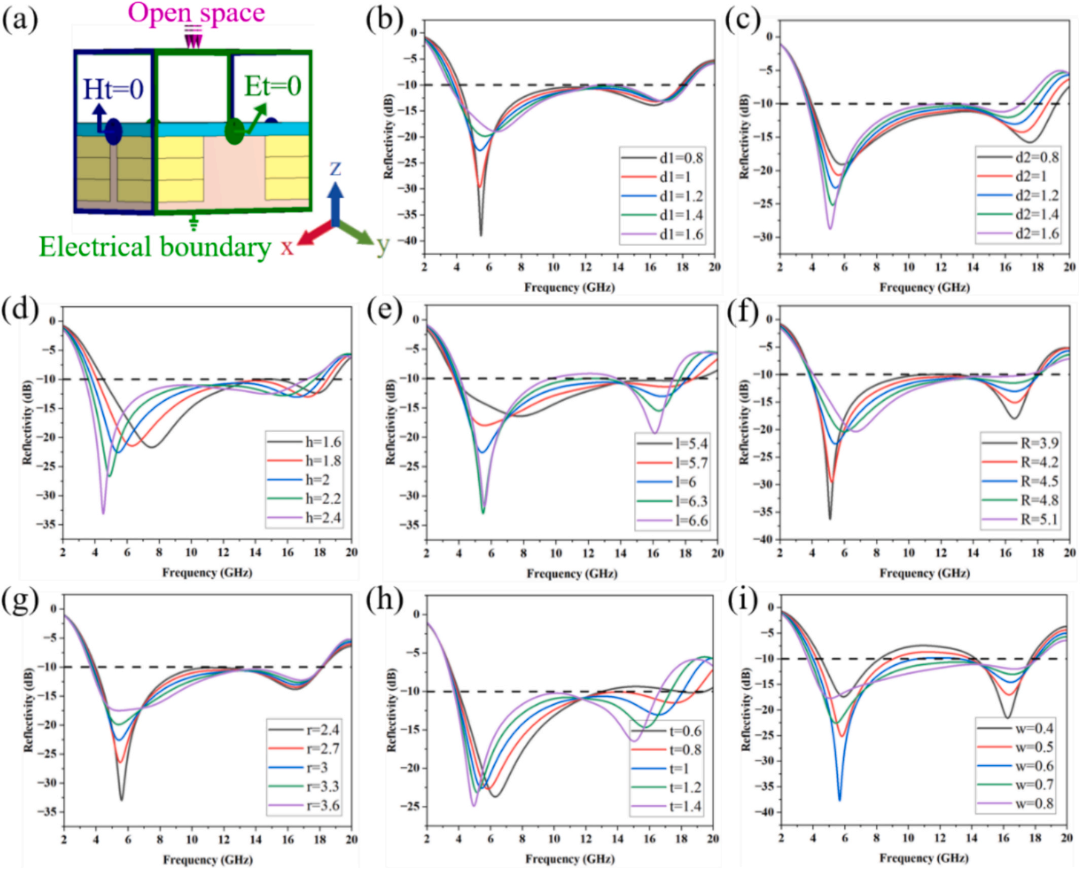
The optimization of structural parameters includes: (a) electromagnetic boundary configuration in CST simulation; (b) bottom plate thickness ‘d1’; (c) top plate thickness ‘d2’; (d) filling layer thickness ‘h’; (e) honeycomb structure side length ‘l’; (f) outer resistive coating inner edge length ‘R’; (g) inner resistive coating inner edge length ‘r’; (h) honeycomb wall thickness ‘t’; (i) resistive coating width ‘w’.
Simulation results clearly show that, at different frequencies, the power loss of electromagnetic waves is concentrated in different resistance layers, and this is the physical evidence of the gradient design to achieve broadband absorption.
Results
Experimental results show that this honeycomb sandwich superstructure performs well in a number of performance indicators:
Electromagnetic absorption performance: - Stable broadband absorption is achieved in a wide temperature range from room temperature to 500°C - At a high temperature of 500°C, the effective absorption bandwidth (reflection loss < -10 dB, that is, absorption rate > 90%) reaches 14.18 GHz, covering the 2.32–16.5 GHz frequency band - This means that it covers almost the entire X-band (8-12 GHz) and Ku-band (12-18 GHz)
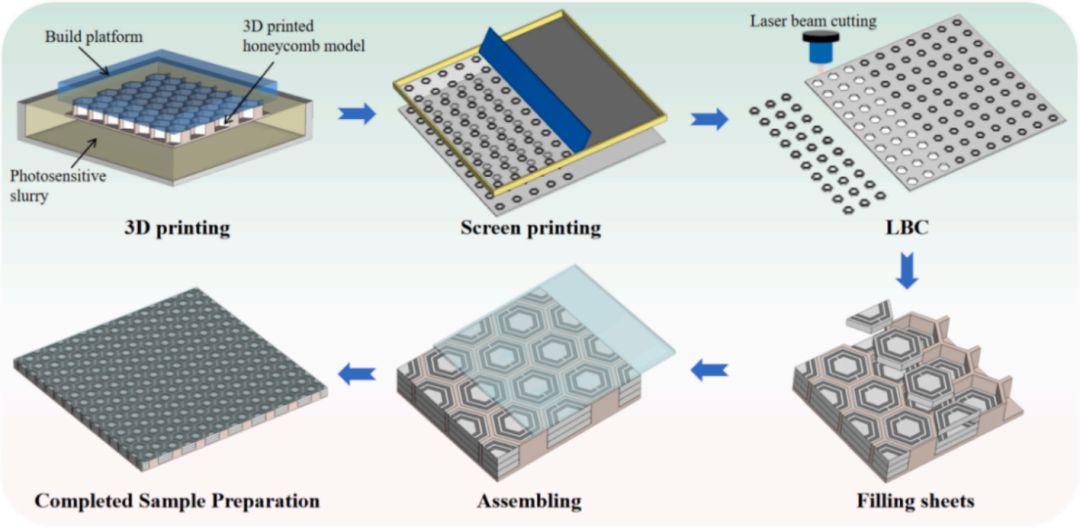
Preparation process of honeycomb sandwich superstructure
Thermal insulation performance: - In the high-temperature exposure test, the backside temperature was significantly lower than the frontside temperature, proving that the airgel-filled honeycomb structure effectively inhibits heat conduction - This provides the possibility for infrared stealth - lowering the target surface temperature and reducing infrared radiation
Mechanical properties: - The compressive strength reaches 31.76 MPa, which is equivalent to withstanding about 320 kilograms of pressure per square centimeter - The overall structural density is about 1.6 g/cm³, relatively lightweight - Impact tests show that the honeycomb structure has effective energy dissipation capabilities
This superstructured manufacturing process, which combines many advanced manufacturing technologies, also deserves attention:
3D printed honeycomb skeleton: Using alumina slurry, the honeycomb structure is manufactured through light-curing 3D printing technology. The printing accuracy can reach micron level, and the wall thickness and pore size can be precisely controlled.
Airgel filling: Inject silica sol into the honeycomb holes, and form an airgel filling body through the sol-gel process and supercritical drying.
Preparation of gradient resistance coating: Carbon-based coatings with different surface resistance values are sequentially deposited on the surface of the airgel through mask spraying. The pattern and resistance value of each coating are carefully designed.
Cover packaging: Finally, it is sealed with a silicon dioxide cover to form a complete sandwich structure.
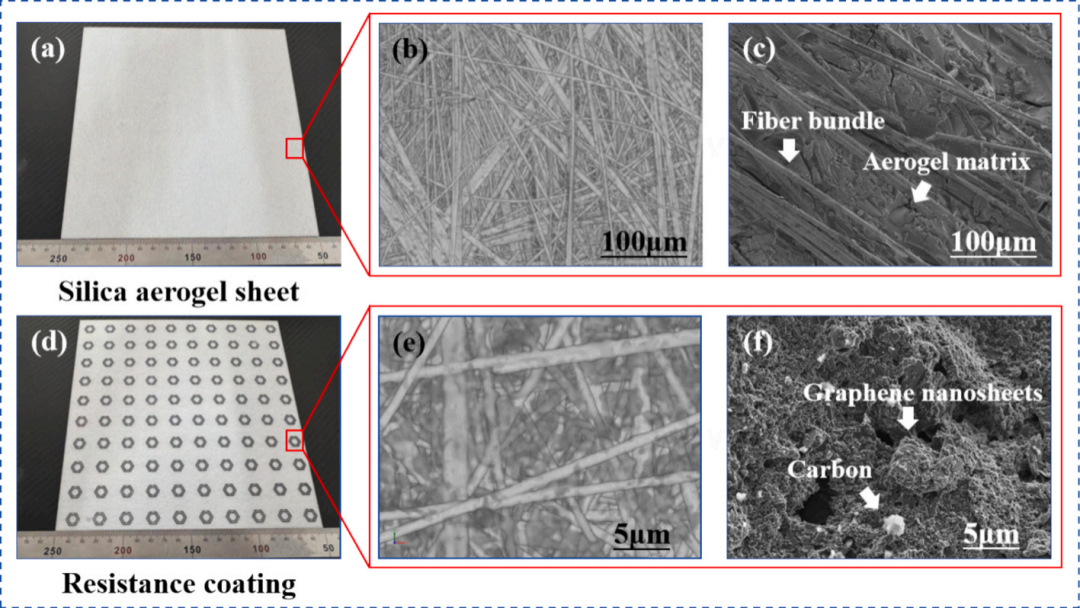
Morphological characteristics of the airgel pad and resistive coating: (a) Macroscopic photo of the airgel pad; (b) CT reconstruction image of the airgel pad; (c) SEM morphology image of the airgel pad; (d) Macroscopic photo of the resistive coating; (e) CT reconstructed image of the resistive coating; (f) SEM morphology image of the resistive coating.
Conclusions
The core value of this work lies not only in the achievement of record wide-band absorption performance, but also in the establishment of a general paradigm for the design of multifunctional load absorbent composite materials through hierarchy integration.
In traditional design, the three functions of wave absorption, heat insulation and load-bearing often conflict with each other: adding wave absorbing agent will reduce the mechanical properties, and adding heat insulation layer will thicken the structure. Through the hierarchical composite design of "ceramic honeycomb skeleton (load-bearing) + aerogel (heat insulation) + gradient resistance layer (wave absorption)", the three functions are cleverly decoupled and can work together in the same structure.
In the future, this concept of design could be extended to: - other ceramic materials (e.g., SiC, ANN) to optimize high temperature performance - the demand for suction in other frequency bands (e.g., low frequency, millimetre wave) - more extreme conditions of service (e.g. heat-power-electromagnetic coupling tests)
This multifunctional integrated structure provides a promising technical route for application scenarios such as high-power electronic equipment protection, aerospace stealth structures, and shipboard radar radomes.
Paper citation information: Han, Y. https://doi.org/10.1016/j.compositesa.2026.109764