Materials research
BaTiO₃ from particle size to sintering
Particle size affects rheology and light scattering, then cure depth, green-part defects and property development during sintering.
This KUNWU editorial note is based on the supplied technical source. Reported results belong to the described study or sample and are not KUNWU equipment specifications.
Solids loading, viscosity and light scattering
To make dense BaTiO₃ ceramics, the solid content in the photosensitive slurry must be increased as much as possible: this is because the more pores left after pyrolysis of the photosensitive resin, the higher the shrinkage rate after sintering. However, increasing the solid content means that the viscosity soars, and the refractive index of BaTiO₃ is extremely high (n ≈ 2.4). The refractive index mismatch with the photosensitive resin causes ultraviolet light to scatter violently at the ceramic-resin interface, severely weakening the penetration depth of light (cure depth). At the same time, it causes the lateral expansion of the cured area and reduces the dimensional accuracy. This creates a vicious cycle of "high solid content -> high viscosity + strong scattering -> printing defects".
The first step to break the situation is the selection of particle size. Two particle sizes were selected for the study: BTO-0.2 (0.2 μm, specific surface area 5.01 m²/g) and BTO-0.5 (0.5 μm, specific surface area 2.07 m²/g), and photosensitive slurries were prepared at the same solid content of 80 wt.% (mass fraction). The results show that the finer the particle size, the higher the density of contact surfaces between particles and the stronger the network structure between particles, which is manifested in higher yield stress and stronger shear thinning characteristics. Fitted with the Herschel-Bulkley model, the yield stress of BTO-0.2 is 26.10 Pa and the mobility index n=0.8; while the yield stress of BTO-0.5 is only 16.74 Pa and n=0.92. The former means stronger vertical shape retention ability: less deposition and good shape retention; the latter means better fluidity, but insufficient structural rigidity when left standing.
However, the effect of particle size on photocuring is exactly the opposite. The curing depth of BTO-0.5 is significantly higher than that of BTO-0.2. This is because the finer the particle size, the greater the number of particles per unit volume, and the denser the light scattering sites, resulting in faster attenuation of light penetration. In other words, the rheological advantages of fine particle size come at the expense of light curing. The paper tested the curing depth of the two slurries in the range of 2–10 s. The results showed that the curing depth of BTO-0.5 was always higher than that of BTO-0.2 under the same exposure time, while the exposure time of 8–10 s allowed both slurries to obtain a smooth and uniform layer morphology.
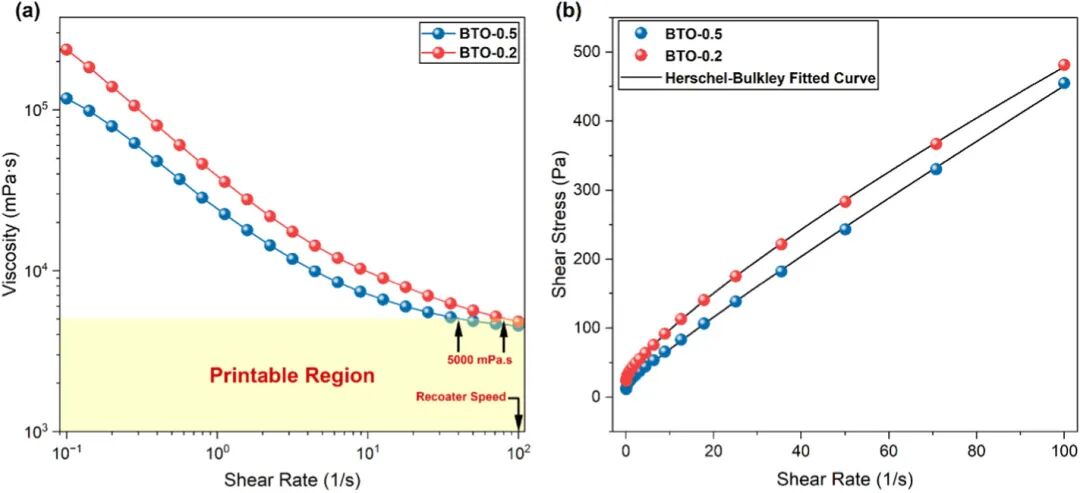
Multipoint slurry injection overcomes viscosity limits
High viscosity alone is not enough, it must also be spreadable. Traditional DLP printers rely on a blade recoater to spread the slurry across the entire printing platform, which is fine for low-viscosity systems. However, high-viscosity slurries will "roll-over" in front of the blade: the front end of the slurry is superimposed on itself under the push of the blade, and bubbles are involved, resulting in defects and unevenness within the layer. The strategy adopted in the paper is "multi-point injection": multiple slurry nozzles are installed above the printing bed, and the high-viscosity slurry is first pre-distributed to various areas, and then a scraper is used for short-distance leveling.
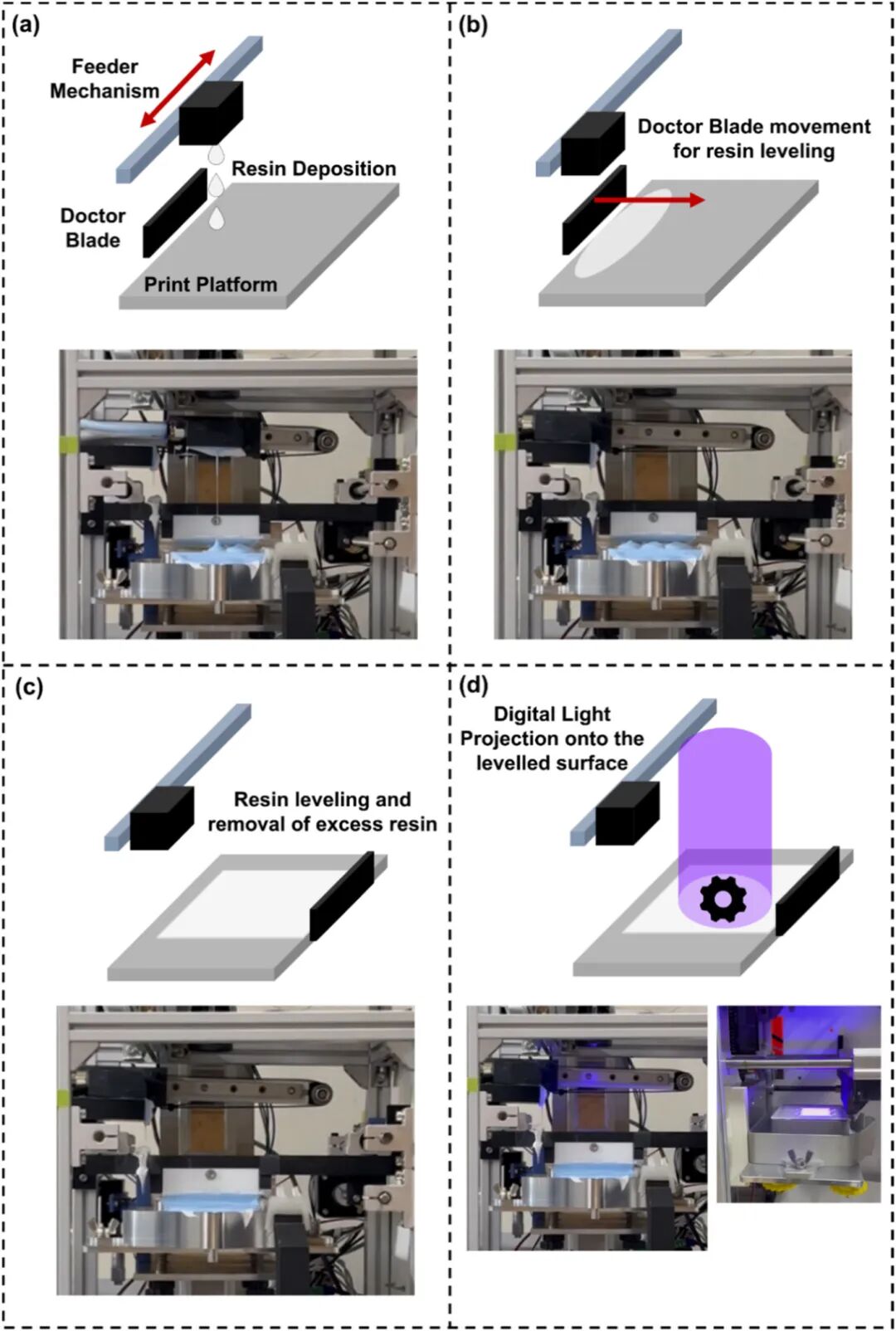
This seemingly simple change actually solves a fundamental physical problem: It reduces the maximum flow distance of the slurry from the “full print bed width” to the “neighbor nozzles space” and avoids its roll-over and bubbles from the source. This makes it possible to stabilize printing even with a very high mass score of 80 wt, without relying on complex viscosic adjustments such as heating, and adjusting formulations. Another design that cannot be overlooked is water-washing resin: the replacement of traditional isopropanol or acetone with deional water ultrasound cleaning avoids the environmental and safety risks of volatile organic solvents, as well as the risk of microcleavage caused by solvent influencing.
Particle-size effects on sintering kinetics and microstructure
The printed green body needs to undergo a two-step heat treatment of degreasing and sintering. TGA analysis shows that organic components undergo concentrated thermal decomposition in the range of 300–550°C, with maximum weight loss at 370°C, and DSC shows a strong exothermic peak at 468.7°C. This temperature range is the "danger zone". If the temperature rises too fast, gas will escape sharply, stress concentration will occur, and cracking or delamination will occur. Therefore, in the degreasing stage, the temperature is slowly raised at 1 °C/min, and the temperature is maintained at 300, 400, 500, and 600 °C for 30 min each to ensure the smooth escape of organic components.
The sintering stage was investigated at three temperature points: 1320, 1350, and 1400 °C. The density measurement results are the first key evidence in the particle size-structure-performance chain: the average volume density of BTO-0.2 is 5.8 g/cm³, corresponding to a relative density of 96.34%; BTO-0.5 is only 5.513 g/cm³, with a relative density of 91.58%. The root cause of this gap lies in the influence of particle size on sintering kinetics: fine particle size has a larger specific surface area, which provides a stronger thermodynamic driving force to promote atomic diffusion, while the tight packing makes the initial green density higher.
XRD refinement (Rietveld refinement) confirmed that both sets of sintered bodies are tetragonal barium titanate phase without impurity phases. The key finding is: the finer the particle size, the higher the tetragonality (c/a): BTO-0.2 has a c/a of 1.0106, and BTO-0.5 is only 1.0075. This means that the Ti⁴⁺ ions after fine particle size sintering have a greater displacement along the c-axis and produce stronger spontaneous polarization, which is crucial for the electromechanical coupling performance of piezoelectric devices. SEM observation revealed the pattern of grain coarsening with increasing sintering temperature: the average grain size of BTO-0.2 was 42.99 μm at 1350°C, and coarsened to 54.61 μm at 1400°C. Obvious traces of layered arrangement can also be seen in the microstructure after sintering, indicating that the layered structure deposited layer by layer by DLP is still partially retained after high-temperature sintering.
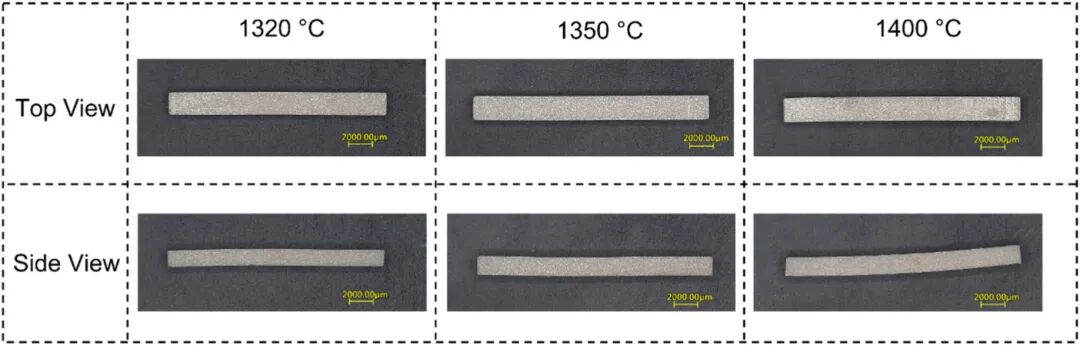
Flexural strength and hardness
The results of mechanical properties show a classic strength-hardness entangled phenomenon. For the three-point bending strength, both sets of formulas reached the peak value at 1350 ℃: 38.24 MPa for BTO-0.2 and 36.64 MPa for BTO-0.5. However, after the temperature rises to 1400°C, the flexural strength drops sharply: BTO-0.2 drops to 16.26 MPa, and BTO-0.5 drops to 23.56 MPa. The reason is that excessive grain growth reduces the area of grain boundaries, which are key microstructures that hinder dislocations.
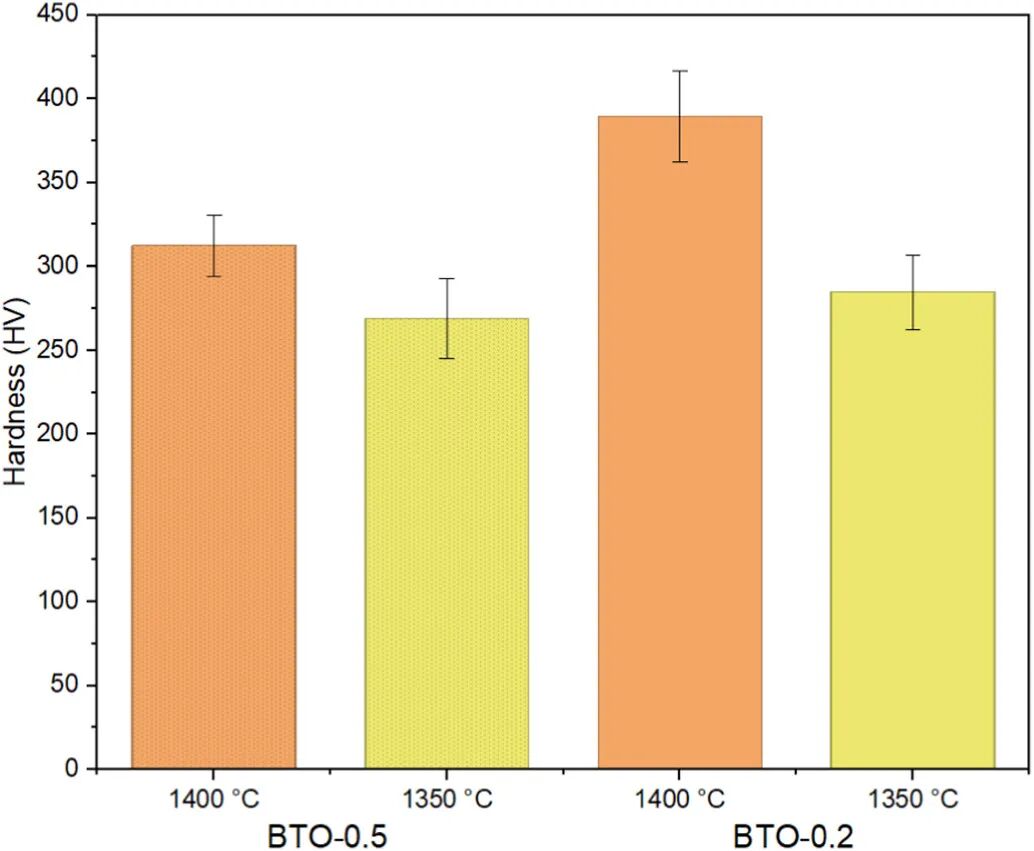
The trend of Vickers hardness is exactly the opposite: the hardness of both sets of formulas increases with the increase of sintering temperature. BTO-0.2 reaches the highest hardness of 389.3 HV at 1400 ℃ and 284.8 HV at 1350 ℃. This is because large grains have stronger resistance to local indentation, but too thick grains also lead to a decrease in grain boundary bonding force, which is manifested in a reduction in bending strength macroscopically. The optimal sintering temperatures for flexural strength and hardness do not coincide: the former looks at the density of grain boundaries, and the latter looks at the resistance to indentation of individual grains. In actual projects, the sintering parameters need to be selected according to the stress mode of the parts: 1350 ℃ for components dominated by bending stress, and 1400 ℃ for occasions where surface wear resistance is the main concern.
| Property | BTO-0.2 (0.2 μm) | BTO-0.5 (0.5 μm) |
|---|---|---|
| Yield stress (Pa) | 26.10 | 16.74 |
| Shear-thinning index n | 0.80 | 0.92 |
| Relative density (%) | 96.34 | 91.58 |
| Tetragonality c/a | 1.0106 | 1.0075 |
| Flexural strength at 1350 °C (MPa) | 38.24 | 36.64 |
| Vickers hardness at 1400 °C (HV) | 389.3 | 312.5 |
Table 1 · Comprehensive comparison between BTO-0.2 and BTO-0.5 in various dimensions
Conclusion
Looking at this research, its core contribution is to upgrade "particle size" from a simple raw material selection problem to a complete knowledge chain of serial rheology, photocuring, sintering kinetics, phase structure and mechanical properties.
First, particle size is the tug-of-war point between “viscosity and shape retention”. Fine-grained powder provides stronger shear thinning and higher yield stress, so that the printed layer does not deposit or deform when left standing, but at the expense of increased light scattering and reduced curing depth, which requires longer exposure time to compensate. This entanglement lays the foundation for the inherent entanglement between "printability and curability" in high-solid content ceramic slurry systems.
Second, process improvements can bypass the physical limitations of the materials themselves. The multi-point grouting strategy does not change the slurry formula, but changes the delivery path of the slurry, which physically avoids the roll-up and air entrainment of high-viscosity slurry during the scraping process. This shows that in ceramic additive manufacturing, equipment structure optimization and material formula optimization are equally important: when the physical limitations of the material (refractive index, viscosity) cannot be broken through, the process route can provide another way out.
Third, the sintering temperature regulates the bending strength and hardness in opposite directions. 1350°C is the optimal point for bending strength, because the grain boundaries are fully developed but not excessively coarsened at this time; the hardness is the highest at 1400°C, but the coarsening of the grains leads to a decrease in the grain boundary bonding force, and the bending strength is reduced instead. This means that the strategy of simply pursuing high sintering temperature to obtain high density and high hardness is not foolproof and needs to be weighed according to the actual stress situation.
Reference papers
Prajapati M.J., Lei P.K., Liao X., Liu Y., Jeng J.Y., Macek W., Jiang C.P. Process-structure-property driven additive manufacturing of BaTiO₃ ceramics via water-washable resin development and multi-point injection DLP process. Ceram. Int. 52 (2026) 30714–30726. DOI: 10.1016/j.ceramint.2026.05.109