Ceramic processing
Bio-based binders for alumina VPP: balancing carbon content and printability
A 52 vol% alumina study compares 72.8% and 55.0% calculated bio-based carbon binders, reaching about 97% relative density while exposing the viscosity trade-off.
Localized technical adaptation of the supplied article. BCC values are formulation estimates, not final-product radiocarbon measurements; research results do not specify KUNWU equipment performance.
Ceramic vat photopolymerization (VPP) commonly uses petroleum-derived acrylate binders. Replacing them with bio-based components is not a simple substitution: a highly filled slurry must still spread, cure despite particle scattering, form a strong green body and survive debinding. Ozkan and colleagues treated bio-based carbon content (BCC) as a formulation variable. With 52 vol% alumina, two binder routes at calculated BCC of 72.8% and 55.0% produced approximately 97% relative density, 313–320 MPa flexural strength and about 18 GPa hardness after sintering. These are results for the reported alumina specimens, not general specifications for ceramic printers.
1. Why binder replacement is difficult
VPP offers fine features, internal channels and geometries difficult to form conventionally. Yet high-temperature sintering still dominates energy demand, so a bio-based binder does not make the entire route carbon-neutral. In the slurry, viscous bio-based ingredients can narrow the workable solids-loading window. The uncured or partly cured object must tolerate handling and debinding; pores or cracks formed there can remain after sintering. The study therefore optimized printability, curing and green strength together, rather than maximizing renewable content alone.
BCC is the share of carbon derived from biological rather than fossil sources, as defined in ASTM D6866. Here the reported binder BCC values are calculated from supplier/formulation information. The paper did not report radiocarbon measurement of the final material, nor a cradle-to-gate life-cycle assessment. The distinction matters when comparing formulations or making environmental claims.
2. The low-viscosity monomer and its green-strength penalty
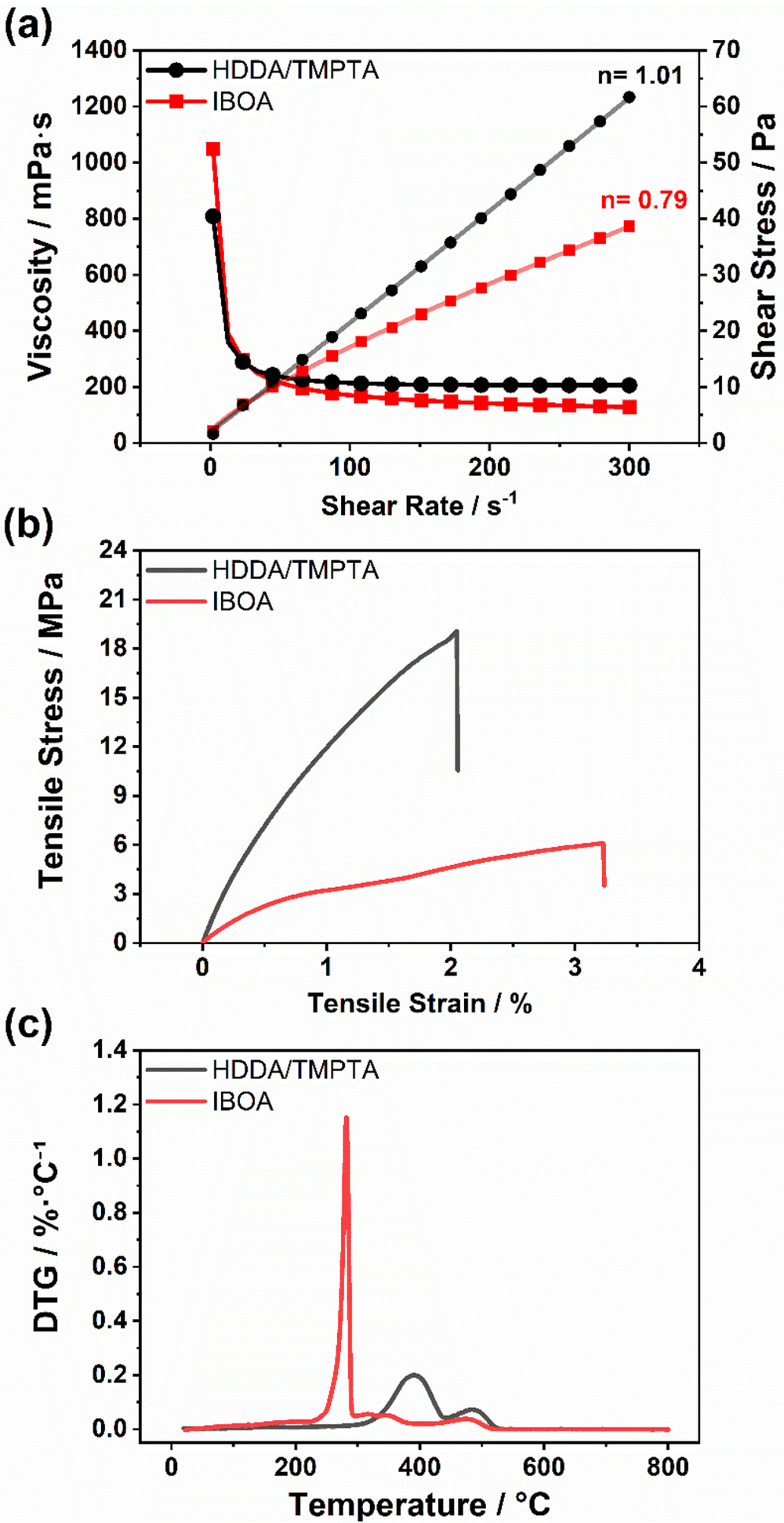
The reference petroleum binder combined difunctional HDDA and trifunctional TMPTA at 50:50. The alternative monomer IBOA (isobornyl acrylate) had supplier-reported BCC of 77% and offered low viscosity and reduced shrinkage stress, but its monofunctionality limits network connectivity. In a 45 vol% alumina slurry, IBOA showed shear-thinning behaviour (flow index n = 0.79), while HDDA/TMPTA was close to Newtonian (n = 1.01). The IBOA green tensile specimen failed around 6 MPa versus roughly 19 MPa for the reference. Its main decomposition peak lay near 280 °C, rather than the broader multistep 400–500 °C response of the reference. This established the need for a network-forming co-component.
3. Stage one: oligomers and the BCC design window
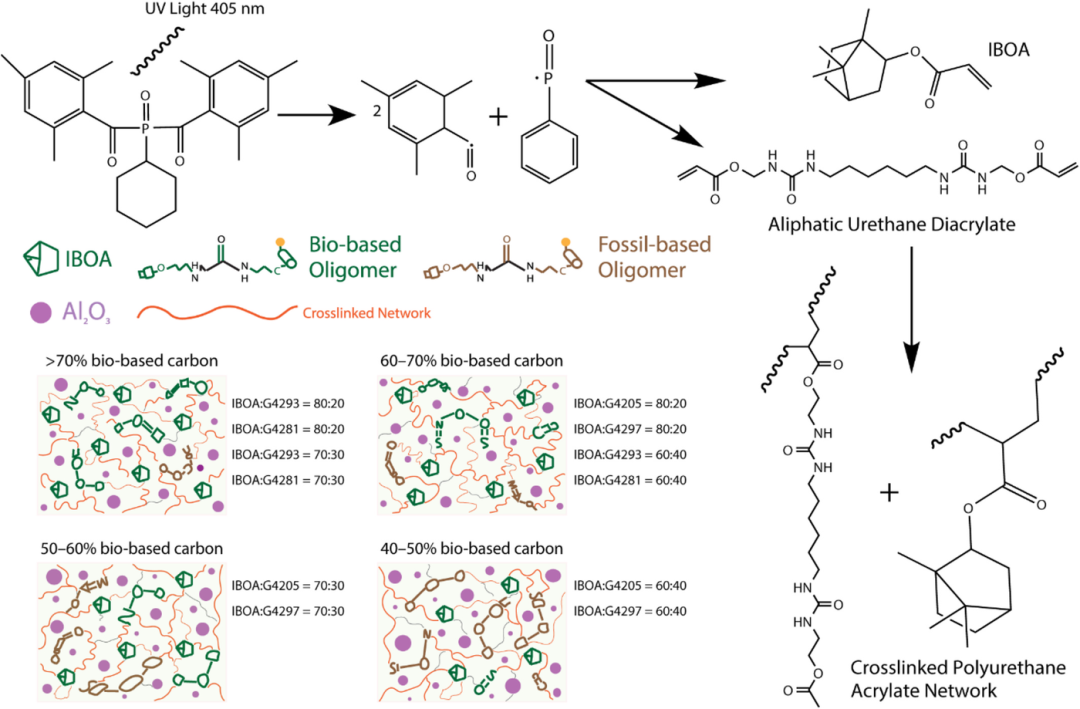
At fixed 45 vol% alumina, the team varied IBOA/oligomer ratio from 80:20 to 60:40. Four polyurethane (meth)acrylate oligomers were screened: bio-based G4293 (56% BCC) and G4281 (55% BCC), with petroleum-based G4205 and G4297 as controls. Under 405 nm exposure, the monomer and difunctional oligomer copolymerize into a crosslinked network. The formulation map groups their combinations into BCC bands of more than 70%, 60–70%, 50–60% and 40–50%.
At 30 s⁻¹, increasing the IBOA share from 60 to 80 wt% reduced apparent viscosity respectively from 2155 to 375 mPa·s for G4293, 1123 to 905 for G4281, 765 to 236 for G4205, and 662 to 219 for G4297. Curing depth followed the logarithmic exposure-energy relationship of the Jacobs working curve. Penetration depth stayed around 60–75 μm; critical exposure energy varied more by oligomer, about 2.2–3.8 mJ·cm⁻², with the methacrylate-terminated controls generally higher.
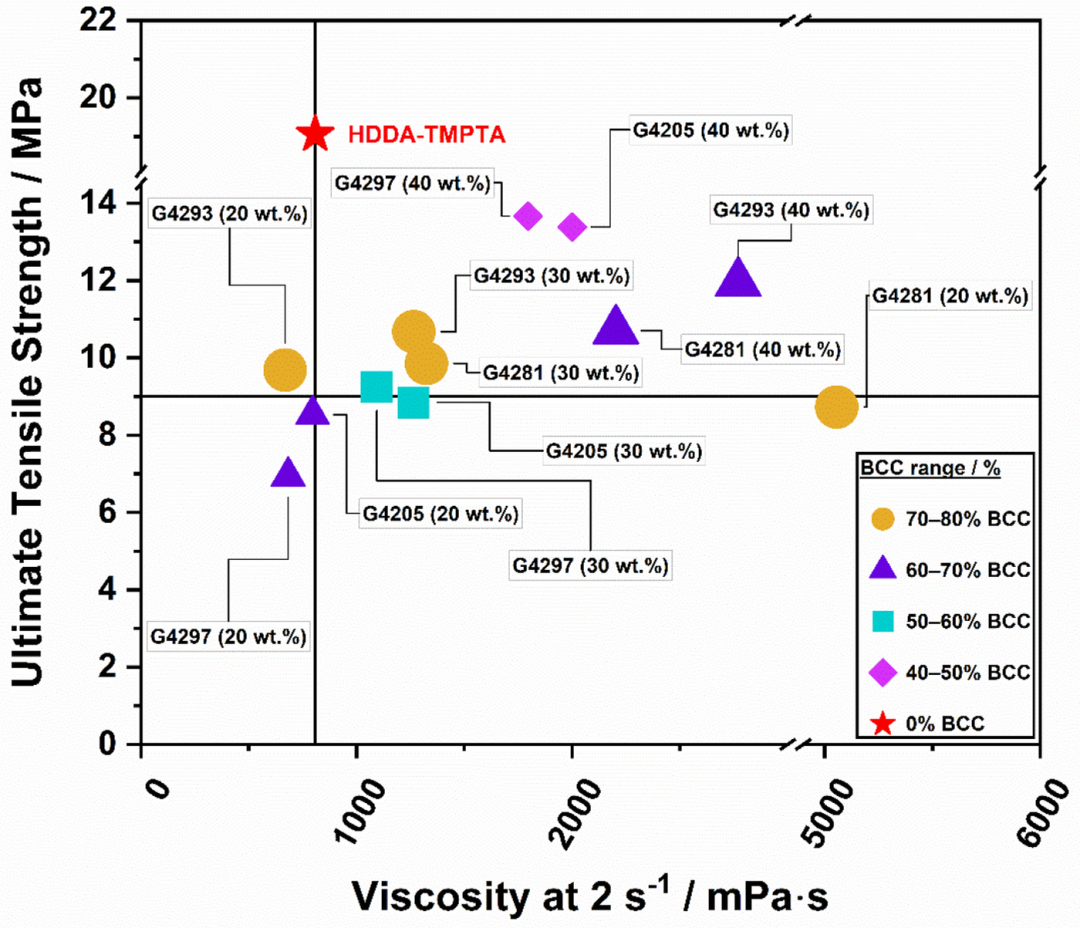
More IBOA lowered green ultimate tensile strength: roughly 10–14 MPa at 60 wt% IBOA versus 7–10 MPa at 80 wt%; elastic modulus fell from about 0.9 to 0.6 GPa. A three-objective plot—BCC, low-shear viscosity and green strength—identified G4293 at 20 wt% and G4281 at 30 wt% oligomer as useful starting points in the ≥70% BCC band. G4293 at 30 wt% could strengthen the green part further, but reduced viscosity headroom for later modifications.
4. Stage two: changing monomer functionality at 55% BCC
Five replacement monomers, from one to six reactive functions, were compared while binder-phase BCC was held at 55%: monofunctional ACMO; difunctional HDDA and MPDDA; trifunctional TMPTA; and hexafunctional DPHA. Higher functionality tended to increase viscosity and crosslink density. ACMO offered deeper light penetration but the highest critical exposure energy and weakest green tensile response. DPHA lowered the energy threshold and strengthened the green network, yet raised viscosity and limited penetration. The bifunctional options offered a more useful compromise: MPDDA was selected with G4293 and HDDA with G4281.
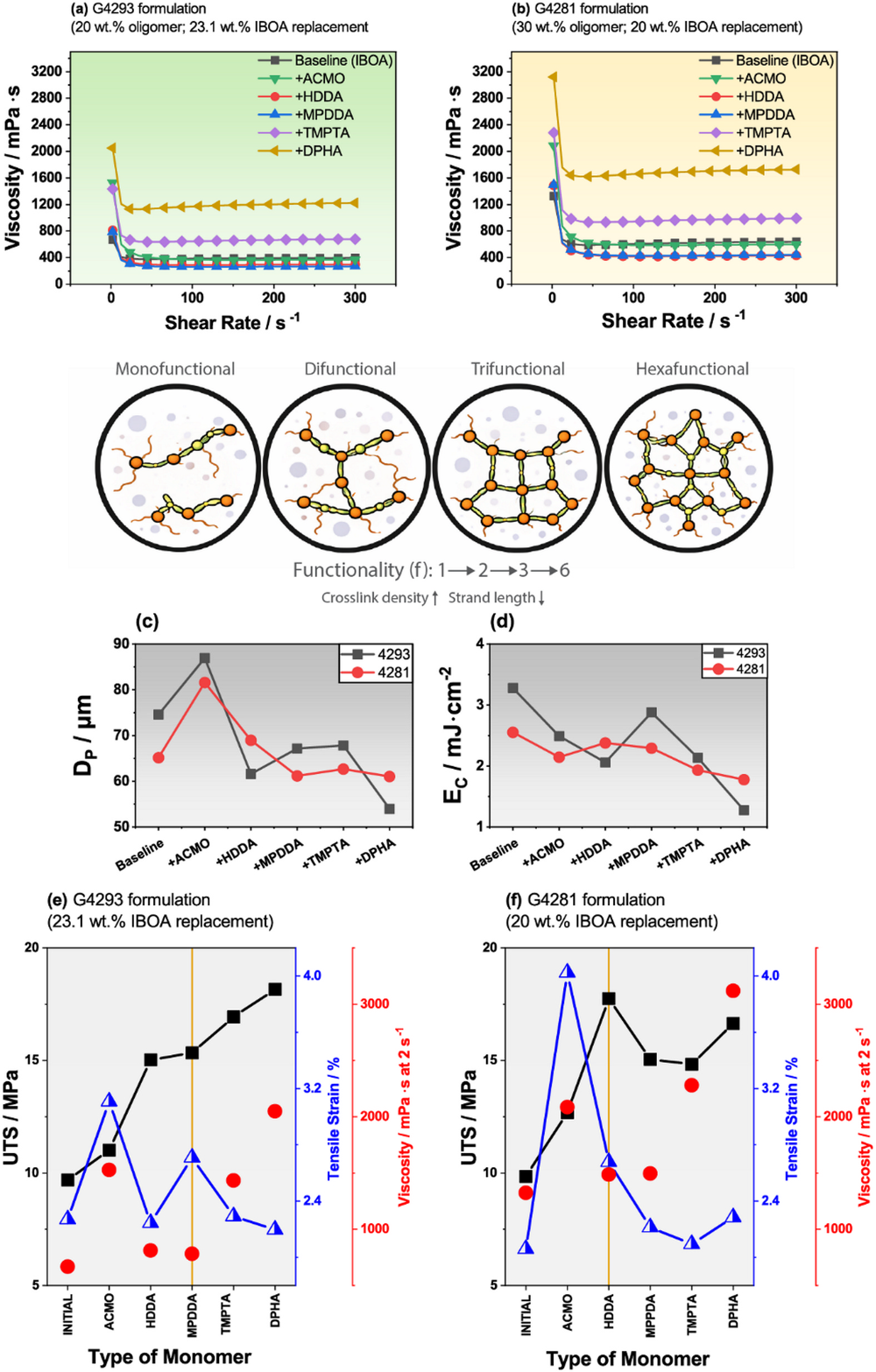
Thermogravimetric results located the main decomposition region of these formulations around 280–320 °C. The higher-functionality binders generally spread the mass-loss peak over a broader interval. This may reduce peak gas-release intensity during debinding, but it does not remove the need to validate heating schedules and crack formation for each part geometry.
5. Validation at 52 vol% alumina
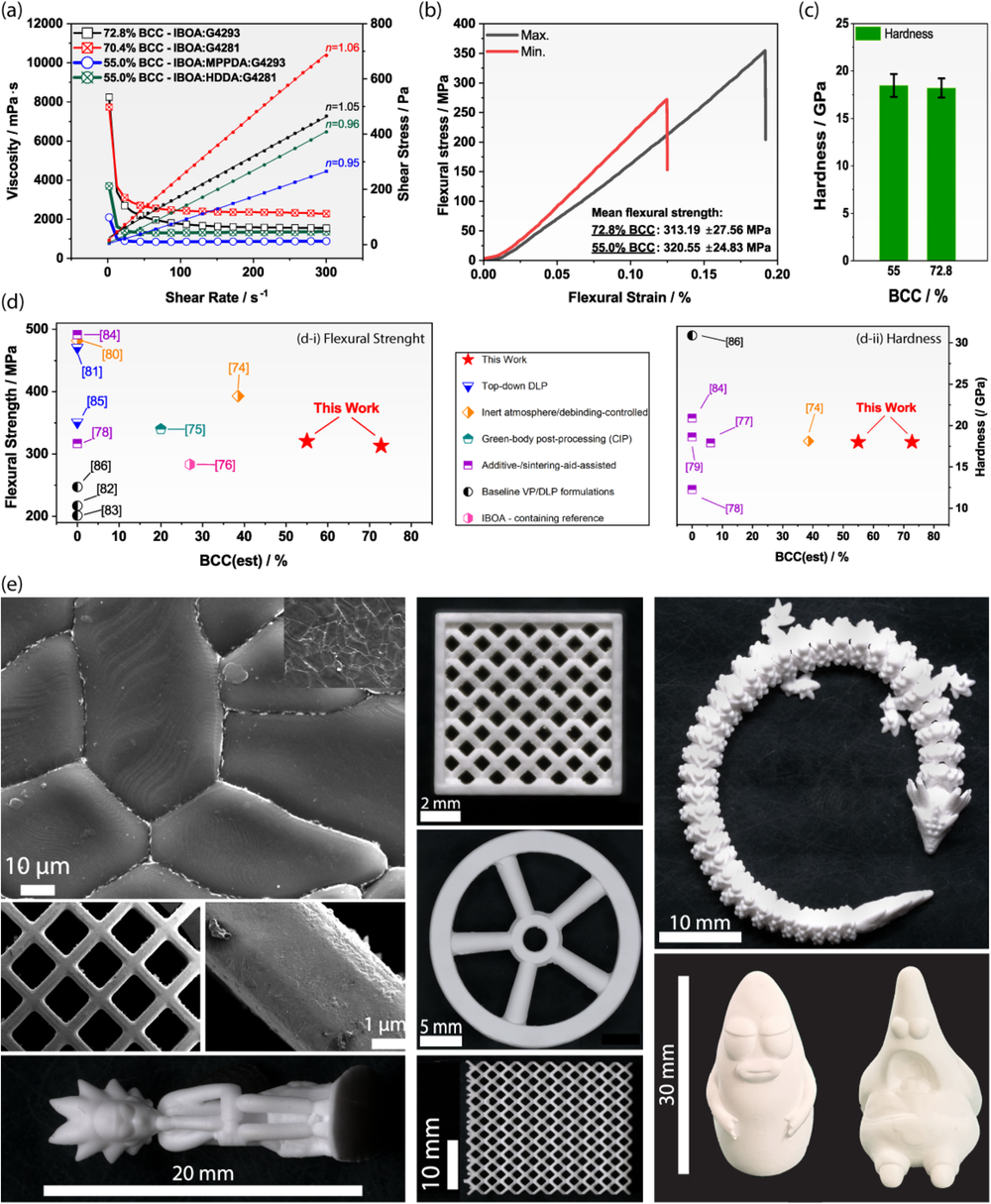
The final comparison used the G4293 family at 52 vol% ceramic solids: binary IBOA:G4293 at 72.8% calculated BCC, and monomer-optimized IBOA:MPDDA:G4293 at 55.0%. At 30 s⁻¹, viscosity fell from approximately 2600 to 890 mPa·s with MPDDA. After the same 1650 °C, 4 h sintering schedule, the two routes reached 3.86 ± 0.03 and 3.87 ± 0.02 g·cm⁻³, corresponding to 96.98 ± 0.75% and 97.07 ± 0.50% relative density. The measured flexural strengths were 313.19 ± 27.56 and 320.55 ± 24.83 MPa; both had Vickers hardness near 18 GPa.
SEM images showed comparatively dense and uniform grains without conspicuous microcracks in the reported fields. The authors printed and sintered small lattices, rods, wheel-like and freeform parts, with no visible macroscopic collapse in the examples shown. The two routes therefore trade renewable-content share against a wider spreading and handling window; success on small specimens does not by itself establish yield or tolerance for larger, thicker production parts.
6. What the comparison does—and does not—show
Many published alumina VPP recipes above 300 MPa use conventional resins or additional measures such as inert-atmosphere debinding, cold isostatic pressing, sintering aids or powder engineering. This study reached its stated strength and hardness without inert debinding, cold isostatic pressing or sintering aids. Comparisons across papers are not matched trials: powders, specimen geometry and testing differ. The BCC values inferred for literature formulations are estimates, not independently radiocarbon-verified values.
The demonstrated material was alumina only. The design logic may be explored for 3YSZ, SiO₂, AlN or SiC, but each powder, optical response, debinding route and sintering cycle needs new validation. The higher-BCC recipe also had a narrower rheological margin. This research is useful as a way to rank BCC alongside viscosity, cure energy and green strength—not as certification that every bio-based formulation is lower-impact or suitable for industrial-scale parts.
Sources
Original paper · DOI
Ozkan B, Goulas A, Saremi-Yarahmadi S, Vaidhyanathan B. Bio-based photocurable binder design for vat photopolymerisation 3D printing of advanced ceramics. Materials & Design. 2026;270:117043.