Applications
Black zirconia TPMS for solar-thermal systems
This FFF—not DLP—study combines optical absorption, permeable architecture and mechanical stability for heat exchange.
This KUNWU editorial note is based on the supplied technical source. Reported results belong to the described study or sample and are not KUNWU equipment specifications.
When ceramics learn to "photosynthesize": How can a 3D printing black technology triple solar energy efficiency?
Research background
In the world of engineering materials, ceramics are high-temperature resistant, corrosion-resistant, and have high hardness. They are ideal materials for aerospace engine blades, artificial joints, and electronic substrates. However, ceramics also have a fatal weakness: brittleness. When manufacturing complex-shaped ceramic components, traditional machining methods are not only inefficient and costly, but can also easily cause micro-cracks, resulting in extremely low yields.
Summary legend
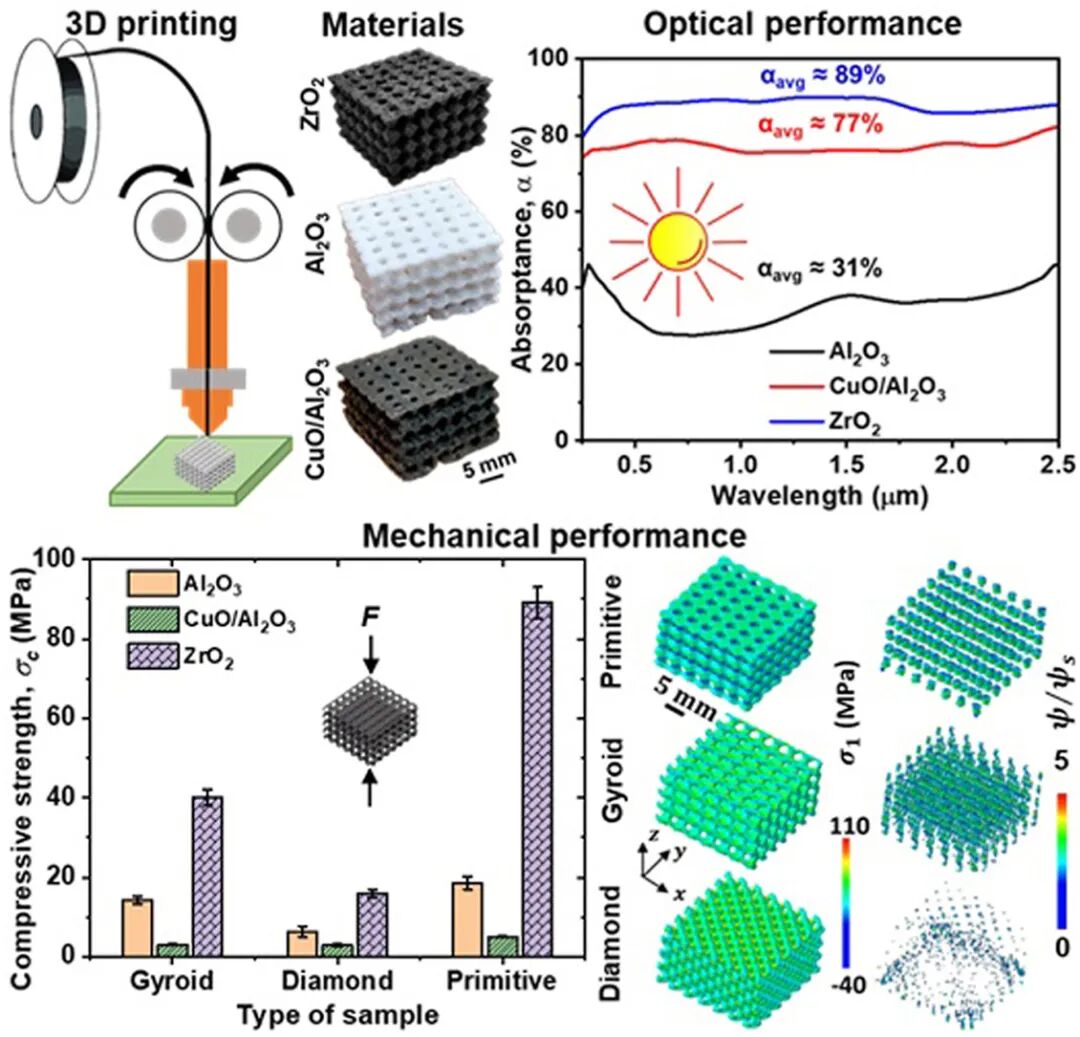
This leads to the “unpossible triangle” of ceramics: complex shapes, low cost, high performance, which are often not available in combination. The emergence of enrichment (3D printing) technologies, particularly the melting wire (FFF) technology, has made it possible to break this impasse. The FFF technology is like stacking a stereo structure with a layer of ceramic glue, which is low-cost, fast and can theoretically make any shape.
But problems ensued: Although ordinary white aluminum oxide (Al₂O₃) or zirconium oxide (ZrO₂) ceramics are low-cost, their color is white, which means they will reflect away most of the sunlight. In concentrated solar power (CSP) systems, what we need are "black" materials that can efficiently absorb light energy and convert it into heat energy. The traditional approach is to add black fillers such as silicon carbide (SiC), but this will significantly increase the cost.
So, can we make ceramics both "black" and "strong" while maintaining low costs? This is the core motivation of this study.
Methods
The solution given by the research team is very clever and can be summarized in two keywords: material blackening and structural topology optimization.
- The study used commercial black ZrO₂ filament. A secondary phase, commonly transition-metal oxides, increases visible-to-near-infrared absorption in the main solar-energy band.
- Three porous TPMS architectures—Gyroid, Diamond and Primitive—were printed instead of solid blocks. Their surface area, mechanics and lightweight potential make them candidates for solar absorbers, heat exchangers and bone-scaffold research.
To verify the effectiveness of this strategy, they not only fabricated three TPMS structures of black ZrO₂, but also fabricated solid black ZrO₂ blocks, as well as white Al₂O₃ samples as controls. In addition, the results were compared with previously reported CuO/Al₂O₃ composites. This is a comprehensive performance "parade" with multiple materials and multiple structures.
The experimental results are exciting. Black zirconia has completely surpassed traditional materials in key properties.
- Optical performance
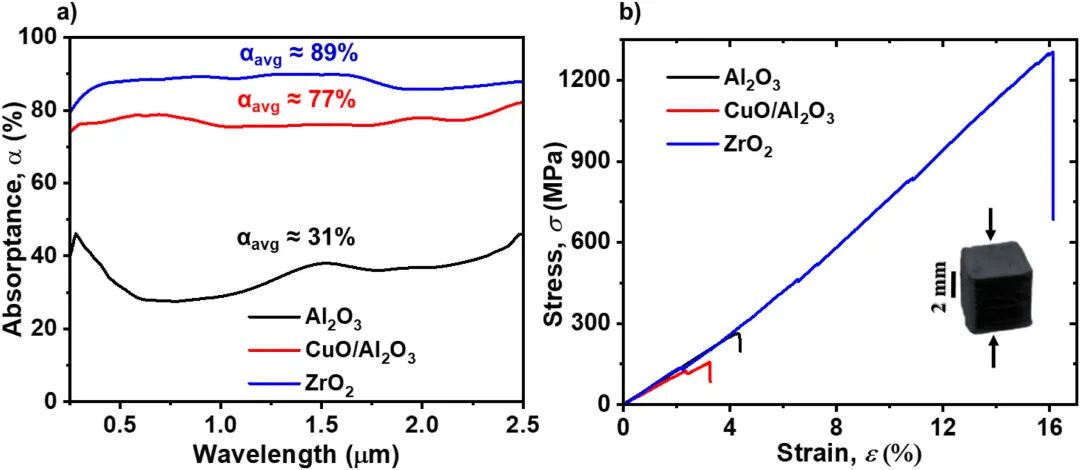
- Reported optical absorption: approximately 89% for black ZrO₂ versus approximately 31% for white Al₂O₃.
- The comparison gives nearly three times the absorption, indicating greater solar-energy capture under the tested illumination conditions.
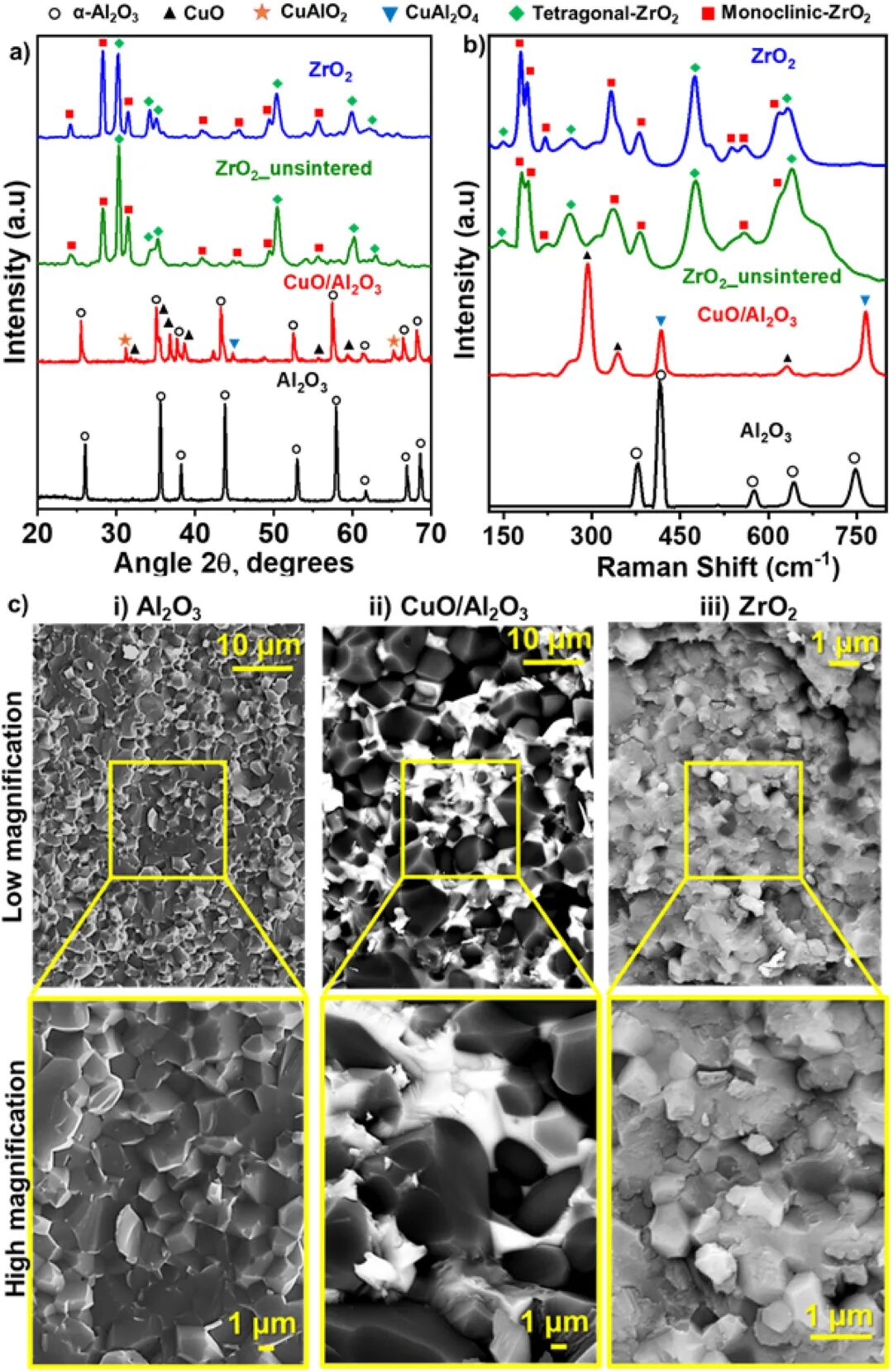
Figure 2: (a) XRD pattern of 3D printed ceramics, (b) Raman spectrum, and (c) SEM image of 3D printed ceramics (fracture surface). Note: The dark particles in (c-ii) represent the alumina matrix, while the white particles are diffused copper oxide
Light absorption and mechanical properties of 3D printed ceramics. (a) Absorption spectra in the UV-Vis-NIR wavelength range and (b) stress-strain curves of bulk ceramics tested under compressive loading.
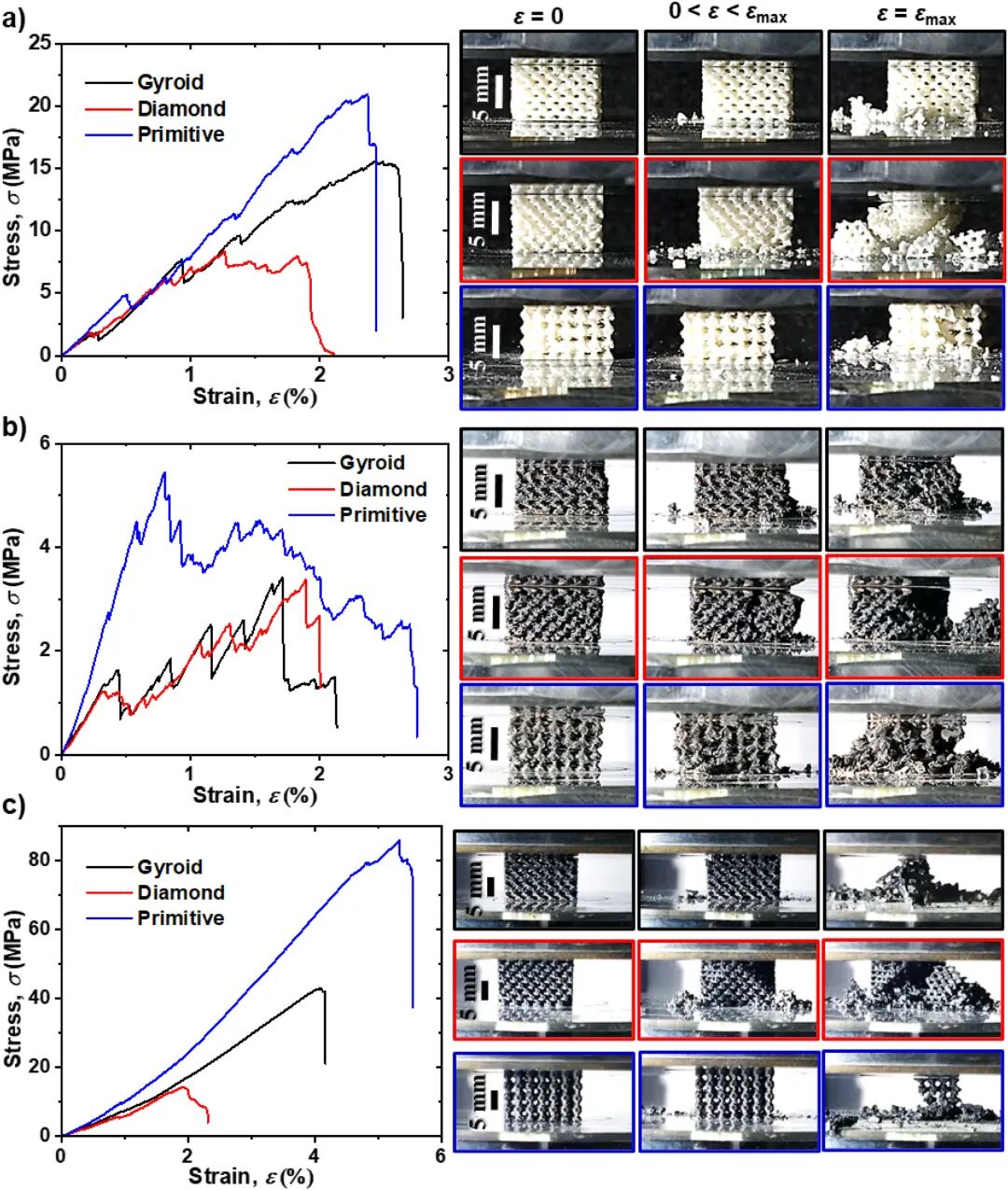
Microstructure: SEM and XRD analysis show that the microstructure of black ZrO₂ has finer grains and higher density. This is the fundamental reason why its mechanical properties are much better than white Al₂O₃. Fine-grain strengthening is a classic law of materials science.
Thermal Cycling Stability: Although the paper abstract does not give specific values, the study clearly evaluates thermal cycling stability. It can be inferred that ZrO₂, due to its higher thermal shock resistance, can maintain stable performance during repeated hot and cold alternations, which is crucial for long-term service in CSP systems.
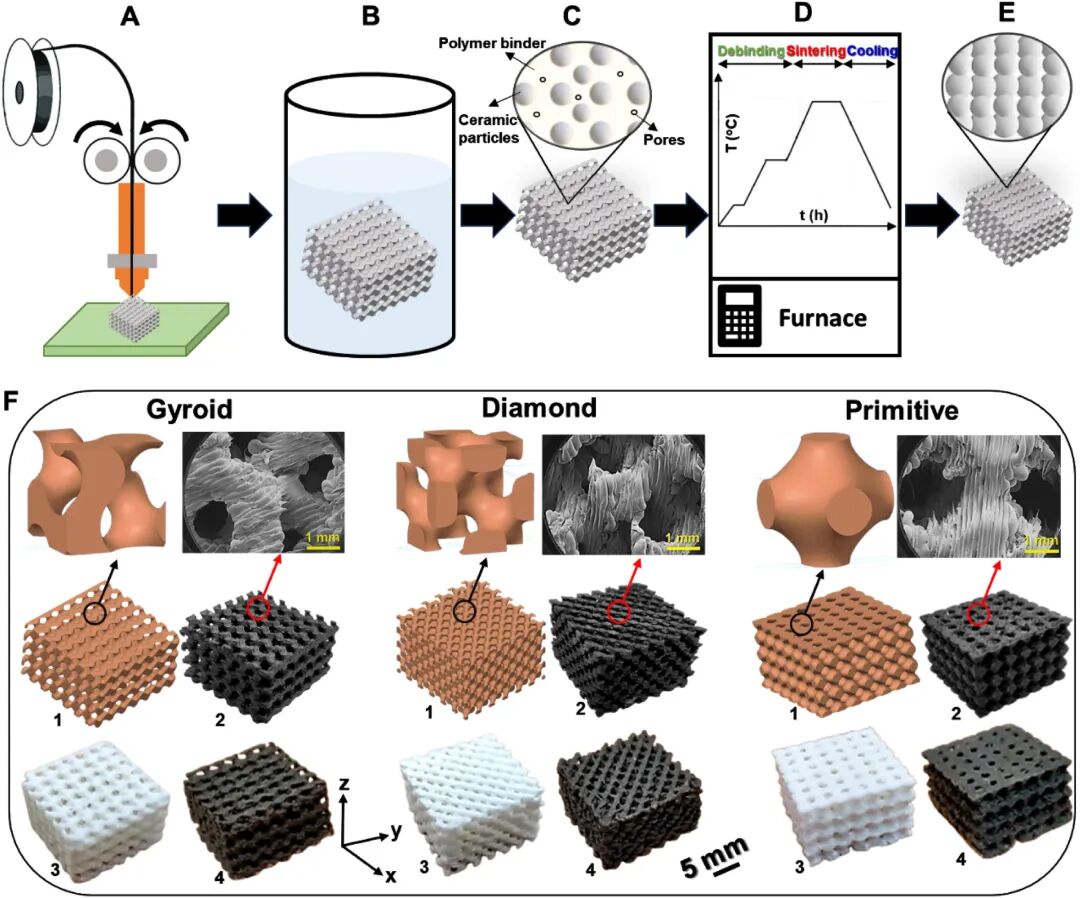
Schematic diagram of ceramic parts prepared using FFF technology. (A) 3D printing, (B) solvent debinding, (C) air drying, (D) thermal debinding and sintering, (E) final sintered part, (F) CAD model and photo of the corresponding 3D printed TPMS ceramic structure after sintering. Numbers in (F) represent the following samples: 1) CAD model, 2) ZrO₂, 3) Al₂O₃, 4) CuO/Al₂O₃. The black circle marked in (F) represents the unit cell, and the red circle highlights the SEM image demonstrating the print quality. It should be noted that CuO/Al₂O₃ was prepared in our previous study with additional post-printing heat treatment
Conclusion
This study is much more than a paper. It clearly demonstrates the enormous potential of combining FFF 3D printing technology with advanced material design.
- FFF offers a potentially lower-cost equipment route than some ceramic photopolymerization or laser-sintering systems. Large-scale, low-cost production remains a development objective, not a demonstrated cost guarantee.
- Black ZrO₂ TPMS combines optical absorption with structural strength, making it a candidate for concentrated-solar receivers, solar thermochemical reactors and high-temperature heat exchangers.
- Wall thickness, porosity and topology can be adjusted for the intended response: thinner walls in absorption-focused regions, or Primitive architecture where strength is prioritized, subject to validation.
Of course, there are still challenges to overcome in moving from the laboratory to large-scale applications. For example, how to ensure printing accuracy and uniformity on larger-sized parts? What is the long-term durability of the material in actual high-temperature, high-radiation environments? These require further in-depth research.
Paper citation information: Costa Oliveira F A, Sardinha M, Galindo J, et al. Additive manufacturing of black zirconia ceramic TPMS structures with superior physico-mechanical and optical properties[J]. Journal of Materials Research and Technology, 2026, 42: 11477-11488. DOI: 10.1016/j.jmrt.2026.05.226.