Materials research
C/ZnO-assisted lithium-disilicate photopolymerization
The additives are investigated as tools for controlling light absorption and scattering in a particle-loaded glass-ceramic system.
This KUNWU editorial note is based on the supplied technical source. Reported results belong to the described study or sample and are not KUNWU equipment specifications.
Why high transparency complicates DLP printing
The industrial structure of dental ceramic 3D printing has been divided into two parts. One side is a zirconia crown, and the other side is a lithium disilicate glass-ceramic (LD) that has been stuck for a long time. The industrial allure of this material is obvious: it combines 200-300 MPa flexural strength, beautiful translucency, and good biocompatibility. It is the mainstream choice for full crowns, veneers, and inlays for posterior teeth. However, for a long time, the accuracy of moving LD onto the DLP ceramic 3D printing platform has never improved - it can print a general shape, but it cannot meet the requirements of dental restoration for edge closeness and morphological details.
The essence of DLP (Digital Light Processing) is to irradiate the ceramic slurry layer by layer with 405 nm ultraviolet light to trigger cross-linking and solidification of the resin. For light-colored opaque ceramics such as alumina and zirconia, light is scattered on the particle surface and the desired solidified layer is controllably formed - this is the physical prerequisite for the stable operation of DLP ceramic 3D printers. But lithium disilicate glass ceramics is different: its extinction coefficient (k) is almost 0, its refractive index (n) is about 1.6, and it "almost does not absorb and almost completely transmits" ultraviolet light. The result is: UV light penetrates the designed curing area with almost no attenuation, the cured layer far exceeds the designed thickness, and there is severe over-polymerization between adjacent pixels - if you want to punch a 0.4 mm hole, you may actually get a hole that is not even 1.6 mm deep.
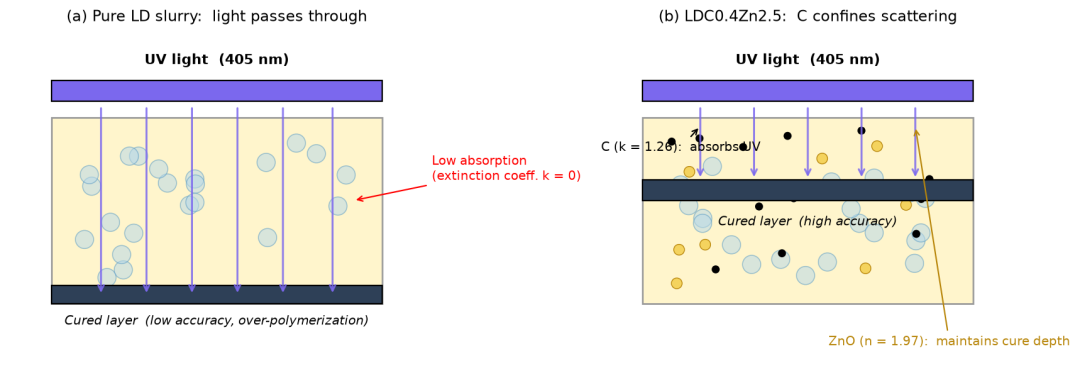
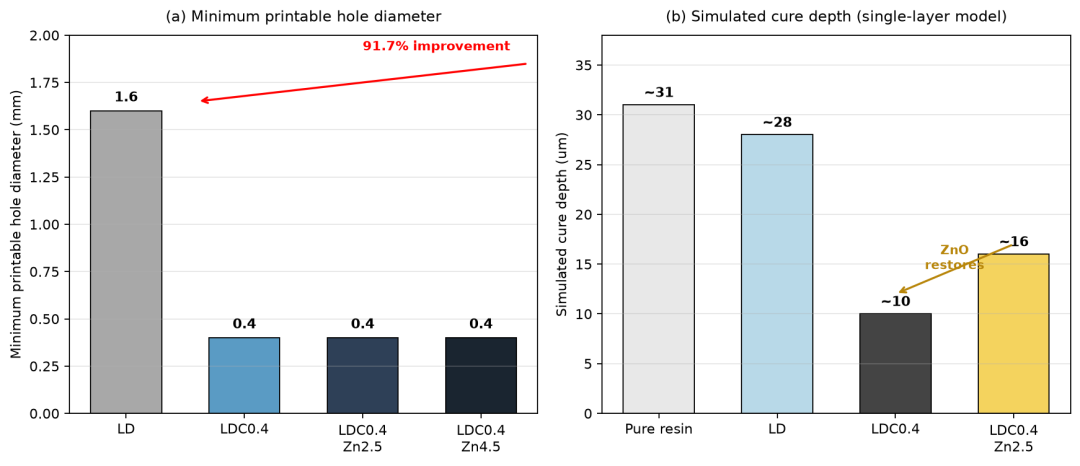
The team's optical simulation shows that under the single-layer 40 μm model: the curing depth of pure resin is about 31 μm, and the pure LD slurry is about 28 μm. After adding 0.4 wt% carbon powder (LDC0.4) alone, the curing depth plummets to 10 μm - the accuracy is there, but it is not thick at all. This is the core contradiction: if you want precision, you have to add C, and adding C sacrifices the solidification depth.
C + ZnO: complementary optical effects
The researchers' idea to solve the problem is to no longer pursue a single component to solve all problems, but to use two groups of optically "opposing" powders to complement each other:
Carbon (C, 0.4 wt%, particle size 45 nm): extinction coefficient k = 1.26, is a strong absorber of UV light and is responsible for "limiting scattering and improving accuracy" - but adding it alone will cause excessive absorption and insufficient curing depth. Zinc oxide (ZnO, 2.5 wt%, particle size 5.6 μm): refractive index n = 1.97, higher than resin (n = 1.456). It forms a strong scattering center in the slurry, extending the optical path of light on the surface layer, allowing the photoinitiator to be effectively utilized. At the same time, it hardly absorbs UV (k = 0.01), and is responsible for "guaranteing the curing depth" - and incidentally brings antibacterial function.
It's a typical "relative properties synergetic" design: C, like the "brakes" crushing light, Zno, like the "oil doors" maintain the necessary solidity depth. They complement each other in terms of physical mechanisms.
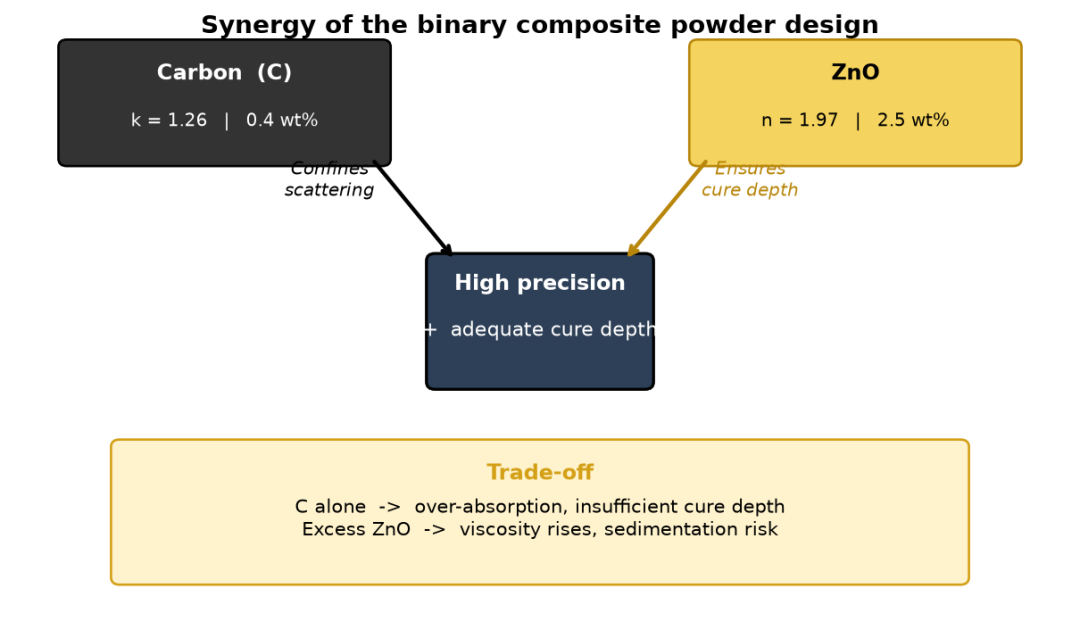
It is worth noting that this synergy is based on strict proportions: when C is added to 0.6 wt%, the curing depth is no longer enough; when ZnO is added to 4.5 wt%, the viscosity of the slurry increases and there is a risk of settling. The final optimal formula was locked at LDC0.4Zn2.5 - 0.4 wt% C + 2.5 wt% ZnO, with a solid loading of 45 vol%.
Accuracy, mechanics and antibacterial performance
The effect of the composite powder strategy is reflected in three sets of key data.
① Printing accuracy increased by 91.7%. The minimum printable pore diameter of the pure LD group is only 1.6 mm; after adding C + ZnO, the minimum printable pore diameter is reduced to 0.4 mm, and the hole radius error is as low as 13 μm (2 mm hole). This means that fine dental forms that were previously impossible to achieve - crown edges, veneer textures, inlay undercuts - begin to enter the printable range.
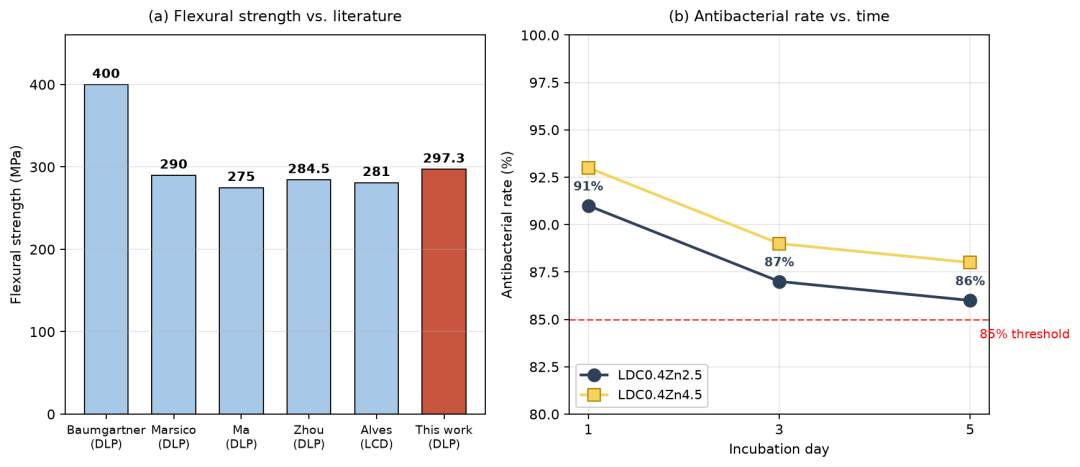
② Bending strength 297.28 MPa, surpassing most similar DLP products. After sintering at 920°C, the LDC0.4Zn2.5 group has a flexural strength of 297.28 ± 10 MPa, which is 43.1% higher than the pure LD group (207.6 MPa); the fracture toughness is 3.74 ± 0.05 MPa·m1/2. It is comparable to or even better than DLP works such as Marsico (290±60), Ma (275±40), and Zhou (284.5±37) in the literature, and second only to Baumgartner’s 400 MPa (but the latter does not involve accuracy optimization).
| Study | Process | Flexural strength (MPa) | Hardness (GPa) | Fracture toughness (MPa·m½) |
|---|---|---|---|---|
| Baumgartner | DLP | 400 | 6.75 | 2.96 |
| Marsico | DLP | 290 ± 60 | 5.5 ± 0.3 | 2.07 ± 0.22 |
| Ma | DLP | 275 ± 40 | 5.2 ± 0.1 | 3.4 ± 0.2 |
| Zhou | DLP | 284.5 ± 37 | 5.2 ± 0.3 | 2.3 ± 0.1 |
| Alves | LCD | 281 ± 37 | 5.3 ± 0.2 | — |
| Zhang et al. (2026) | DLP | 297.28 ± 10 | 6.12 ± 0.12 | 3.74 ± 0.05 |
Table 1 Comparison of the mechanical properties of Zhang et al. (2026) and DLP/LCD printed lithium disilicate glass ceramics in the literature
③ The antibacterial rate remains above 85% within 5 days. The addition of ZnO brought unexpected dividends: the inhibition rate against Escherichia coli (E. coli) and Streptococcus mutans (S. mutans, the main pathogenic bacteria of dental caries) exceeded 90% on the first day, and remained about 86% on the fifth day. This is a substantial functional plus for dental restorations – secondary caries is one of the main causes of dental restoration failure.
Accuracy and strength at the expense of translucency
Looking at all the data in this work together, the most noteworthy thing is not a certain "new high", but the way it is chosen. The price of the C + ZnO composite powder is not the mechanical loss - the flexural strength is increased by 43.1% - but the compromise of aesthetic performance: the pure LD group has the highest visible light transmittance. After adding toner, the transmittance of each group decreased, but it still remained above 50%. The color of the product became grayer and the translucency decreased. For a dental ceramic whose core selling point is "aesthetic restoration," this is a concession that cannot be ignored.
In other words, this study provides proof of feasibility of the "function before aesthetics" route: when the requirements for strength, antibacterial, and personalized shape are higher than the need for light transmittance at the restoration site (such as posterior crowns, implant abutments, and children's inlays), this composite powder strategy is sufficient for clinical evaluation; and to conquer scenarios where aesthetics is paramount, such as anterior tooth veneers, the next step is to solve How to achieve equivalent scattering suppression with less (or smaller particle size) carbon powder - this may point to the exploration of nanocarbon coatings, core-shell structures, or other low-absorption high-scattering fillers.
From the perspective of the ceramic 3D printing industry, the message of this work is clear: the DLP printing of cortex ceramics is not a bottleneck in printer hardware, but the triple trade-off of "optic-magnetic-aesthetic" at the level of the plasma formulation. Those who can first identify the three are able to take their positions on this segmented track.
Reference papers
Zhang F, Zhang Y, Kang J, Wang S, Xiao Z, Fu 10.26599/JAC.2026.9221253