Ceramic materials
Can ceramics deform plastically at room temperature? Mechanisms, size and proof
A cautious review of six deformation mechanisms, micro-scale size effects and the evidence needed before applying room-temperature plasticity claims to bulk ceramic parts.
Localized technical adaptation of the supplied review. Micro- and nano-scale deformation results do not establish bulk-part ductility or KUNWU equipment performance.
Ceramics are valued for hardness, heat resistance and chemical stability, yet many fracture at room temperature before measurable plastic deformation. A 2026 review by Xu and colleagues asks when that familiar sequence can be changed. It separates toughness, plasticity and tensile ductility; surveys six deformation mechanisms; and examines size effects, design routes and the evidence required to claim room-temperature plasticity. Its conclusion is conditional: convincing local plasticity exists, but micro-scale or specially structured results cannot simply be carried over to bulk components.
1. Toughness, plasticity and ductility are not interchangeable
Fracture toughness measures resistance to initiation or propagation of an existing crack, usually with fracture-mechanics methods and a defined sharp crack. Plasticity is irreversible deformation before failure. Tensile ductility is the amount a specimen elongates in tension. Crack deflection, bridging or shielding can raise toughness without genuine plastic flow; conversely, plastic strain need not improve fracture toughness. A nonlinear stress–strain curve alone is not proof of plasticity: microcracking, interface debonding, crack closure and damage can produce a similar response.
Intrinsic plasticity arises inside the load-bearing crystal, for example through dislocation motion, twinning or irreversible lattice rearrangement. Extrinsic accommodation happens in the architecture around it—grain boundaries, phase interfaces or particle rearrangement. Strong evidence pairs a detectable yield or residual strain with microstructural observations that distinguish irreversible flow from damage.
2. Why a crack usually wins the race
Directional ionic and covalent bonds make many ceramic lattices stiff and their dislocation cores narrow. Moving a dislocation requires many strong bonds to break and reform in sequence, whereas a crack can separate one fracture plane. At room temperature the stress needed to nucleate and move dislocations can therefore exceed the fracture stress. Many ceramics also have too few independent slip systems for unconstrained polycrystalline plastic deformation. High temperature, pressure, favourable orientation or small test volume can change the balance—but none is a blanket property of all ceramics.
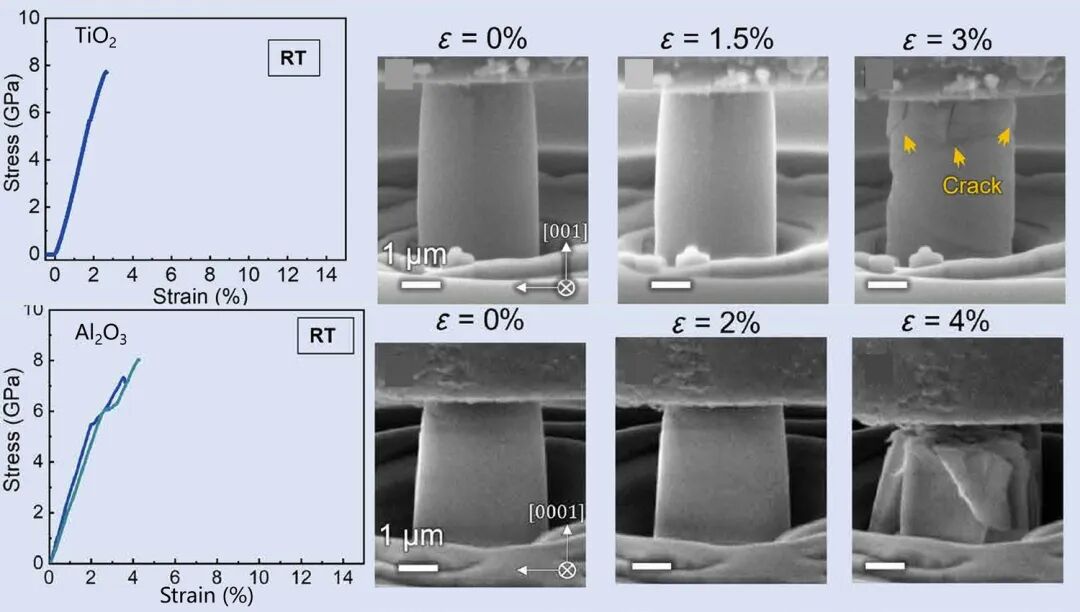
The review illustrates the baseline with room-temperature compression of single-crystal TiO₂ and Al₂O₃ micropillars. Curves and sequential images show fracture or shear failure at only a few percent strain, rather than a broad yield plateau. A pillar test isolates local crystal response, but its stress state and flaw statistics differ from a bulk tensile component.
3. Six pathways for irreversible strain
Dislocation glide moves defects along crystallographic slip planes. It is most accessible when orientation and resolved shear stress are favourable and lattice resistance is low; high-symmetry oxides and some very small nitride specimens can show it at room temperature. Grain-boundary sliding lets fine grains move relative to one another, often coordinated by diffusion or interface reactions. It typically needs grains below about 1 μm, elevated homologous temperature and low strain rate; classic large-elongation superplasticity should not be presented as ordinary room-temperature bulk behaviour.
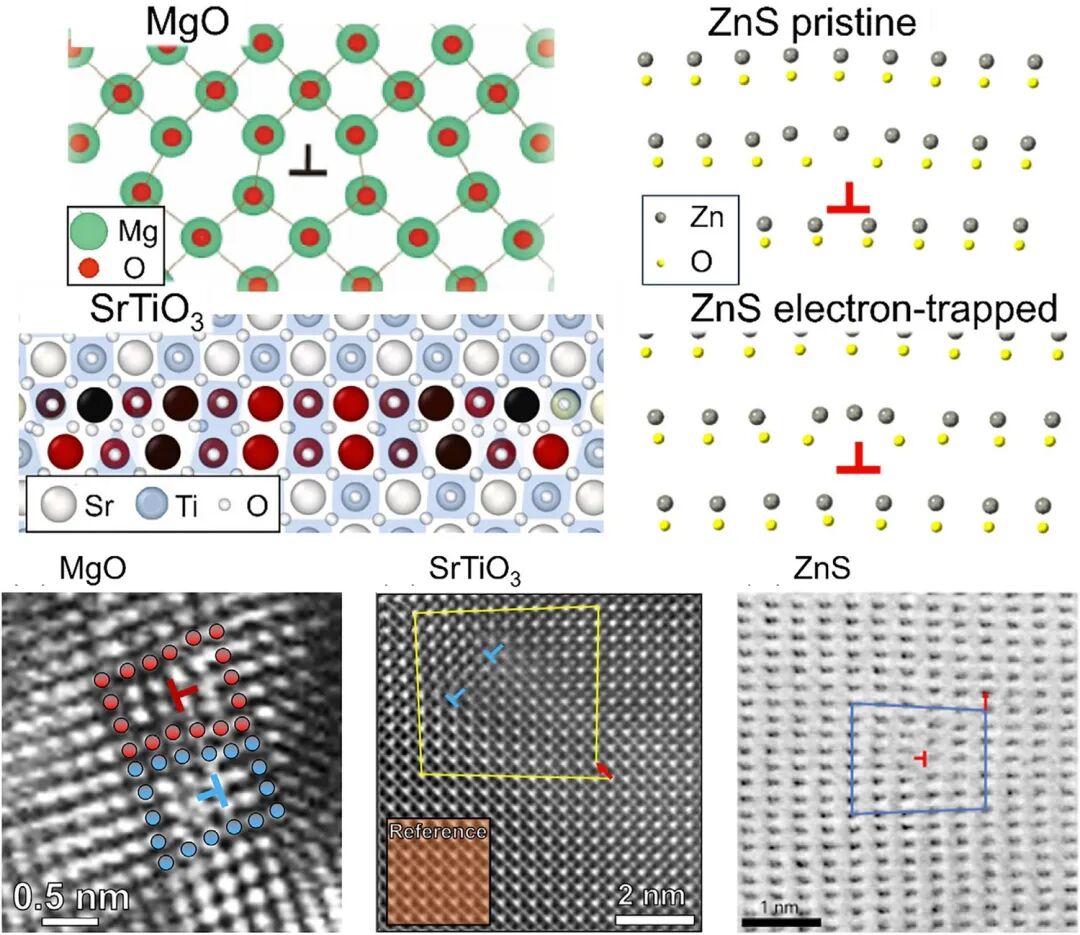
Twinning is coordinated lattice shear that creates a reoriented domain; motion of its boundary accommodates strain, especially under high stress, rapid loading or impact. A stress-driven phase transformation can also provide shear and volume strain when a metastable parent phase is available. Both are limited by the number of active twin systems or transformable material, and new interfaces may themselves nucleate cracks. Amorphous flow uses viscous or non-Newtonian shear in a glassy phase or grain-boundary film, often near softening temperature. Interface sliding transfers strain through heterogeneous or coherent boundaries, but debonding and wear may lower stiffness or strength. Several pathways can coexist; seeing dislocations near an interface does not alone establish which one carries the strain.
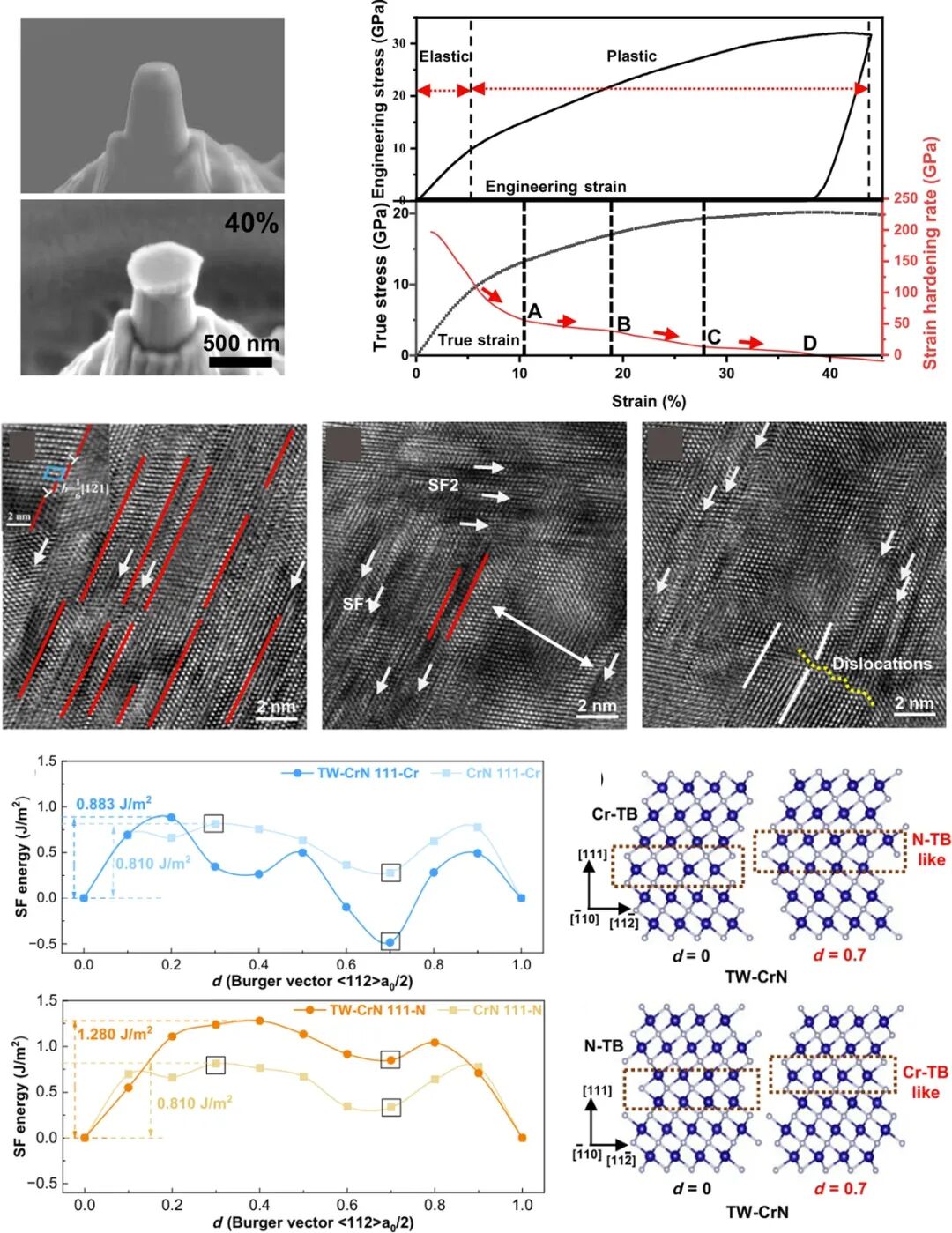
One prominent example is nanotwinned CrN: a specially made micropillar in the cited work reached around 40% engineering compressive strain with sustained hardening. Atomic-scale observations relate stacking faults and dislocations to the twin boundaries. This is not evidence that conventional bulk CrN, or all ceramic components, can elongate 40% in service.
Mechanism guide: conditions and limits
| Mechanism | Strain carrier | Favourable conditions | Main limit |
|---|---|---|---|
| Dislocation glide | Slip-plane motion | Resolved shear, favourable orientation or small volume | High activation stress and few slip systems |
| Grain-boundary sliding | Relative grain motion | Fine grains, high homologous temperature, slow rate | Cavitation and grain growth |
| Twinning | Coordinated lattice shear | High stress, rapid loading or impact | Limited twin systems; crack initiation at boundaries |
| Phase transformation | Transformation shear and volume change | Metastable parent phase and sufficient stress | Limited transformable fraction; residual stress |
| Amorphous flow | Shear in glass or intergranular film | Near softening or glass transition | Creep resistance and crystallization |
| Interface sliding | Shear at phase or coherent boundary | Suitable compliant interface and shear stress | Debonding, wear and stiffness loss |
4. Size changes both strength and apparent plasticity
When a specimen becomes smaller, the chance that it contains a critical pore, crack or damaged surface decreases. In this flaw-limited regime it becomes stronger. At still smaller dimensions, pre-existing flaws may stop dominating and dislocation nucleation from a free surface or interface becomes rate-controlling. If plastic activity starts before a crack grows, the micro-specimen may sustain more irreversible strain—the often described “smaller is more ductile” regime. The transition depends on material, geometry and stress state; it cannot be converted into a universal diameter threshold.
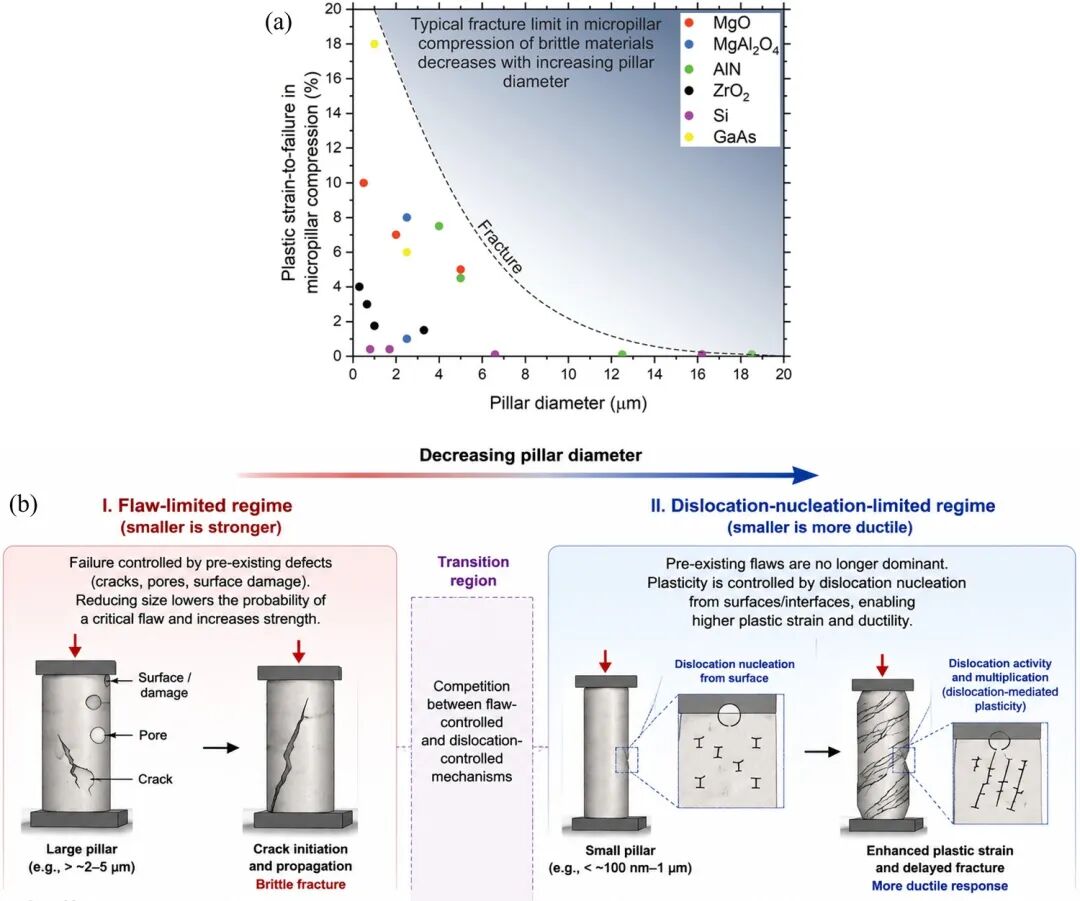
Micropillar compression and nanoindentation are therefore powerful mechanism probes, but they do not certify a bulk part. Flaw statistics, residual stresses and loading mode change on scale-up. The graph in Figure 4 gathers several ceramic and semiconductor systems, not one material measured in an otherwise identical series.
5. Three design lines—and their trade-offs
First, tune defects and dislocations. Doping or non-equilibrium processing can alter oxygen vacancies and dislocation nucleation barriers; prior high-temperature loading, high-pressure torsion or repeated scratching can seed dislocations that remain on cooling. Electric current, fields, stress, ultrasound or light may assist some deformation mechanisms, but local heating, compositional changes and uniformity have to be controlled. Such effects are material- and loading-specific, not a general recipe for making ceramics ductile.
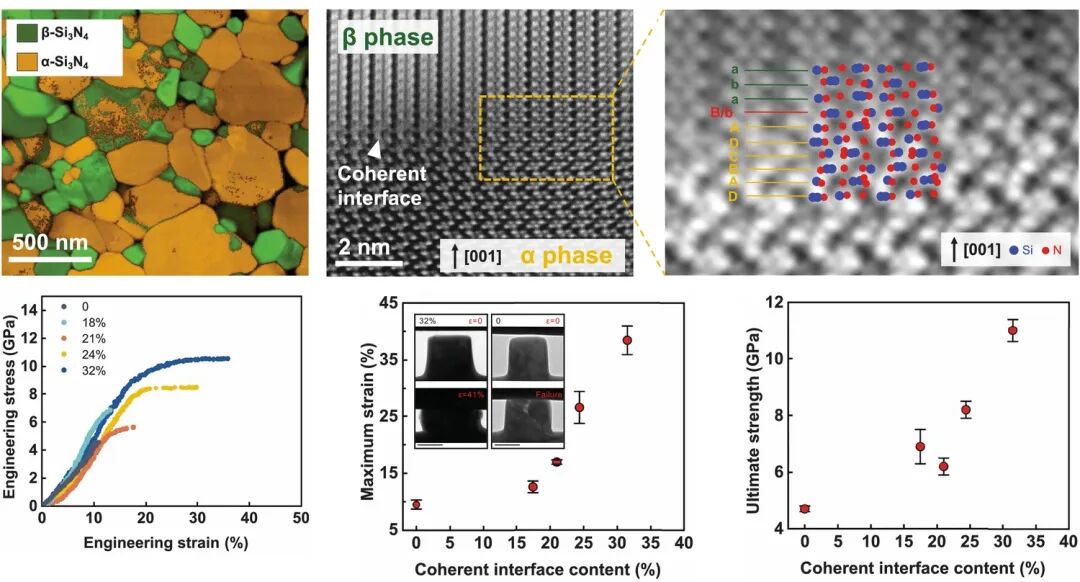
Second, design grain structure and interfaces. Nanocrystalline grains raise the fraction of atoms at boundaries and can shift strain accommodation toward boundary processes, though grain growth threatens thermal stability. Layered or multiphase architectures divide load between hard and compliant constituents, and coherent interfaces may permit bond switching while limiting crack advance. The cited dual-phase Si₃N₄ example relates coherent-interface content to compressive strain and ultimate strength in selected specimens. Its curve does not establish the same response in a large printed Si₃N₄ part.
Third, combine crystalline and amorphous domains so that the interface redistributes stress while nanocrystals rotate or the amorphous phase shears. This avoids relying on a single carrier of irreversible strain, but a softer phase can compromise creep resistance and stability. Every strategy must be judged against fracture, strength, cyclic loading, environment and manufacturability—not plastic strain alone.
6. How to prove room-temperature plasticity
Bulk small-strain tests can use digital image correlation, precise extensometers or strain gauges to resolve yield, work hardening and residual strain. Micro/nano tests—indentation, pillar compression, microbeam bending and microtension—probe local behaviour near high stresses while reducing the chance of a critical flaw. They do not measure the same thing. Ion-beam damage, pillar taper, constrained multiaxial indentation stress, notch quality, surface condition, platen friction and alignment can all create misleading signals. A load pop-in may indicate dislocation nucleation or cracking.
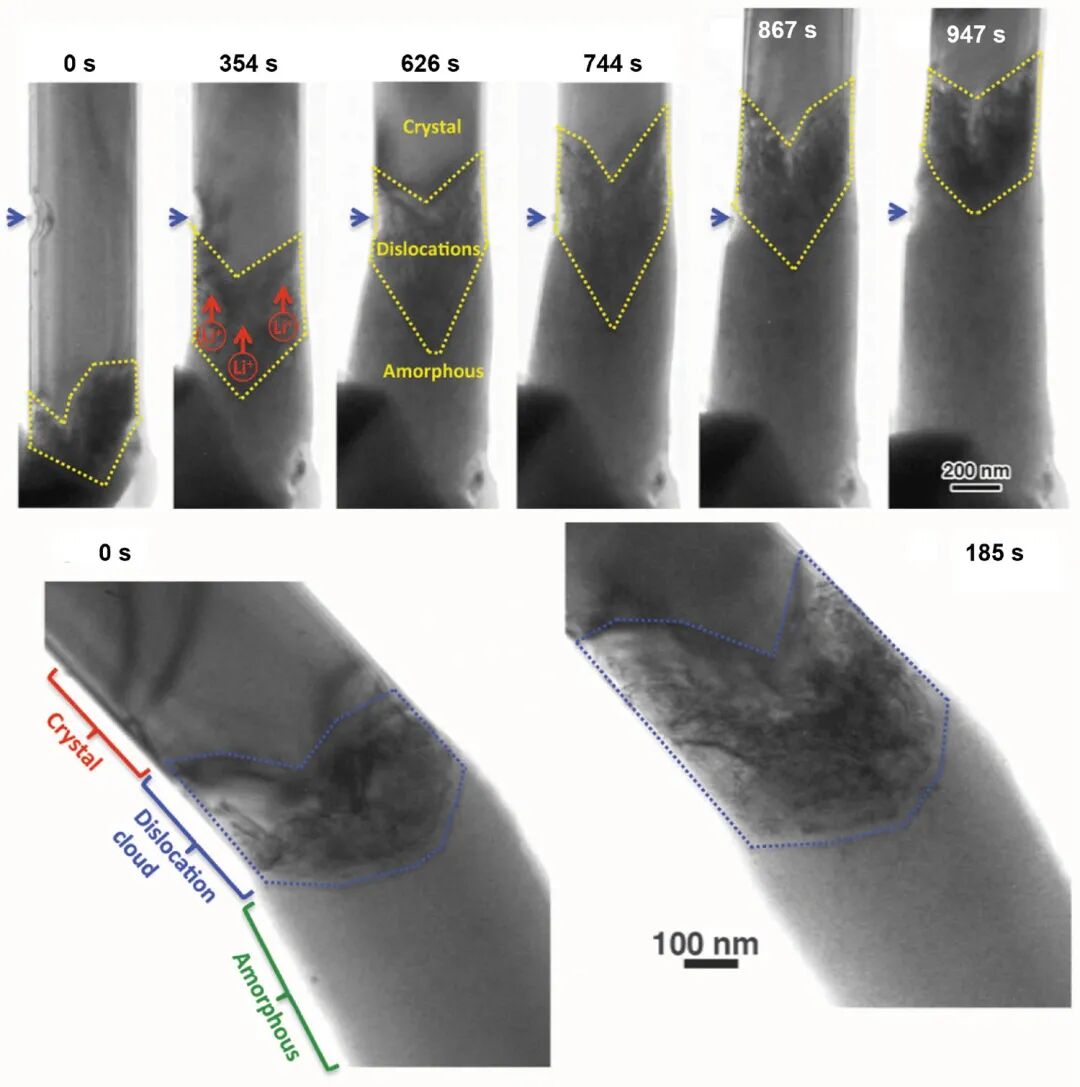
In-situ imaging can connect force–displacement data to specific defects. Figure 6 follows a nanowire during tensile deformation: dislocations accumulate and an amorphous region forms. Such frame-by-frame evidence is stronger than a curve alone, but its size and loading conditions still limit generalization. A practical claim should report specimen dimensions, stress state, temperature, strain rate, microstructure and repeated tests, and should identify whether the deformation is intrinsic or architecture-mediated.
Engineering interpretation
The review overturns a categorical “ceramics can never plastically deform at room temperature”, not the practical need to manage brittle failure. Most striking demonstrations remain at micro/nano scale, in selected orientations or in deliberately engineered defect and interface structures. Reproducible bulk-scale response with useful strength, cyclic life and environmental stability remains an open development problem. For ceramic additive manufacturing, pore control, surface finish, residual stress and validation at the intended component scale are therefore as important as a promising microscopic mechanism. None of the cited curves is a KUNWU printer specification.
Sources
Original paper · DOI
Xu Z, Zhang J, Dong L, et al. Rethinking brittleness in ceramics: The emergence of room-temperature plasticity. Journal of Advanced Ceramics. 2026;15(9):9221353.