Biocatalysis
3D-printed ceramic supports for enzyme immobilization
Designing a ceramic insert for continuous biocatalysis: surface chemistry, flow, immobilization and cleaning.
Expanded research guide adapted from Valotta et al. (2021), CC BY 4.0. Seven original diagrams are reproduced unchanged; explanatory text and captions are adapted or translated. Not a verbatim full-paper reprint or a KUNWU product test. Full paper and license are linked below.
Study context and model reaction
Valotta and colleagues (2021) combined printed alumina inserts, covalent enzyme immobilization and automated flow optimization. Phenolic acid decarboxylase from Bacillus subtilis (bsPAD) converted para-coumaric acid into vinylphenol. The work tests this particular reaction and carrier system; it does not establish equivalent performance for all enzymes.

Six inserts and the ceramic manufacturing route
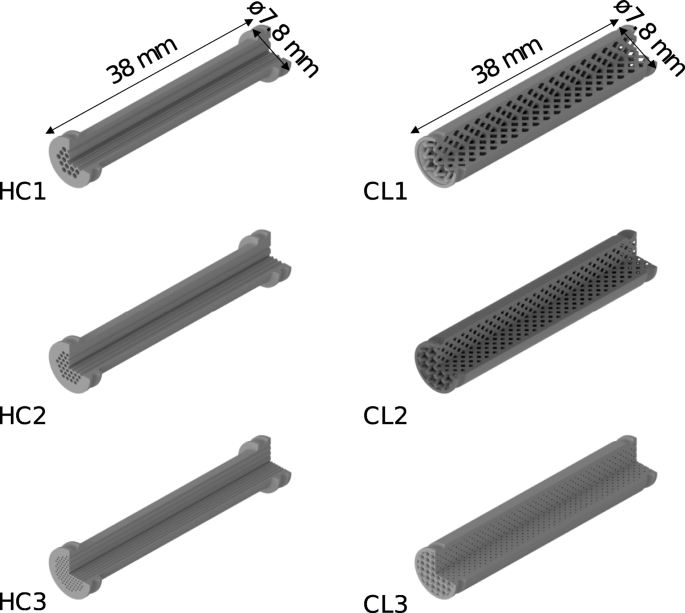
The authors compared straight hexagonal honeycomb channels (HC1–HC3) with interconnected cubic lattices (CL1–CL3). Both had end seals to suppress bypass flow and a length of 39.8 mm for an 8 mm internal-diameter, 40 mm HPLC column. The seal region was 7.8 mm in diameter; the honeycomb middle section was reduced to 5.8 mm to avoid excessive solid mass. Each architecture was made at three channel sizes.
Lithography-based printing used an alumina suspension, followed by cleaning, preconditioning at 120 °C, binder removal and sintering at 1500 °C for two hours. These are the paper’s processing conditions, not a transferable recipe for any commercial slurry.
Measure the flow, rather than assume plug flow
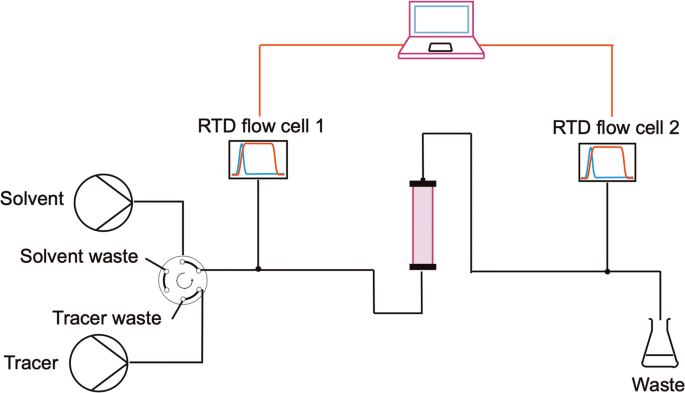
Two inexpensive optical cells measured a methylene-blue tracer at the column inlet and outlet. Recording both signals allowed correction for dispersion introduced by connecting capillaries. Tested flow rates were 0.05, 0.1, 0.2, 0.5, 1 and 2 mL/min.
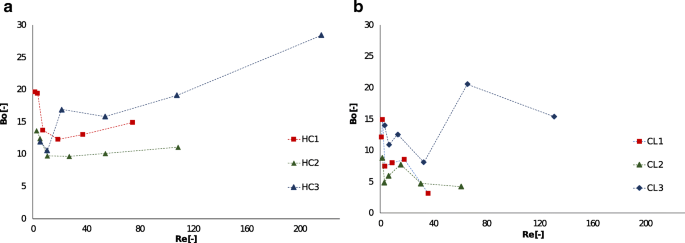
All tested inserts had Bodenstein numbers below 100 over the investigated range, indicating substantial axial dispersion. HC3 approached plug-flow behavior more closely at higher flow rates, but neither a honeycomb shape nor an attractive CAD model guarantees ideal flow. The authors also discuss pump pulsation and unequal channel feeding at low rates.
Surface chemistry and its measurement limits
After acid activation and APTES silanization, the team compared a glutaraldehyde route with EDC/NHS-assisted coupling. Preliminary batch tests favored the latter for immobilization yield and activity stability, so it was used for the flow inserts. Enzyme binding was performed in flow to reduce intermediate handling.
Immobilization yield was estimated from the decrease in activity of the enzyme solution before and after binding: Yi = (Ab − Aa) / Ab × 100%. This is not a direct measurement of every enzyme molecule inside the channels, nor proof that all bound enzyme retains its initial activity. BET measurements and activity assays complement, but do not replace, a complete functional validation.
Solvent and automated experimental platform
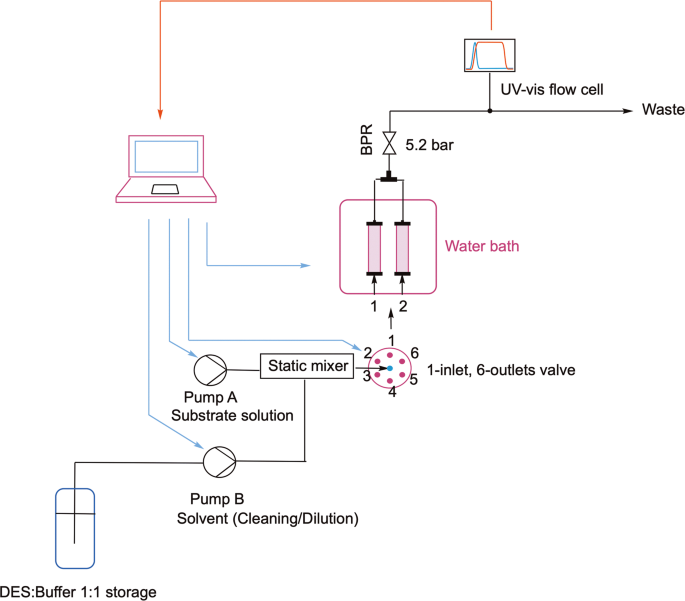
The solvent combined choline chloride and glycerol at a 1:2 molar ratio, diluted 1:1 by volume with pH 6 phosphate buffer. Solvent and substrate pumps fed a static mixer, followed by selectable temperature-controlled insert columns and online UV–visible analysis. The system was flushed for at least one hour before screening to remove loosely attached enzyme.
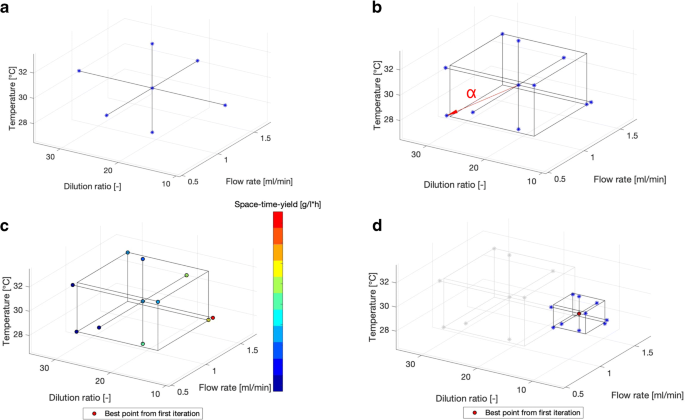
The optimization varied temperature, feed flow and substrate concentration. Fractional central composite design used 11 experiments in the first iteration and 10 in the second. Space-time yield, STY = product concentration × flow / internal reactor volume, was the principal objective; maximizing conversion alone is not the same task.
Results, optimum and limits of transfer
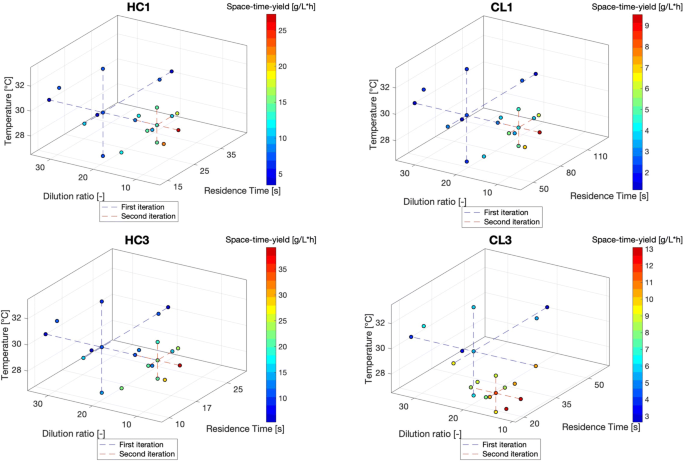
For HC1, HC3 and CL1, the selected conditions were 30 °C, 1.1 mL/min and approximately 1.86 mM feed concentration. CL3 followed a different optimum at 28 °C, 1.464 mL/min and approximately 0.93 mM. The authors explain that a local search can favor different nearby optima; the algorithm did not exhaust every possible condition.
HC3 reached 39.21 g/(L·h), compared with 4.8 g/(L·h) in the earlier system cited by the authors—roughly an eightfold increase. Its low internal volume and high surface-to-volume ratio contributed to this result. It is a reactor-volume-normalized productivity for this experiment, not an eightfold improvement in every ceramic biocatalyst.
Geometry must serve both flow and enzyme
Channels need to wet the surface, provide a predictable residence-time distribution and keep pressure drop acceptable. More surface does not always mean more productivity: passages that are too narrow or tortuous can hinder filling, washing and bubble removal. Comparing residence-time distribution before enzyme immobilization helps separate geometry from biochemistry.
The support surface needs its own chemistry
A printed and sintered ceramic does not automatically become a biocatalyst. Cleaning, surface activation, a suitable attachment route and evidence that the procedure preserves enzyme activity are required. For covalent immobilization, assess immobilization yield, retained activity, leaching, time-on-stream stability and repeatable regeneration or insert replacement.
Compatibility belongs to the real process medium
The substrate and functional layer must tolerate the operating pH, solvent, salts, temperature and sanitation or sterilization method. Test substrate and product adsorption, pore fouling and complete washability. Even a chemically resistant ceramic does not guarantee the stability of a silane layer, linker or enzyme.
A first trial plan
Provide the model reaction, column envelope, flow rate, fluid viscosity, pH and temperature, selected enzyme and proposed immobilization chemistry. The first series should compare a blank ceramic insert, a functionalized support without enzyme and the immobilized biocatalyst. This separates flow, surface and enzymatic effects.