Printing practice
Curved through-pore zirconia structure
The sample combines a curved shell with a permeable lattice, testing slurry removal and retention of open channels.
This KUNWU editorial note is based on the supplied technical source. Reported results belong to the described study or sample and are not KUNWU equipment specifications.
Zirconia (ZrO₂) combines high strength, high toughness and wear resistance, and is a research hotspot in the field of structural ceramics and functional ceramics. However, it is almost impossible to use traditional molding processes for three-dimensional curved porous structures - grouting cannot accurately control the direction of the channels, machined thin walls are prone to cracking, and internal through-channels cannot be processed. DLP ceramic 3D printing is formed by layer-by-layer light curing, which is exactly what it takes to overcome such difficult structures.
This case focuses on a type of zirconia sample that is extremely difficult to print: a three-dimensional curved surface connected porous structure.
Porous zirconia specimens
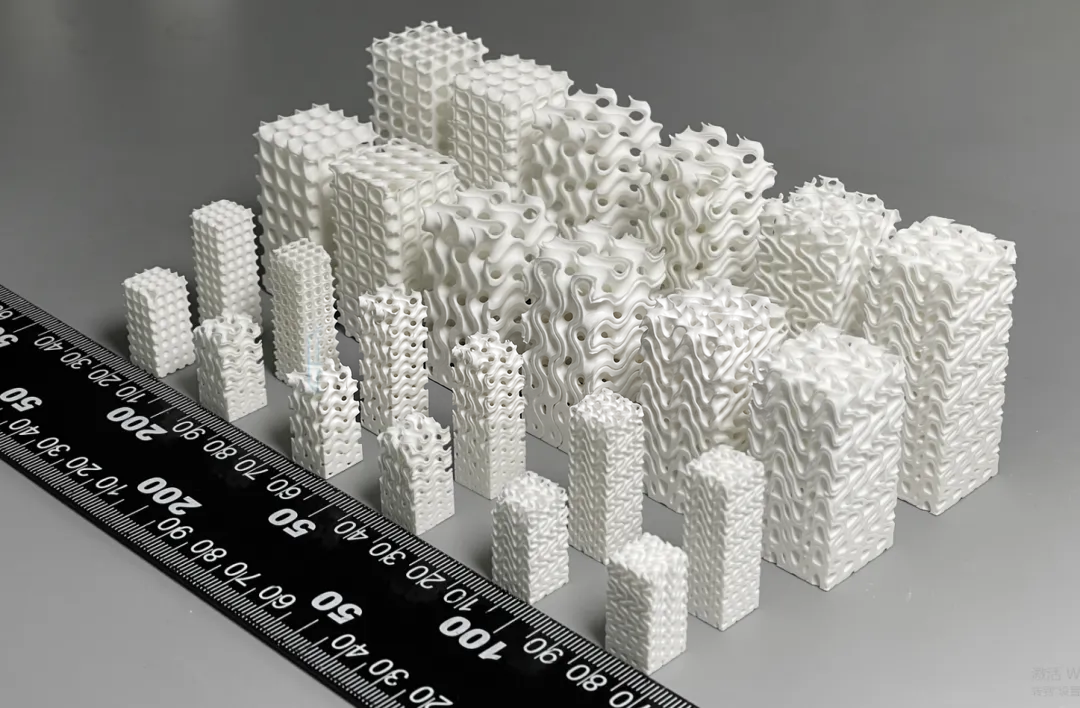
The figure shows a set of zirconia porous cube samples with varying size gradients. The surface of each unit body has a continuous curved surface topology with all holes connected through it. Multiple specifications ranging from millimeter to centimeter levels are printed simultaneously within the same batch.
The difficulty of printing these structures is high in the DLP ceramics process for a number of reasons:
Slurry spreading and cleaning. The three-dimensional curved surface will form a large number of isolated micro-sections on each layer of slices, requiring the slurry to evenly cover the cured surface topology of the cured layer each time it is laid. If the slurry has high viscosity and insufficient fluidity, the slurry in curved grooves and isolated sections will spread unevenly, resulting in material shortage defects. After printing is completed, the uncured residual slurry needs to be thoroughly cleaned from hundreds of connected pores - the finer the pores and the longer the path, the more difficult it is to clean, and the residual slurry will cause hole plugging or carbon residue in subsequent degreasing.
Thin wall curing control. The wall thickness of the curved surface is extremely thin. If the UV light penetration depth is slightly larger, it will cause over-curing, solidifying the areas that should not be cured, and blocking the pores. If the irradiation energy is insufficient, the inter-layer bonding force will be insufficient, and the thin wall will break during degreasing or sintering. A precise balance in exposure parameters is required.
Debinding cracks are a significant risk. In thin curved walls, gases released by decomposing organic binder may have long escape paths and create internal pressure. Curvature and local geometry can concentrate stress. If the debinding temperature rises too quickly, cracks can initiate at curved transitions; these defects may be absent after printing and become evident only after thermal processing.
Uneven sintering shrinkage. Large and small specifications coexist in the same batch. Large-sized parts and small-sized parts have different heat dissipation rates and different shrinkage rhythms. When sintering in the same furnace, it is easy for large parts to shrink in place and small parts to be over-fired, or small parts to be dense and large parts to be under-fired.
Judging from the actual effect of the sample:
First, the structural continuity is good - the transition between curved thin walls is smooth, and there are no obvious signs of fracture or delamination, indicating that the slurry spreading and inter-layer bonding are well controlled. Second, all the pore channels are connected - regular through holes can be seen on the surface of each unit body, and an open network is formed between the holes, which means that the cleaning process is effective and there is no clogging after degreasing. The third is the coexistence of multiple sizes—the structural integrity is maintained from the smallest to the largest specifications, indicating that the process window has good adaptability to different scales.
After zirconia is made into this connected porous structure, while maintaining the material's intrinsic wear resistance and chemical stability, it introduces high specific surface area and controllable mechanical response characteristics. This type of structure has research value in catalysis, filtration, biological scaffolds, etc. The advantage of DLP ceramic 3D printing is that researchers can quickly iterate different porosity, pore size and topological configurations, and use the same equipment to verify different design assumptions, which is difficult to achieve with traditional processes.
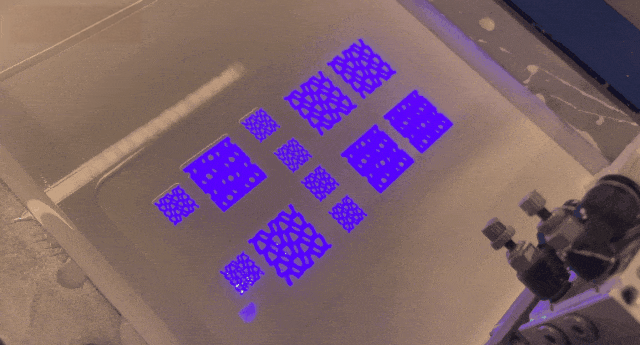
The sample was printed on a KUNWU ceramic 3D printer. The equipment has a built-in material process parameter package, which can directly call the zirconia printing parameters without debugging from scratch.
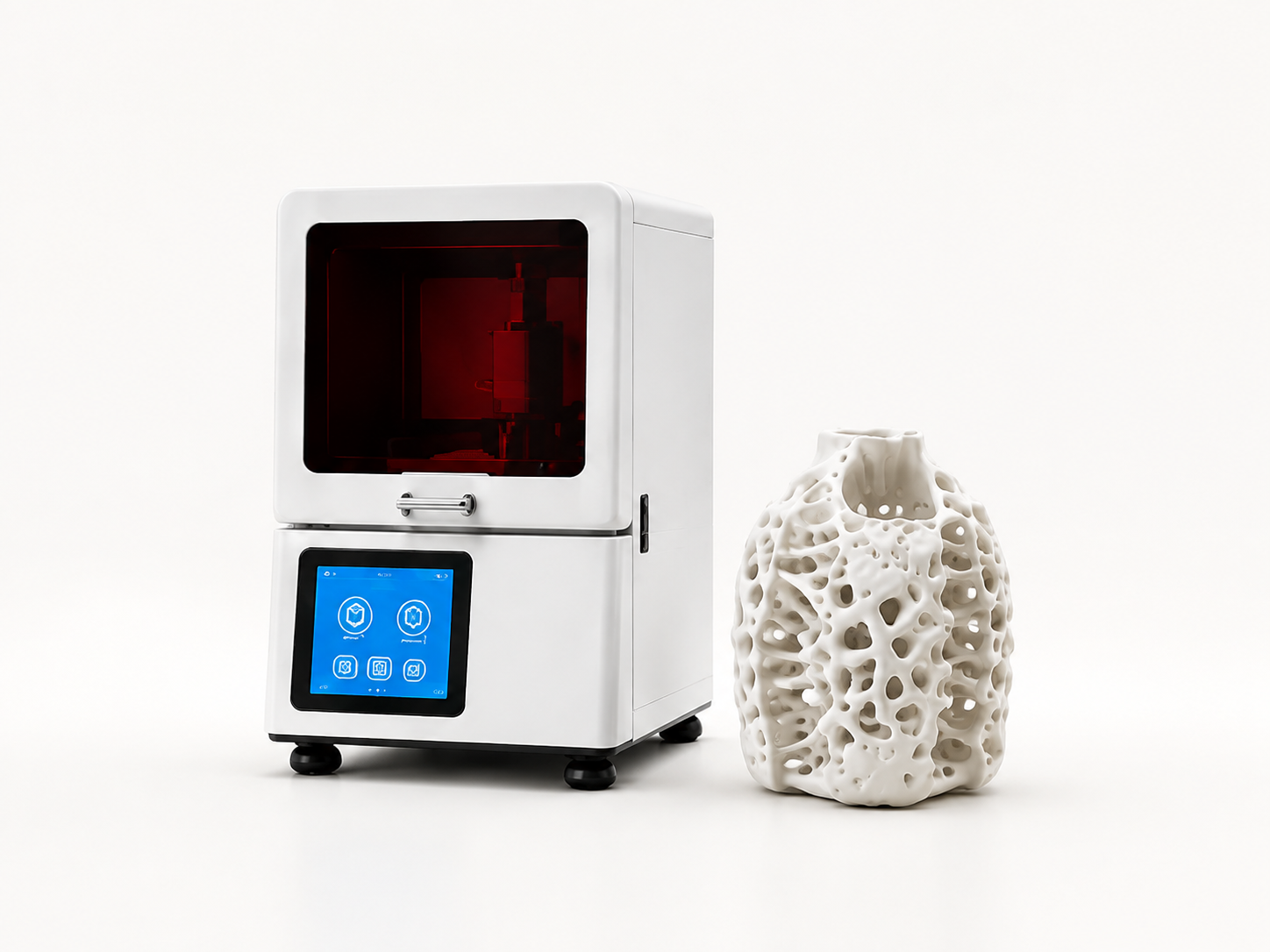
KUNWU ceramic 3D printer series