Research horizon
Five directions in ceramic additive manufacturing
Bioceramics, piezoceramics, high-temperature materials, multi-material printing and AI define five application-led research directions.
This KUNWU editorial note is based on the supplied technical source. Reported results belong to the described study or sample and are not KUNWU equipment specifications.
Which ceramic additive-manufacturing research directions deserve sustained attention? Current trends highlight five: bioceramics, piezoelectric ceramics, high-temperature structural ceramics, multi-material ceramic printing and AI-enabled manufacturing.
Every year during the project planning and topic layout stages, many teachers always have the same question: In the next few years, what other directions in the field of ceramic additive manufacturing are worthy of continued investment?
As a long-term ceramic 3D printing overall solution provider serving universities, scientific research institutes and corporate R&D centers, KUNWU has participated in and witnessed the advancement of a large number of scientific research projects in the past few years. We found that the research focus of ceramic additive manufacturing is quietly changing - more and more topics are beginning to shift from "process feasibility verification" to "application scenario driven", from the pure pursuit of printing forming to the collaborative design of structure, performance and function.
So, standing at the time node of 2026, what other research hot spots are worthy of attention in the field of ceramic additive manufacturing in the next few years? Which directions are expected to become important breakthroughs in the next round of scientific research and innovation? Perhaps the answer lies in the following research directions that are heating up rapidly.
Bioceramics: a long-term research direction
Growing demand for bone-defect repair and personalized healthcare keeps bioceramic 3D printing an important long-term research field.
Currently popular materials include hydroxyapatite (HA), β-tricalcium phosphate (β-TCP), bioactive glass and composite bioceramics. The focus of the review has shifted from "can it be printed" to the directions of osteoinduction and osteogenesis mechanisms, vascularization promotion mechanisms, vascularization promotion mechanisms, immune regulatory functions, gradient structure design, and multi-scale pore structure construction. If the subject can be combined with basic research on cell behavior, tissue regeneration, and biological toxicity testing, the competitiveness will be significantly improved.
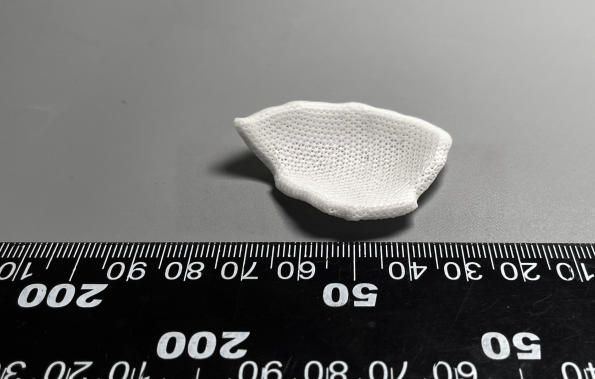
KUNWU printed HA human skull prosthesis
Piezoelectric ceramics: a growing field
Rapid development in smart sensing, flexible electronics, medical testing and intelligent equipment is making piezoelectric and functional ceramics a promising direction in ceramic additive manufacturing.
For piezoelectric materials such as barium titanate and PZT, research is moving beyond simple components toward three-dimensional periodic architectures, gradients and multi-material designs that improve electromechanical conversion and functional integration. Complex structures are particularly relevant to ultrasonic transducers, intelligent sensors and energy harvesters.
Piezoelectric and functional ceramics have interdisciplinary characteristics such as materials science, advanced manufacturing and electronic information. They not only have clear application prospects, but also contain rich basic scientific issues.
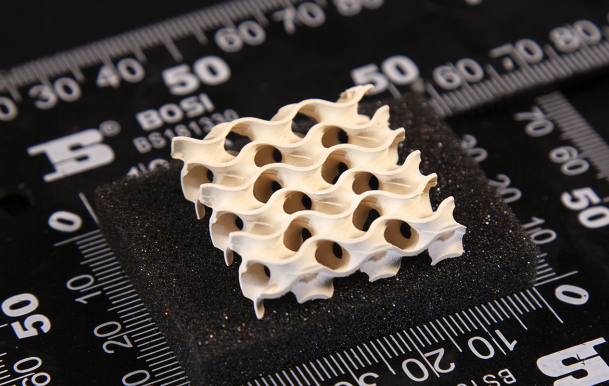
PZT complex hollow structure printed by KUNWU
High-temperature structural ceramics for aerospace
In the field of advanced ceramics, high-temperature structural ceramics have always been one of the strategic directions that the country focuses on. Compared with traditional metal materials, high-temperature structural ceramics represented by silicon nitride, silicon carbide, etc. are becoming more and more widely used due to their advantages of high temperature resistance, corrosion resistance, wear resistance, and excellent specific strength.
Layer-by-layer ceramic additive manufacturing creates complex geometries that are difficult to obtain conventionally, supporting development of ceramic antennas, casting cores, thermal-protection components and lightweight high-temperature structures.
At present, the research focus of high-temperature structural ceramics has gradually shifted from simple material preparation to deeper issues such as structural design, service behavior and performance control. In particular, research around complex structural construction, high-temperature service mechanisms, and structure-performance collaborative optimization not only meets major national needs, but also has strong academic innovation value.
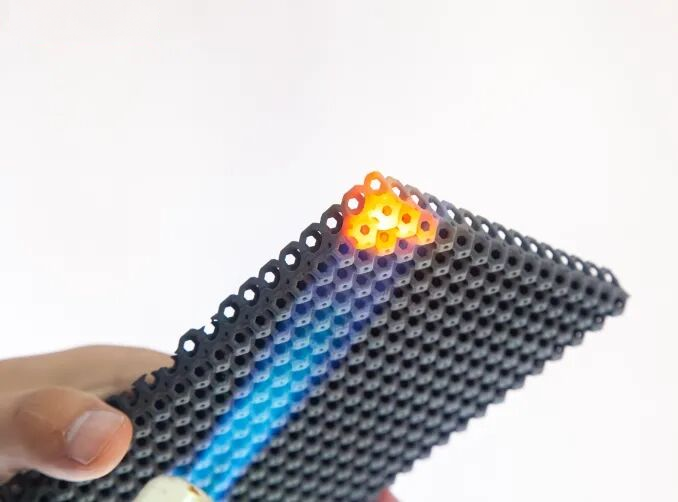
KUNWU printed silicon carbide thermal radiation plate
Multi-material printing for next-generation ceramics
If single-material ceramic printing solves the problem of "complex structure manufacturing", then multi-material ceramic printing is trying to solve the problem of "structure and function integrated design".
By realizing the precise distribution and collaborative construction of different materials in the same component, researchers can obtain functionally graded structures, composite functional structures, and interface-enhanced structures that are difficult to achieve with traditional processes. For example, in the biomedical field, a gradient bone scaffold with both mechanical support and biological activity is constructed, and in the electronic field, the collaborative design of thermal conductivity and insulation functions is realized.
At the same time, multi-material ceramic printing has also brought about many scientific issues that have not yet been fully resolved, such as the interface bonding mechanism between different materials, sintering shrinkage matching rules, and multi-phase system structure design methods. Multi-material ceramic printing, which has both engineering application value and basic research depth, is becoming one of the research directions that has continued to receive increasing attention in recent years and has great development potential.
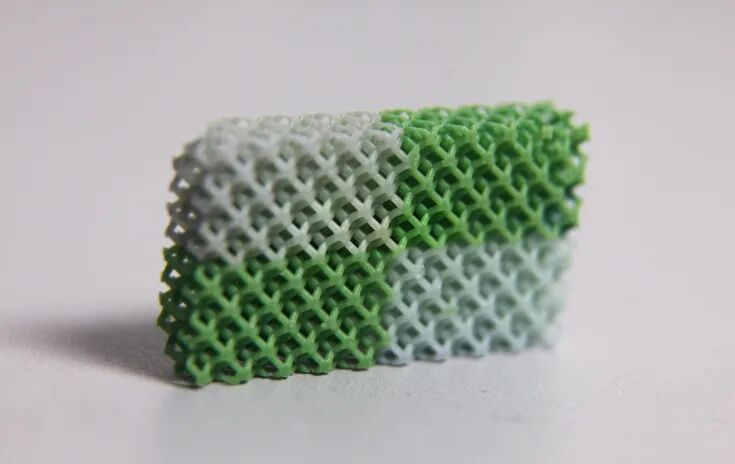
Multi-material prototype printed by KUNWU
AI and ceramic AM: from experience to data
With the rapid development of artificial intelligence technology, the deep integration of AI with advanced manufacturing is becoming an important direction for the new scientific layout. Through techniques such as machine learning, data modelling and digital twinning, researchers can significantly improve R & D efficiency and process stability by establishing a relationship between material composition, process parameters and final performance, optimizing print parameters, predicting defects and sintering processes. In particular, AI is gradually moving from being a support tool to being an important vehicle for innovation in the development of new materials and complex structural design.
Keywords such as "artificial intelligence + advanced manufacturing", "data-driven material research and development" and "intelligent manufacturing equipment" have frequently appeared in various scientific research project guides in recent years. For the field of ceramic additive manufacturing, how to use artificial intelligence to reveal the laws of material preparation and performance evolution and build a more intelligent design and manufacturing system not only has important engineering application value, but also contains rich basic scientific issues.
Conclusion
The manufacture of ceramics is moving from a “technical validation phase” to an “application-driven phase”. The core of future fund competition is not who can print out more complex structures, but who can use materials for manufacturing to solve critical issues in the fields of aerospace, semiconductor, biomedical, etc.
Judging from current trends, bioceramics, piezoelectric ceramics, high-temperature structural ceramics, multi-material ceramic printing and AI-enabled manufacturing are becoming the five most noteworthy directions in the field of ceramic additive manufacturing. If teachers are still thinking about how to layout their scientific research work in the second half of the year, they might as well start from these directions.