Applications
Hierarchical ceria reactor for solar thermochemistry
Multiscale porosity aims to combine radiation absorption, heat transfer, gas exchange and accessible reactive surface.
This KUNWU editorial note is based on the supplied technical source. Reported results belong to the described study or sample and are not KUNWU equipment specifications.
When sunlight meets "ceramic sponge": How can 3D printing turn carbon dioxide into fuel and cycle it 50 times without "stopping"?
Research background
Ceramic material cerium oxide (CeO₂) is like an efficient "oxygen ion sponge", which can release oxygen at high temperatures and absorb oxygen atoms at lower temperatures, thereby breaking down CO₂ molecules into carbon monoxide (CO) and oxygen. CO is an important raw material for synthetic fuels.
However, for this "sponge" to work efficiently, its internal structure must be carefully designed. An ideal reactor needs to meet three seemingly contradictory requirements at the same time: allowing sunlight to shine in (light penetration), allowing gas to quickly enter and exit (gas transport), and allowing the heat generated by the reaction to be quickly transferred (heat transfer). Traditional manufacturing methods, such as adding pore-forming agents or using templates, can also create porous structures, but they are often like "carving by feel", making it difficult to precisely control the size, shape and distribution of pores, and the manufactured structures are prone to "tired" or even collapse after hundreds of high-temperature cycles.
Now, a study published in Additive Manufacturing Frontiers provides an elegant solution to this problem: digital light processing (DLP) 3D printing technology. The researchers not only successfully printed high-precision cerium oxide ceramics, but also cleverly built a dual-scale multi-level pore structure of "millimeter-sized large pores + micron-sized pores" inside it, and still maintained excellent performance and structural integrity after 50 harsh high-temperature cycles.
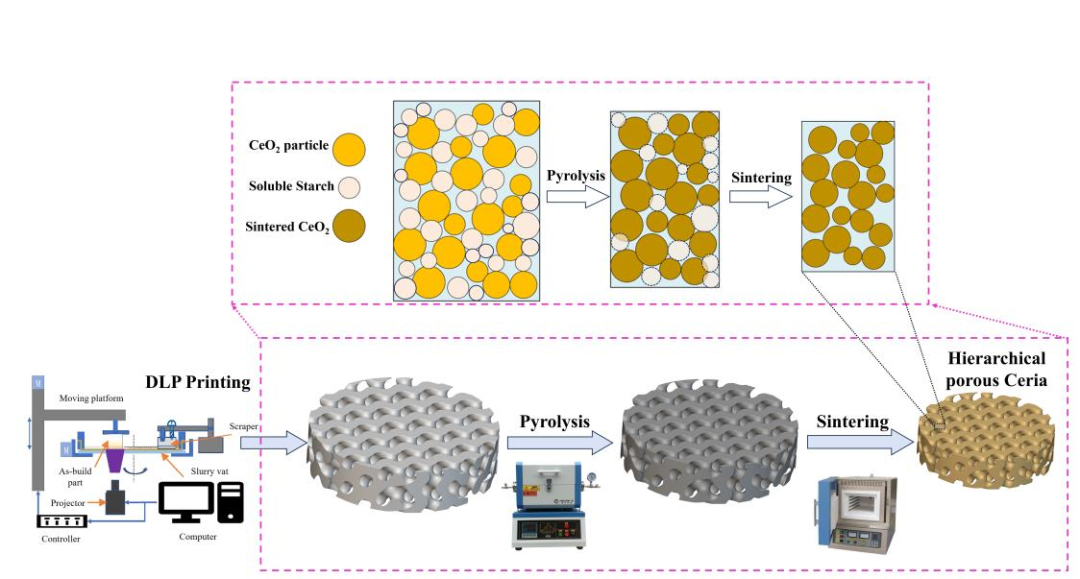
Schematic diagram of the process flow of DLP printing of multi-level porous cerium oxide ceramics. Starting from a ceramic slurry containing soluble starch, it undergoes DLP light curing molding, thermal degreasing and high-temperature sintering to finally form a ceramic body with a dual-scale pore structure.
Methods
Although DLP technology can achieve extremely high printing accuracy (micron level), it has strict requirements on the optical properties of the material. The ceramic slurry used for printing needs to cure quickly under UV light, and cerium oxide has a very high refractive index. The high refractive index means that light will be strongly scattered in the slurry, causing UV light to be unable to penetrate deep into the slurry. Curing only occurs on the surface, and printing can easily fail.
To this end, the research team developed a special composite slurry. They added soluble starch to the cerium oxide powder. This "additive" plays three key roles: 1. Adjusts rheological properties: allowing the slurry to flow and set quickly during printing. 2. As a pore-forming agent: Starch granules will be completely decomposed during subsequent high-temperature treatment, leaving micron-sized pores. 3. Reduce light scattering: The presence of starch changes the optical properties of the slurry, making it easier to be cured by UV light penetration.
By optimizing the slurry formula and printing parameters, the research team successfully printed cerium oxide green bodies with millimeter-scale macroscopic skeletons. These millimeter-sized holes are the "highways" reserved for light and gas.
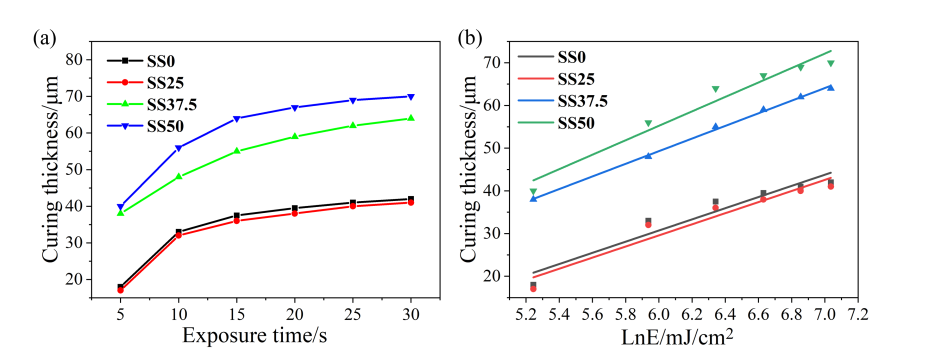
Photocuring properties of cerium oxide ceramic slurries with different proportions of soluble starch
Printing is just the first step, the real magic happens in the subsequent “pyrolysis” and “sintering” processes.
At high temperatures, the photosensitive resin and starch in the green body will first be removed by pyrolysis. The disappearance of the resin forms a millimeter-sized macroporous skeleton; while the decomposition of starch leaves countless micron-sized pores on the "walls" of the macropores. After high-temperature sintering, the ceramic particles are tightly connected, giving the structure sufficient strength.
Ultimately, it is a well-structured “porcelain sponge”: a millimetre-scale large hole: like the heavy pillars and corridors in the building, they ensure the mechanical strength of the structure and provide access to the depth of light and rapid macrotransmission of gas. Micrometre-scale small holes: Like small gas holes in the walls of sponge cells, they significantly increase the material ' s surface area. The reaction (CO2 decomposition) occurred mainly on this huge surface, with small holes providing gas molecules with numerous “workstations”, thereby significantly increasing the rate of reaction.
This two-scale multi-level cavity structure successfully resolved the tension between light, air and heat and achieved the effect of 1+1>2.
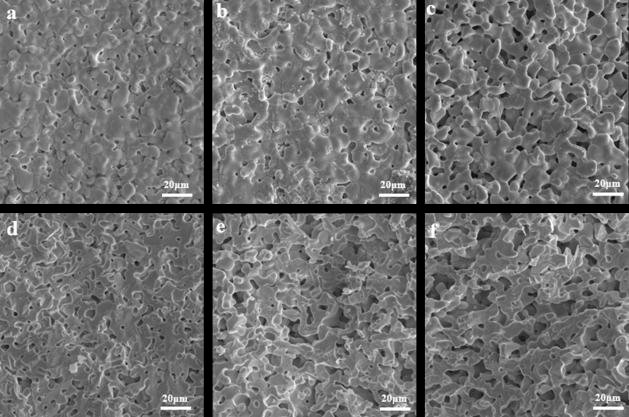
Scanning electron microscope (SEM) image of the microstructure of DLP-printed hierarchical porous cerium oxide ceramics. (a–c) Surfaces of samples in SS0, SS37.5 and SS50 groups; (d–f) Cross sections of samples in SS0, SS37.5 and SS50 groups.
Results
In order to verify the actual performance of this "ceramic sponge", the researchers conducted rigorous tests on it. They placed the sample in a high-temperature reactor to simulate a real solar thermochemical cycle: 1. Reduction step (1400°C): At high temperature, cerium oxide releases lattice oxygen and is reduced itself. 2. Oxidation step (900°C): Lower the temperature and introduce CO₂ gas. The reduced cerium oxide has a strong "oxygen-robbing" ability. It will snatch an oxygen atom from the CO₂ molecule, reduce it to CO, and at the same time re-oxidize itself into CeO₂, completing a cycle.
The results are exciting: * High productivity: In a single cycle, each gram of printed cerium oxide ceramic can produce 100.76 micromoles (about 2.257 milliliters) of carbon monoxide. This performance is superior to many similar materials manufactured using traditional methods. * High strength: The compressive strength of the sample is as high as 124.21 ± 9.49 MPa, which is stronger than many natural rocks (such as limestone), proving the stability of its structure. * Ultra-long life: The most critical thing is that after experiencing 50 consecutive severe temperature cycles from 1400°C to 900°C, the sample not only did not suffer any structural collapse, but its CO production also showed almost no decay, demonstrating amazing cycle stability and thermomechanical stability.
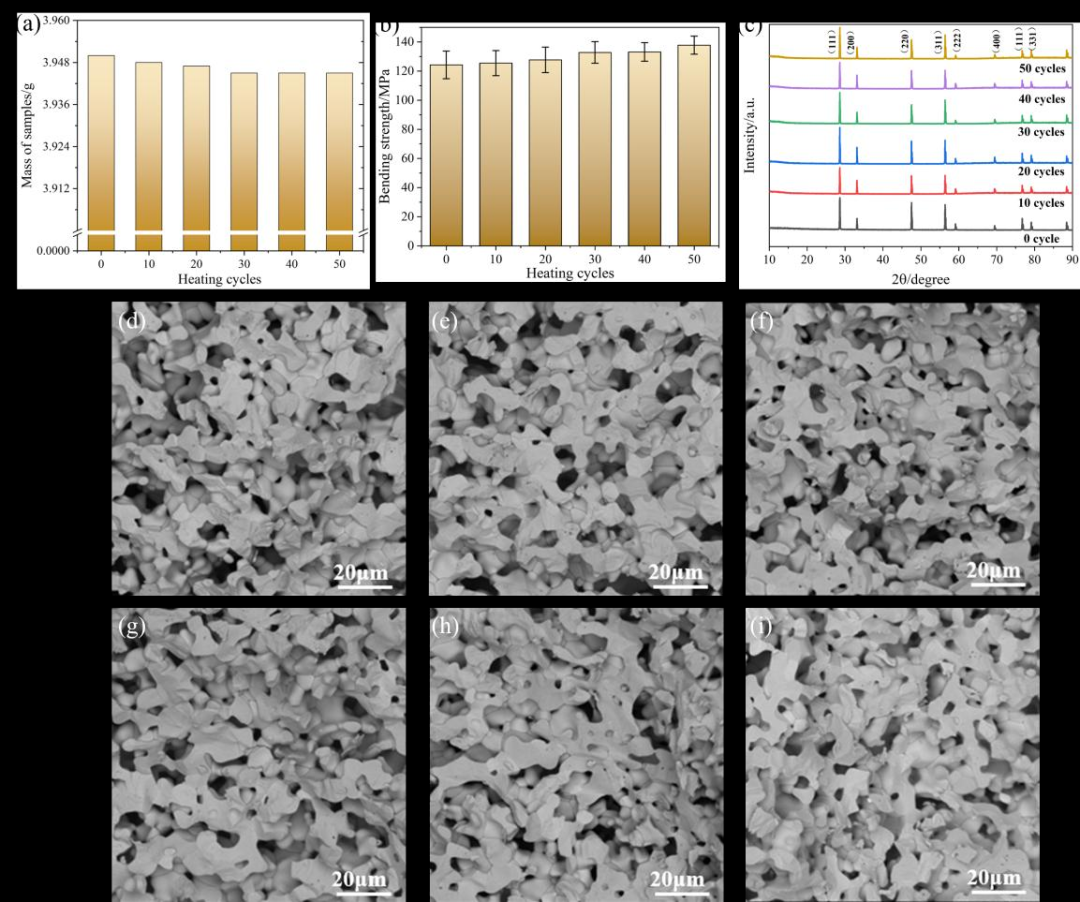
Thermochemical stability test results of cerium oxide samples under 50 redox cycles: (a) sample mass change; (b) sample change trend during 50 cycles; (c) XRD results of cerium oxide structure; (d–i) cross-sectional scanning electron microscope images after 0, 10, 20, 30, 40 and 50 cycles.
Conclusion
The significance of the study is that it successfully combines advanced 3D printing technologies with energy material science, opening a completely new and precisely designed path to high-performance, long-lived solar thermal chemical reactors. We are no longer confined to traditional processes, but are able to precisely design the internal structure of the material at both micro and macro scales, based on the demand for reaction, like building blocks.
Of course, there is still a long way to go from laboratory samples to a "sunlight fuel factory" that can actually be put into use. This study provides a practical path. When sunlight, carbon dioxide and 3D printed ceramic "sponges" are perfectly combined, we are one step closer to making fuel from sunlight.
Paper citation information:
Lian Q, Qi S, Chen Y, et al. Digital light processing of hierarchically porous cerium oxide ceramics for CO₂ splitting and fuel production[J]. Additive Manufacturing Frontiers, 2026: 200299. DOI: 10.1016/j.amf.2026.200299.