Structure design
Balancing properties in hierarchical porous ceramics
Hierarchical pores enable joint tuning of strength, heat transfer and biological interaction, but the optimum depends on the target function.
This KUNWU editorial note is based on the supplied technical source. Reported results belong to the described study or sample and are not KUNWU equipment specifications.
The performance of porous ceramics is determined by the "pores". But bigger pores are not better, nor are more pores better - everyone who makes materials knows this truth, but in actual operation the contradiction is difficult to reconcile: when the porosity is high, the mechanical strength will inevitably decrease; when the porosity is low, the permeability and specific surface area cannot increase; the thermal barrier coating needs low thermal conductivity (high porosity), but also requires mechanical reliability (low porosity); the bone repair scaffold needs high porosity to allow cells to grow in, but it also needs a certain strength to withstand physiological loads.
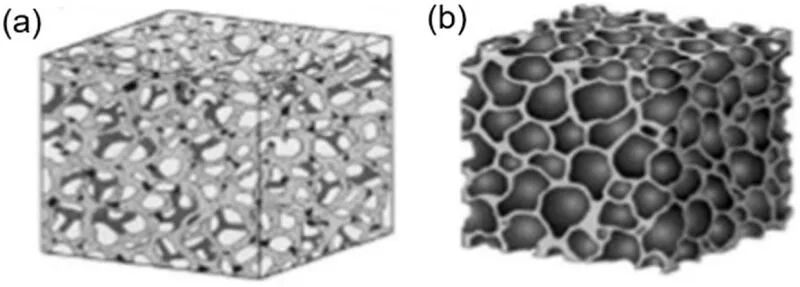
The traditional method of writing on an aperture scale will never solve this contradiction — because the micro-pores (<2 nm), the pores (2-50 nm), and the large holes (>50 nm) control different physical functions. The central argument of this synthesis is that the "strength vs function" conflict can be resolved from the root by integrating the three aperture-scale holes into a single material that allows them to do their job. It's the design philosophy of huerarchical ceramics.
Three scales, each performing its own duties
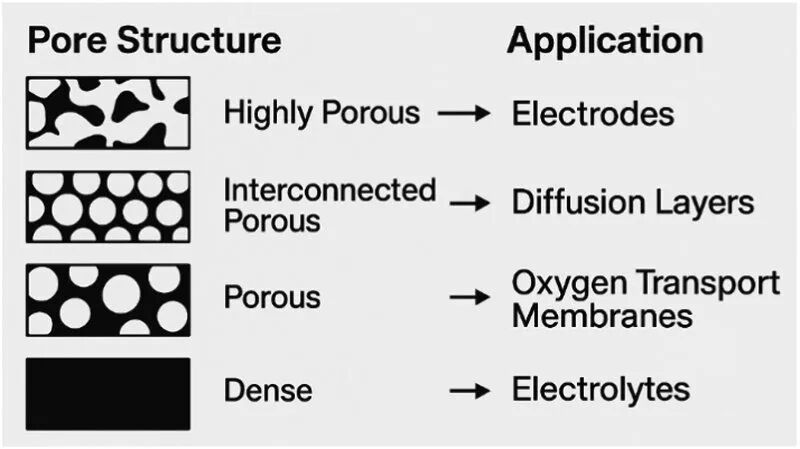
The strength of micropores (<2 nm) is surface activity - large specific surface area, suitable for catalysis and adsorption scenarios, but mechanical strength is almost zero; mesopores (2-50 nm) dominate diffusion and transport - the diffusion path of molecules inside is just right, which is an ideal scale for energy storage and separation processes; macropores (>50 nm) are responsible for mechanical support and cell penetration - when the pore size is large enough, human bone marrow mesenchymal stem cells (hBMSCs, 15-30 µm) and cell clusters (~200 µm) can be entered.
The key is to make micropores responsible for catalytic activity, mesopores responsible for ion/gas diffusion, and macropores responsible for mechanical support and biological penetration—the three functions are decoupled rather than fighting with each other on one scale. This is the core logic of hierarchical porous structures: each pore does what it does best, rather than trying to fit all needs with one pore size.
Application 1: Solid oxide fuel cell (SOFC) - three-phase interface density increased by 40-60%
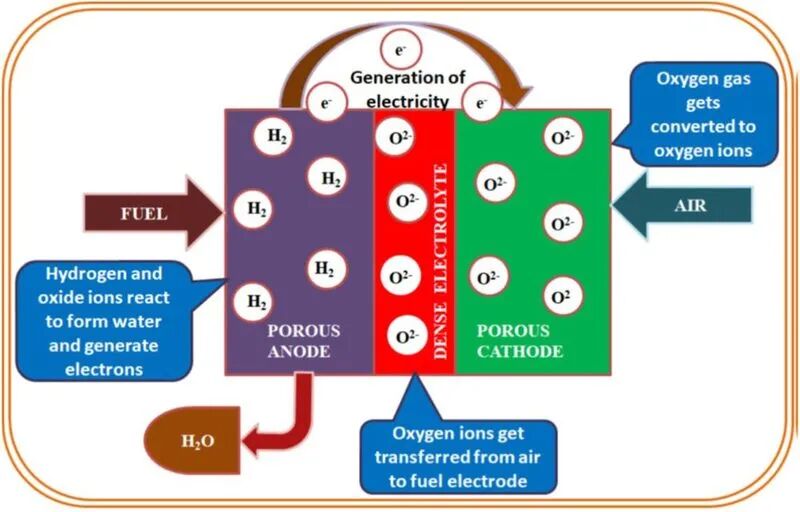
The anode reaction of a solid oxide fuel cell occurs at the "triple phase boundary" (TPB) - the area where solid fuel, oxygen ions, and gaseous fuel meet. The higher the density of the three-phase interface, the faster the reaction and the better the battery efficiency. The problem with traditional porous anodes is: high porosity means more three-phase interfaces, but insufficient mechanical strength; increasing porosity improves catalytic activity, but at the same time the mechanical properties decrease.
The problem is solved by the stratum of porous anodes: large holes (>50 nm) provide the mechanics to support the skeletons, medium holes (2-50 nm) provide the gaseous diffusion route, micro-pores provide the catalytic activity point - three holes are functional, three interfaces increase density by 40-60 per cent, while maintaining mechanical strength. This data is derived from this synthesis of a comprehensive analysis of recent literature and covers a variety of preparation routes, such as template-aided synthesis, solute-gel, and 3D printing.
Application 2: Thermal barrier coating (TBC) - The thermal conductivity is reduced by half, and it can be cycled at 1100°C for 1000 times without cracking.
Thermal barrier coatings for aerospace engines and gas turbines need to operate at extreme temperatures—the higher the temperature, the greater the thermal efficiency, but also the greater the thermal stress faced by the material. The basic contradiction of thermal barrier coatings is: dense ceramics have high thermal conductivity (poor thermal insulation), and highly porous coatings have good thermal insulation but poor strength.
The decomposition of the cleavage structure is the design of the gradient porosity rate: the construction of the pore rate gradient inside the coating - a high surface porosity rate (low-conductor heat), a low bottom porosity rate (moral support), a reduction of about 50 per cent, and more than 1,000 cycles under 1100°C remain intact. It's a performance that comes from "makes the hole in the right place" -- not evenly distributed across the coating.
Here is an interesting material problem: the shape of the pore and the direction in which it is arranged also have an impact. Directional layers (from directed condensing techniques) have a better effect than randomly distributed hole insulation, as heat flows need to follow a longer path - similar to the structure of a building.
Application Three: Bone Repair Scaffold - Combining porosity of more than 75% and strength of 5-8 MPa
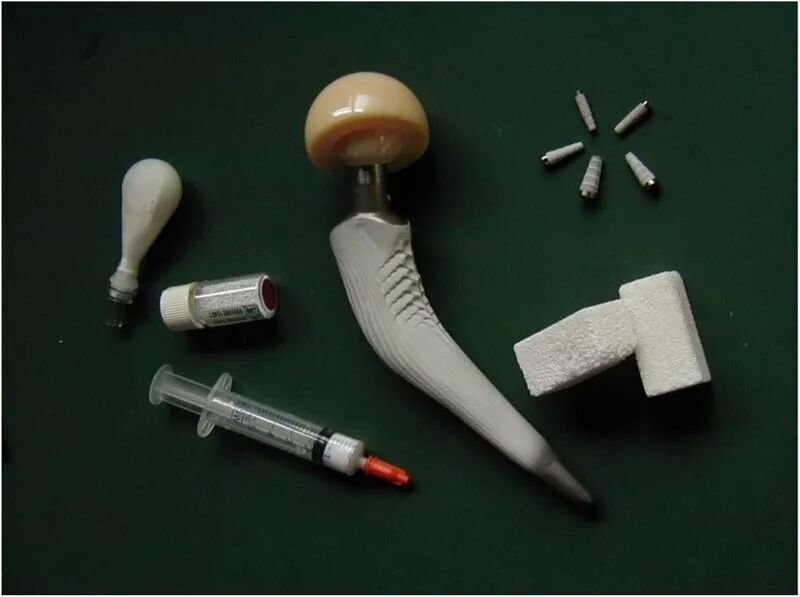
Bone repair scaffolds are one of the most direct applications of porous ceramics. Human bone is naturally a hierarchical pore structure: Haversian canals (diameter ~50 µm) are responsible for the distribution of blood vessels and nerves, bone lacunae (~10-20 µm) accommodate bone cells, and micropores in the bone matrix provide ion exchange surfaces. Mimicking this hierarchical structure is a classic idea in regenerative medicine.
Performance data for the stratification of hydroxyl phosphate (HAp) slabs: 75% porerate and 5-8 MPa - This strength range is close to the pine bone (corporal bone 100-230 MPa, cancellous bone 2-12 MPa) and is sufficient for non-heavy fracture repair. The key is that the stratification design not only binds the skeletal cells to the surface of the frame, but also penetrates the interior - the cell penetration depth rises from ~200 μm to ~400 μm in a equilibrium structure, accelerating bone formation by 4-6 weeks.
Four preparation routes: each has its own scope of application, there is no one-size-fits-all solution
▶ Freeze Casting
Advantages: layers of holes capable of orientation (simulating passages of natural bones) and apertures with a wide range (1-500 μm). scenes suitable for heat barrier coatings and for directed penetration. Limitations: cryogenic equipment is required, sample sizes are limited by crystal growth, and mass production is difficult.
▶ Template-Assisted
Advantages: Accurate control over apertures and perforations is good and can be repeated. Natural porous templates (e.g. wood, corals) can replicate their fine structures. Limitations: Template removal steps are complex, residual templates may contaminate products, with long lead times.
▶ Direct Foaming
Advantages: Simple process, low cost, suitable for large scale production with a pore rate of over 95 per cent. Limitations: Aperture distribution is difficult to control, open/closed ratios are unstable, and mechanics are inconsistent.
▶ 3D printing (Additive Manufacturing)
Advantages: Direct formation of complex geometric shapes and gradient pore structure, CAD design is extremely liberal and print parameters are manageable. Limitations: high cost of equipment, complex formulation of slurry systems and inefficient printing of large size samples.
Conclusion: Layered design is the fundamental way to break the "strength-functionality" contradiction
The core conclusion of this synthesis is summarized in a single sentence: decoupling the transmission function, the mechanics support, and the surface reaction on three scales, namely, micro-coast, meso-pore and large-pore, is the only effective path to solving the problem of multi-pore ceramic properties.
For materials engineers, the design of layered porous ceramics has several clear engineering implications: high-performance TBCs should not have uniform porosity, but gradient porosity; SOFC anodes should ensure both gas diffusion channels and mechanical support, and there is no need and should not use the same pore size to solve both problems at the same time; the pore size design of bone repair scaffolds should refer to the three scales of natural bone (micron-level channels → nano-level matrix → cell-level pores), rather than simply pursuing porosity numbers.
Outlook: Artificial intelligence and machine learning are accelerating the reverse design of layered porous materials - given target properties (thermal conductivity, compressive strength, permeability), AI can quickly screen out the optimal pore size combination and preparation route. This direction may subvert the traditional trial-and-error method of research and development in the next five years.
References
[1] S. Pant, K. Singh, N. Sharma, M. Singh, S. Chaudhary, K. Kishore, C. Pandurangappa, M. Lal, "Hierarchical porous ceramics: Design strategies, structure-property trade-offs, and multifunctional applications in aerospace, biomedical, and energy systems," Next Materials, vol. 12, 102306, 2026. DOI: 10.1016/j.nxmate.2026.102306
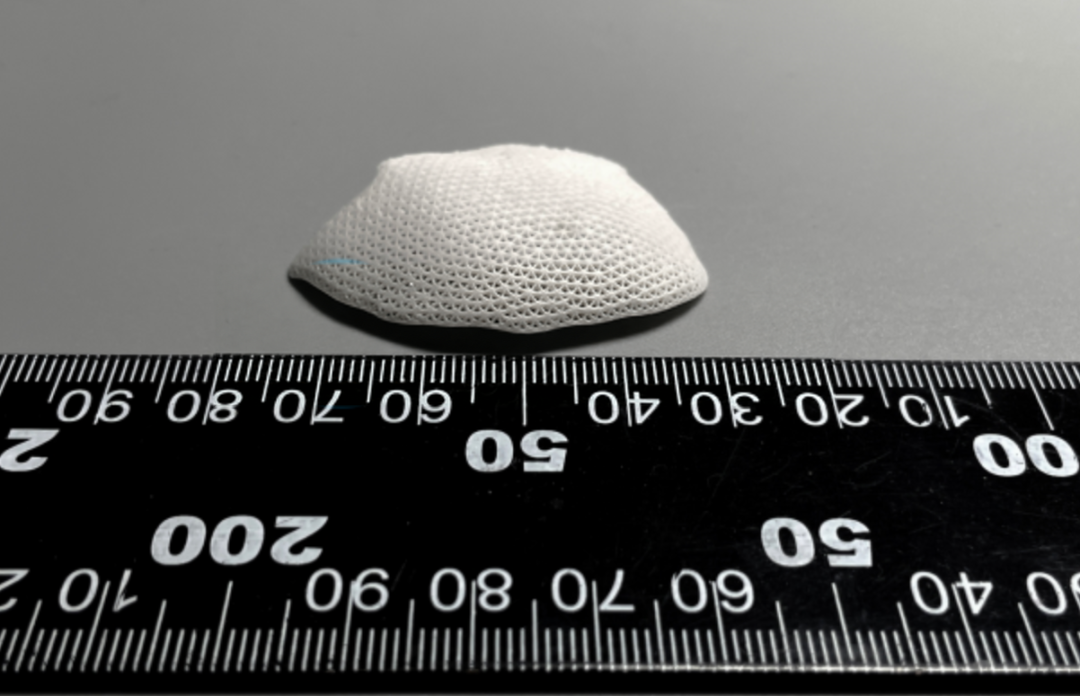
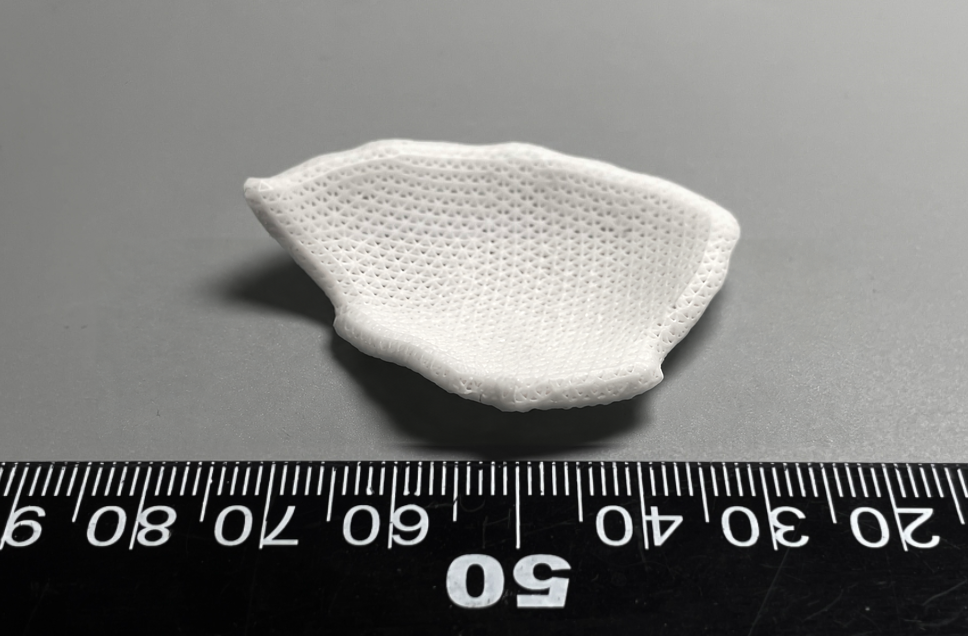
KUNWU printed human skull prosthesis