Structure design
Impact response and progressive collapse of porous ceramics
Hierarchical architecture redistributes local fracture and energy absorption; evaluation must consider impact direction and progressive-collapse mechanisms.
This KUNWU editorial note is based on the supplied technical source. Reported results belong to the described study or sample and are not KUNWU equipment specifications.
When talking about impact-resistant materials, the "hardness" of steel plates, the "softness" of foam, and the "smartness" of honeycomb aluminum may first come to mind. But there is a material that is generally considered to be "breakable at the touch of a touch" and is quietly making its presence felt in the field of impact protection: ceramics. It does not rely on being harder to carry, nor does it rely on softness to cushion, but relies on a set of exquisite structural designs. In this knowledge interpretation, we will start with "how to collapse".
Understanding the roots of brittleness
There is no lack of strength in ceramics. Many structural ceramics can have tens of millions of MPa in resistant strength and do not contain metal in numerical terms. The real short plate lies in fracture resilience: when the stress exceeds the threshold, the crack runs across the entire fault, with virtually no plastic transformation to buffer and absorb energy. And it turns out, once the load comes up, ceramics are not "conforming," but they're just "break."
This means that when traditional fine ceramics are hit, energy is almost entirely used to drive crack expansion, and there are not enough "indigestion" channels. If you want it to hold on to the shock, the idea is not "harder" -- it's only going to spread the cracks faster. A truly effective strategy would be to introduce a large number of controlled holes that would allow materials to continue to consume energy in the course of destruction, to break catastrophicly in one instant and to stretch into a gradual and predictable compression process.
Nature-inspired hierarchical porosity
What kind of pore structure do you need? The answer is hidden in nature. Mantis shrimp prestons can hammer the prey's hard shell unbreakable, pearls can withstand shocks far beyond their own strength, and animal bones are light and resilient. They share a common feature: multi-level, porous structures from nano to macroscale. There is a layer of frame skeletons at the macro level, and micro-pores in directional order. The force waves come in, they're refractioned, tilted, dispersed, and the cracks are "turned" every step, and the energy is consumed by layers in the process.
The difficulty in making ceramics that imitates this design is that the macro lattice and micro pores require different processing methods to be controlled separately, and both must coexist in the same part.
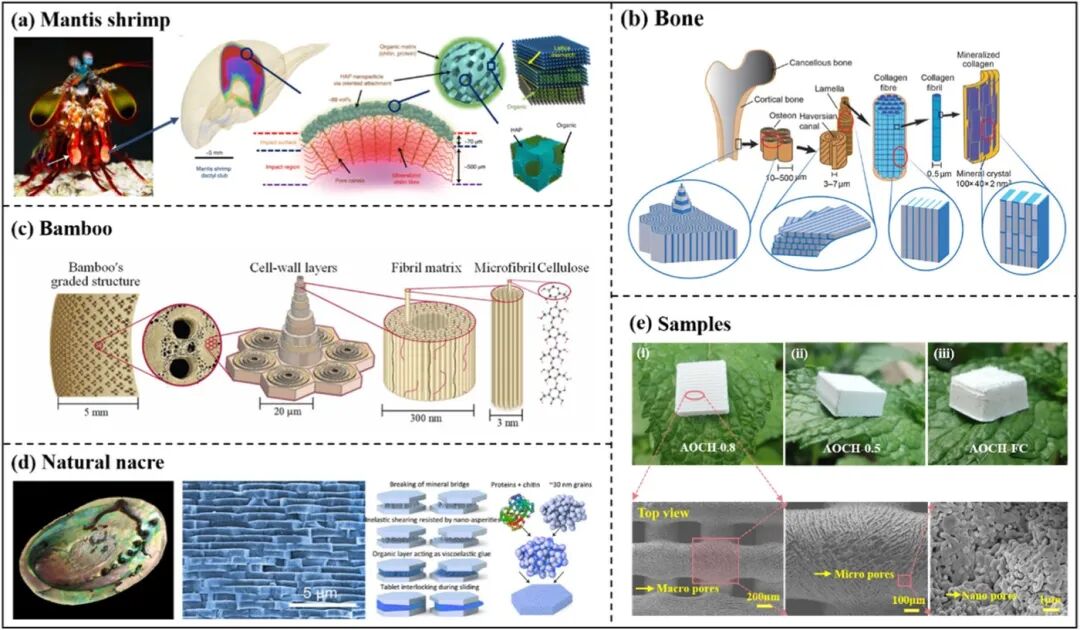
Combining printed macrostructures with freeze-cast micropores
Ceramic 3D printing is good at macro modeling and can accurately design the arrangement, wire spacing, and hierarchical structure of the lattice skeleton. However, its control over micron-sized pores is limited. In turn, freeze casting uses the growth direction of ice crystals to form neat microscopic channels, but it cannot create complex three-dimensional macro shapes. Both have shortcomings.
Combining them, the so-called "cryogenic 3D printing" idea is formed: first use 3D printing to extrude ceramic slurry and lay macro lattice, while allowing the water in the slurry to form ice crystals on a low-temperature platform, and then freeze-drying and sublimation to remove the ice crystals, leaving connected microscopic pores. In this way, the macroscopic skeleton comes from the printing path, and the microscopic pores come from the ice crystal template, and the two scales are realized simultaneously in the same part. This process is essentially an improved direct ink writing (DIW) technology. The introduction of a low-temperature platform allows it to also possess the microscopic pore-forming capabilities of freeze casting.
The stress–strain plateau as evidence of impact absorption
Does multi-level porous structure work? Using a split Hopkinson pressure bar (SHPB) for high strain rate impact testing is the most direct inspection method. In this type of experiment, the shape of the stress-strain curve is most telling. When traditional dense ceramics are impacted, the curve first quickly climbs to a sharp peak, then plummets and breaks. The whole process is extremely short and almost no energy is absorbed.
The curves for hierarchical porous ceramics are different. It will go through three stages: elastic section, platform section, and dense section. The elastic section is the initial response, and then enters a relatively flat "platform". The stress does not continue to rise with strain, but remains at a stable level. This means that the material continues to deform and absorb energy, but does not collapse. The longer and flatter the platform, the better the energy absorption effect. Finally, it enters the dense section, where the pores are compacted and the stress rises again.
Below are the stress-strain curves measured at different strain rates in this study. It can be seen that the higher the strain rate (the stronger the impact), the more obvious the plateau area is. This shows that the energy absorption advantage of the structure will be further amplified under high strain rates.
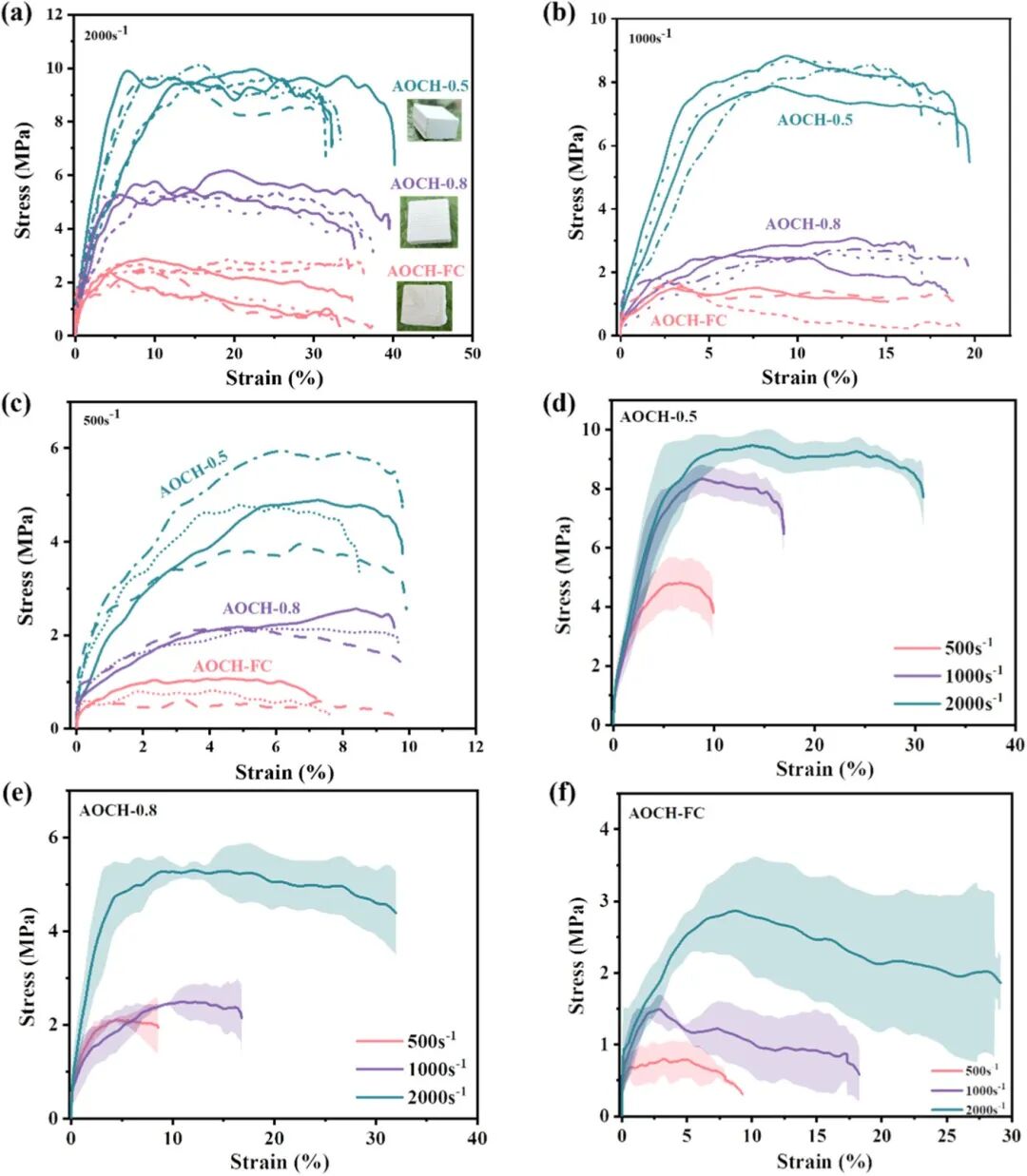
| Specimen | Porosity | Compressive strength at 2000 s⁻¹ | Plateau stress at 2000 s⁻¹ |
| Low-temperature printing, close filaments (0.5 mm) | 86.7% | 9.49 ± 0.18 MPa | 9.28 ± 0.46 MPa |
| Low-temperature printing, sparse filaments (0.8 mm) | 88.9% | 5.37 ± 0.32 MPa | 5.24 ± 0.39 MPa |
| Freeze casting | 87.2% | 2.44 ± 0.29 MPa | 2.04 ± 0.52 MPa |
The porosity of the three groups of samples is similar (all around 87%), but the mechanical performance is several times different. Under the impact of 2000 s⁻¹, the compressive strength of low-temperature 3D printed dense wire samples (wire spacing 0.5mm) is nearly 4 times that of freeze-cast samples, and the platform stress is also higher by the same proportion. The denser the wire spacing and the more uniform the skeleton, the easier it is for stress waves to quickly establish a dynamic balance within the material, and the pore collapse is more synchronous and the fluctuations are smaller.
Controlled collapse: comparison of two failure modes
High platform stress is just the result. What is more worthy of further investigation is "why it is high", that is, how the material is destroyed under impact load. High-speed cameras recorded two distinct failure processes.
Low-temperature 3D printed sample: collapse layer by layer from bottom to top. After the stress wave is transmitted from the incident rod to the sample, it first induces deformation in the bottom layer close to the transmission rod. The macropores are compressed layer by layer, the micropores then participate in the deformation, and the skeleton is compressed layer by layer. The damage started at the bottom and gradually propagated upward, with the top skeleton remaining intact during most of the loading process. This "layer-by-layer digestion" method ensures that the material continues to absorb energy over a long strain range, instead of collapsing first in one place and causing overall failure.
Refrigerated casting samples: Cracking from top to bottom. Again, the shock loads, while the cracks are first on the side of the sample, expanding rapidly in the direction of ice crystal growth. The pieces then began to fall from the top edge and were splattered. It is typical of a fragile fracture, without a layer-by-story buffer process and without efficient energy consumption.
The figure below visually demonstrates the difference between the two failure modes. The left column is a low-temperature 3D printed sample, and the right column is a freeze-cast sample. Also under the impact of 1000 s⁻¹, one gradually compacts and the other cracks and splashes.
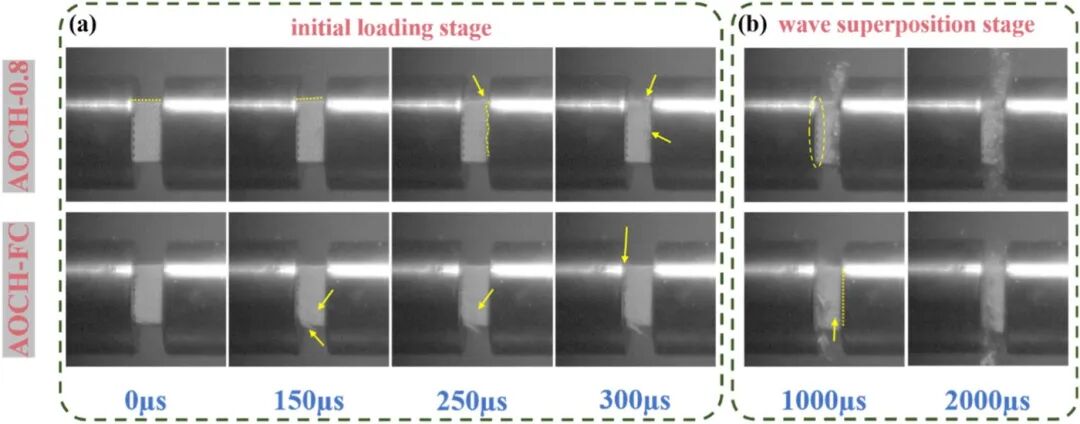
Why is there such a difference? The key is structural continuity. The 3D printed skeleton is connected in three-dimensional space. After one layer collapses, the stress will be absorbed by the adjacent layer. Although the channels of freeze casting are neat, they are arranged in one direction and lack lateral connections between layers. Once cracks occur, there is almost no obstruction along the direction of the channels.
This is further confirmed by the limited meta simulation. The concentration of stress areas in the 3D print samples showed a distribution of the "tetragrass" pattern, indicating an effective dispersion of stress at the cross-section of the skeleton. In frozen casting samples, stress is concentrated along a one-way pore line, with almost no deviation from the crack path.
The added benefit of lightweight design
In addition to their good impact resistance, multi-layered porous ceramics have an underrated advantage: they are lightweight. The porosity is nearly 90%, and the density is only 0.526 g/cm³, but the energy absorption density reaches 2.63 MJ/m³, and the specific energy absorption is about 5.0 kJ/kg. Putting it in the comparison chart of different material systems, it can be clearly seen that at the same density, it surpasses most polymer foams and polymer lattice materials, and can even compete with some lightweight metal foams, but the density is much lower than the latter.
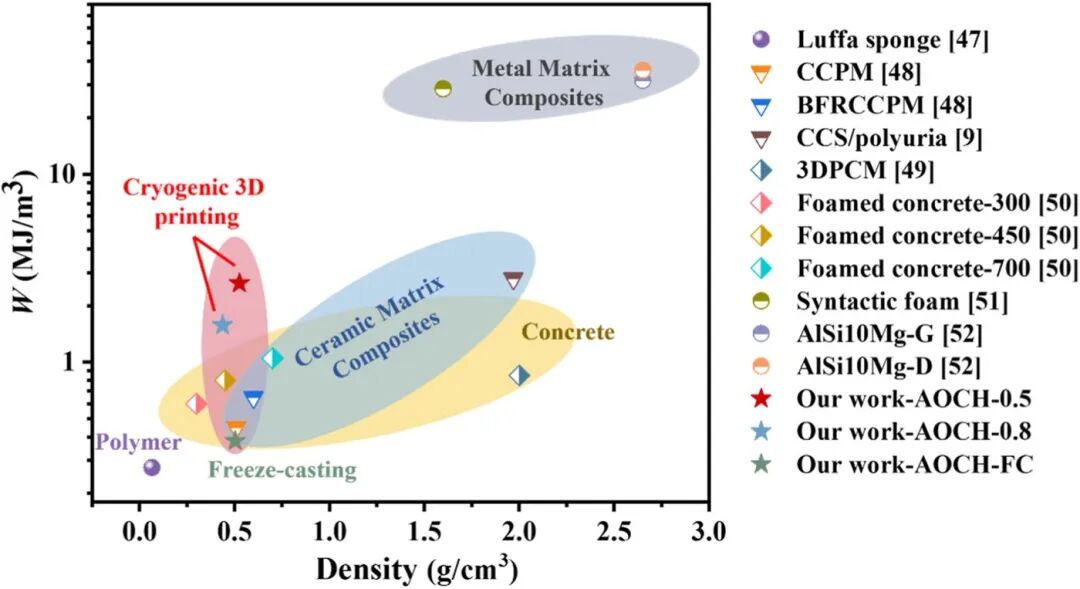
The three labels "energy-absorbing, light, and ceramic" appear at the same time, and are naturally attractive to extremely weight-sensitive application scenarios such as aerospace protective structures, armor linings, and traffic buffers. The porosity, pore diameter and skeleton direction of porous ceramics can all be designed in advance through the ceramic 3D printing path, which makes it possible to "customize energy absorption performance on demand".
Three concluding implications
Back to the original question. Whether ceramics can withstand impacts, the answer lies not in how hard the material itself is, but in whether its structural design can transform catastrophic fractures into progressive energy dissipation. Distill the above discussion into three lessons:
First, to resolve the contradiction between "strength and toughness", we cannot just focus on the ingredients. The introduction of multi-level porous structures is a general idea. This has been proven time and time again with natural materials, from bone to nacre.
Second, structure determines performance, and technology determines structure. Whether the macroscopic skeleton and microscopic pores can be produced at the same time directly determines the final performance. The composite process of 3D printing and freeze casting is the key link to bridge the two scales.
Third, when evaluating an impact-resistant material, a "plateau" on the stress-strain curve is more convincing than peak strength. Stable and long-lasting layer-by-layer collapse is closer to the needs of real impact scenarios than the highest instantaneous intensity.
For ceramic 3D printing, porous structure means designable density and programmable performance. Ceramics are moving from "precision but not impact-resistant" to "both precise and impact-resistant", and this road has just opened.
References
Gao, D., Zhu, Z., Huang, W., & Wang, T. (2026). Bioinspired hierarchical porous ceramics via cryogenic 3D printing: superior energy absorption and strain-rate dependent failure mechanisms. Ceramics International, 52(13), 13579–13592. https://doi.org/10.1016/j.ceramint.2026.02.006