Applications
Monolithic catalyst support for N₂O conversion
The study connects surface area, lattice strength and long-duration catalytic stability in a monolithic support.
This KUNWU editorial note is based on the supplied technical source. Reported results belong to the described study or sample and are not KUNWU equipment specifications.
The greenhouse effect of N₂O (nitrous oxide) is 310 times that of carbon dioxide. Direct catalytic decomposition is the mainstream path for industrial exhaust gas treatment; however, traditional particle catalysts are easy to pulverize and sinter under high-temperature airflow, have a large bed pressure drop, and rapidly decay in performance.
Using the ADT-3D-ZP-Printer-96-50 ceramic 3D printer, a team from the School of Aerospace Science and Engineering of the National University of Defense Technology prepared a high-strength, high-specific-surface-area monolithic Ir/LMA carrier using light-curing molding and in-situ solid-state reaction. "in-situ solid-state reaction-assisted light curing molding" was published in "Ceramics International" (2026). After sintering at 1350°C, the carrier has a specific surface of 10.20 m²/g and a compressive strength of 97.62±22.20 MPa; the decomposition T50 of N₂O after loading Ir is about 50°C lower than that of the granular catalyst, and the stable operation for 72 hours is close to 100% conversion.
Paper title page · Ceramics International 2026
1. Industry pain points: Granular catalysts cannot withstand high-temperature N₂O decomposition
N₂O (nitrous oxide) is not only a strong greenhouse gas (GWP is 310 times that of CO₂ and 30 times that of CH₄), but it is also one of the main culprits in destroying the ozone layer. It is mainly derived from high-temperature exhaust gases such as nitric acid production, adipic acid plants, and fossil fuel combustion in industry. Direct catalytic decomposition has become a mainstream path due to its low energy consumption and high efficiency. However, this path has a hard constraint: N₂O decomposition ΔH = −82.1 kJ/mol is highly exothermic, and the adiabatic temperature rise can reach 1100–1300°C. Under such working conditions, the catalyst carrier and active metal are easily sintered and agglomerated, and the activity and stability collapse.
Granular catalysts are currently the most used in industry, but they have two structural shortcomings: First, the flow channel of the particle accumulation bed is distorted, resulting in large air flow resistance and significant pressure drop; second, under long-term erosion by high-pressure air flow, friction and collision between particles will cause grinding and pulverization, forming internal channels and gas short circuits, further aggravating local overheating. To put it simply: granular catalysts cannot support either strength or service life under high-temperature N₂O conditions.
Monolithic ceramic carriers are generally regarded as a more promising direction - regular flow channels, low pressure drop, and good mechanical strength. However, it is not easy to achieve high specific surface + high strength + high porosity at the same time. The team in this article has set its sights on light-curing ceramic 3D printing.
2. Ideas to solve the problem: light curing molding + in-situ solid phase reaction
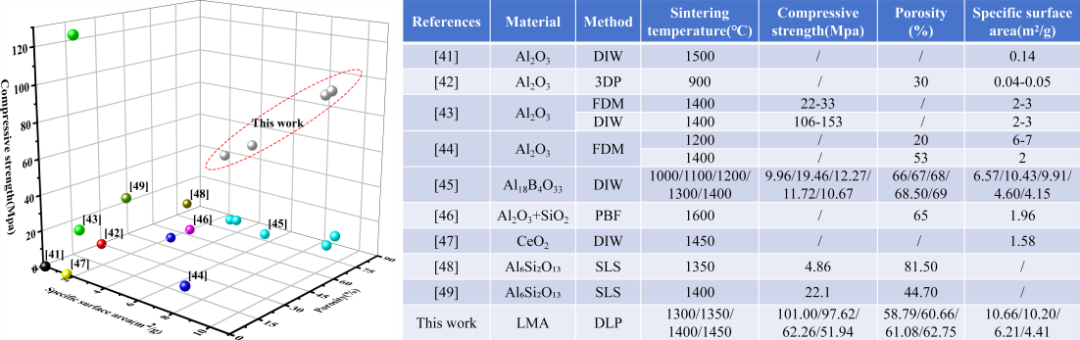
The pain point of the traditional increase in the manufacture of ceramic carriers is an old paradox: the density and intensity of the vectors are to be burned enough to burn the temperature; but once the temperature rises and the temperature is kept longer, it collapses more than the surface. Al2O3 carriers, commonly found in the literature, such as DIW, FDM, SLS, have porosity drops to about 2 m2/g on the surface; and the strength goes up to the surface and can't hold back (this track-off is clearly written in the comparative table of literature given by Fig 7 here).
LMA (LaMgAl₁₁O₁₉, magnesium-based hexaaluminate) is naturally suitable for this working condition: it is a magnetoplumite-type layered crystal, alternately stacked by mirror layers and spinel block layers. The high aspect ratio lamellar structure allows the grain contact area to be small and the surface energy to be high, so it has excellent high temperature resistance and sintering resistance. LMA in the form of powder/granules has proven itself in high-temperature catalytic scenarios such as methane dry reforming and NOx reduction, but there have been few previous reports of making it into a monolithic carrier.
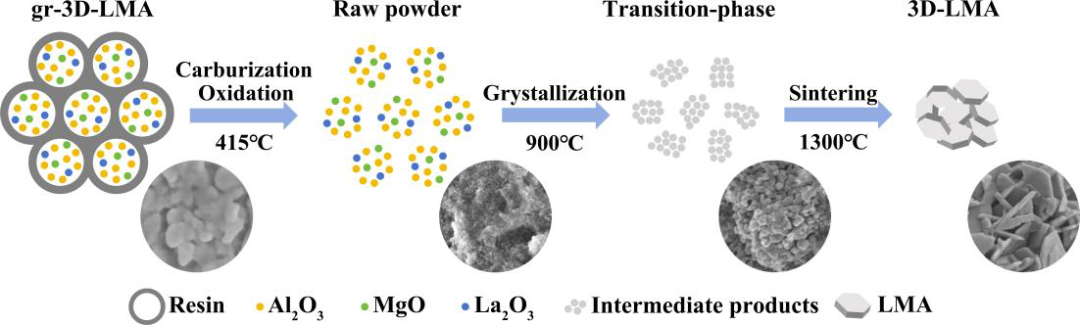
The team changed an idea: instead of synthesizing LMA powder first, printing and then sintering (the high-temperature solid-state method to synthesize LMA itself requires ≥1300°C, the specific surface is inherently low, and it will collapse after burning once), but directly mix the three raw material powders of Al₂O₃/MgO/La₂O₃ into a photosensitive slurry at a molar ratio of 5.5:1:0.5, print out a monolithic green body, and then make it during the sintering process. LMA in-situ phasing - printing in one step, molding and phasing simultaneously.
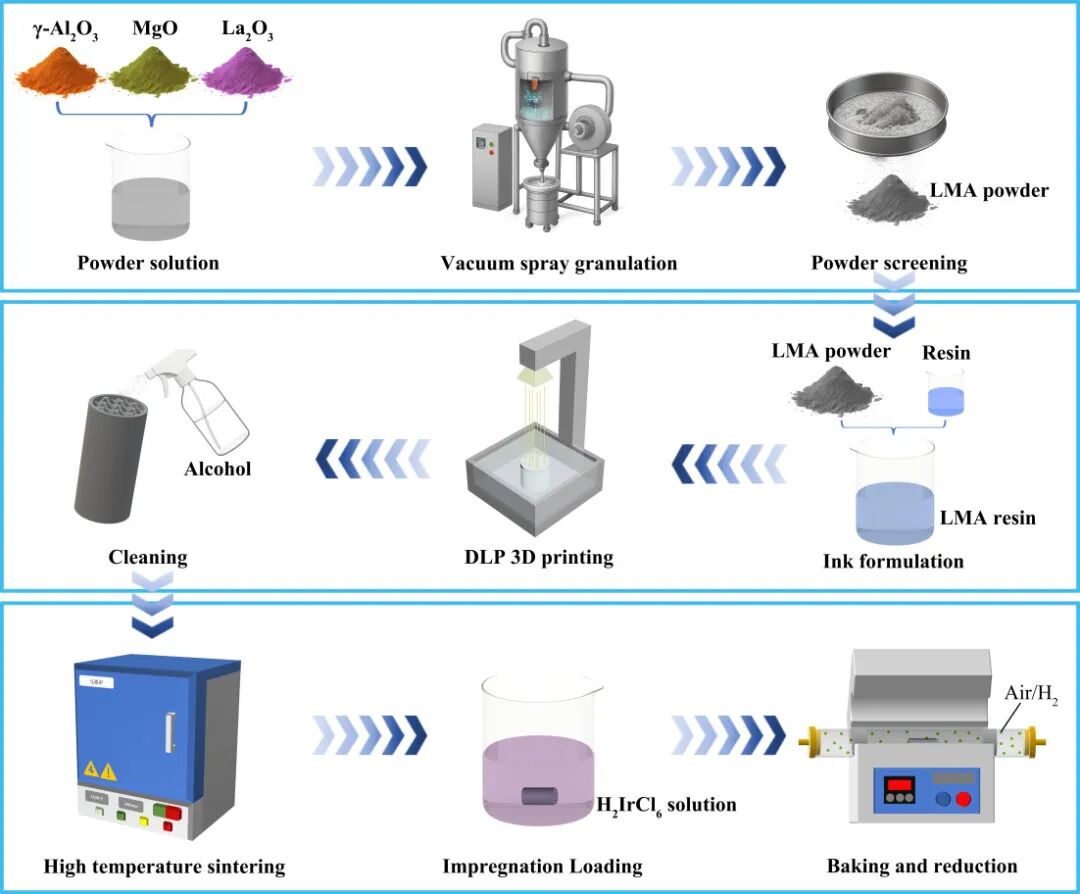
The printing process uses ADT-3D-ZP-Printer-96-50 ceramic 3D printer (DLP light curing molding), with KUNWU H001 photosensitive resin, slurry solid content 45 wt%; printing parameters are: exposure power 30 mW/cm², exposure time 1 s, scraper speed 120 mm/s, layer thickness 90 µm (corresponding curing depth 150 µm, set at a curing depth ≈ 60% of the layer thickness to ensure interlayer bonding).
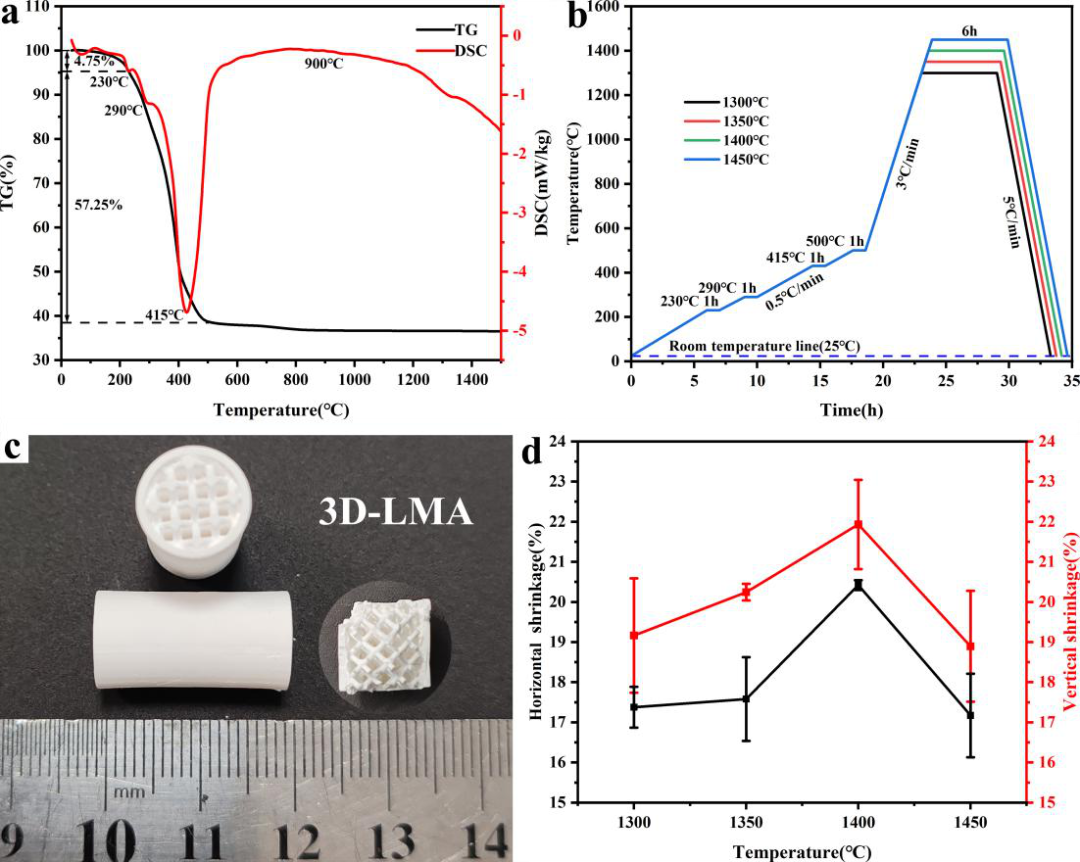
The sintering process is a multi-stage heat preservation process tailored based on TG-DSC: heat preservation for 1 hour each at the three exothermic peaks of organic matter decomposition at 230°C, 290°C, and 415°C to ensure complete oxidation and drainage of the resin; and then heat preservation for 6 hours in the range of 1300–1450°C to regulate the growth of LMA grains and the densification of the carrier to obtain a monolithic carrier with no cracks, complete internal channels, and uniform shrinkage (Fig. Regular channel structure visible in 4c).
3. Performance results: Strength, specific surface area, and porosity are all achieved
The performance results fall in the sweet spot of sintering at 1350°C: specific surface 10.20 m²/g, porosity 60.66%, compressive strength 97.62±22.20 MPa. Three pieces of data are online at the same time. Looking at each item individually may not be the ultimate, but put together, it solves the contradiction between the strength and specific surface of conventional 3D printing ceramic carriers.
| Sintering temperature (°C) | Specific surface area (m²/g) | Pore volume (ml/g) |
|---|---|---|
| 1300 | 10.66 | 2.63×10⁻² |
| 1350 | 10.20 | 2.24×10⁻² |
| 1400 | 6.21 | 1.47×10⁻² |
| 1450 | 4.41 | 1.07×10⁻² |
A sharp change can be seen from the table: the specific surface drops sharply from 10.20 after 1350°C to 6.21 at 1400°C and 4.41 m²/g at 1450°C. This is because the LMA grains begin to coarsen rapidly after 1350°C (from 549 nm to 598 nm, and then to 827 nm), the pore structure changes from mainly mesopores of 5–20 nm to macropores of 20–35 nm, and capillary condensation weakens—the specific surface therefore collapses.
4. In-situ phase formation mechanism + catalytic performance after installing Ir
The combination of these routes is crucial: on the one hand, solidification in form encapsulates the raw powder with resin in the geometric structure of the rules, carbide and oxidizes the resin first during heating, and leaves a flat spatial spacing between particles, which is the basis for the structure of macro-high pore rates and avoids particle conjunction holes; on the other hand, after the resin has been burned, the remaining powder should be fixed in place at the sintering temperature to produce LMA, a moderate combination of the crystal particles, which is the strength of the material instinct and the guarantee of high temperature tolerance. In combination, process control macrostructure + material control properties take effect simultaneously.
This carrier is loaded with precious metal Ir (supersaturated impregnation five times, 30 min each time, ICP measured 8.91 wt%; after hydrogen reduction, metal Ir is obtained, with nanoparticles 2–6 nm, average 3.24 nm, mainly exposed (111) crystal plane), which is the 3D-Ir/LMA monolithic catalyst.
The catalytic performance is directly compared to the standard particle catalyst (GC-Ir/LMA) in the N₂O fixed bed reaction: under the conditions of 30 vol% N₂O + 70 vol% Ar, 100 ml/min, WHSV 60000 cm³·h⁻¹·g⁻¹, the T50 (50% conversion temperature) of 3D-Ir/LMA is only 227.60°C, about 50°C lower than the particle catalyst's 277.11°C; T90 (90% conversion temperature) of 261.71°C, about 85°C lower than the particle's 346.48°C.
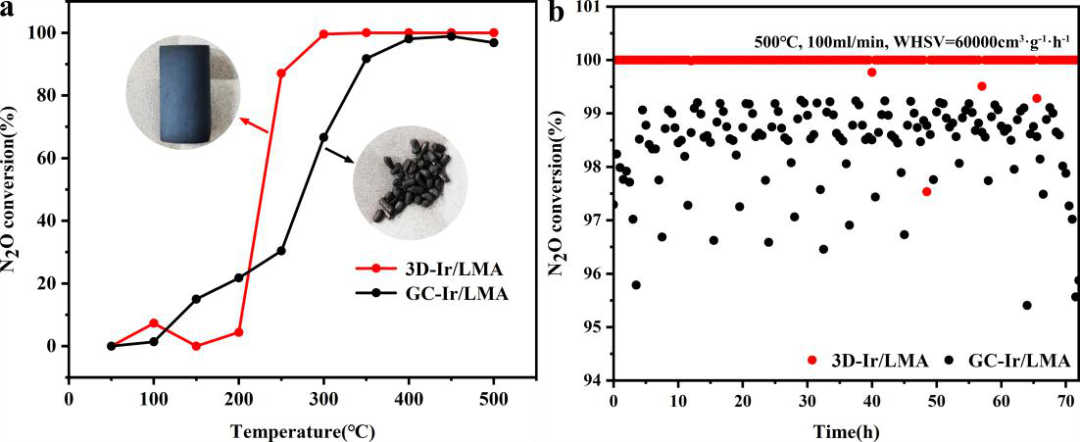
The 72-hour stability test at 500°C further illustrates the problem: 3D-Ir/LMA almost maintained a conversion rate of 99–100% throughout the entire process, with occasional slight fluctuations; the GC-Ir/LMA particle bed continued to oscillate between 95–99%. The reason is that the particle bed rubs and vibrates with each other under the erosion of the air flow, which will cause local collapse of the bed and uneven gas distribution. These are the two structural shortcomings of the particle catalyst mentioned at the beginning. The integral regular channel of 3D-Ir/LMA naturally avoids these two obstacles.
Conclusion: From “Choose One of Two” to “Have All Three”
Taken together, the core value of this research is not to push a certain number to the extreme, but to use light-cured ceramic 3D printing + in-situ solid-state reaction to prove that the monolithic LMA carrier can simultaneously achieve high porosity + high specific surface + high strength triangle, and directly transform this structural advantage into N₂O catalytic decomposition activity and 72-hour stability gains. For N₂O emission sources such as the nitric acid industry, adipic acid plants, and high-temperature exhaust gases from fossil fuels, this is a process path that does not rely on additional sintering aids or external high pressure.
Taking this route apart, what is really worth learning is the idea of printing the green body first and then forming the phase in situ: decoupling the forming and phase formation, allowing the raw material powder to grow into the target phase by itself during sintering. As long as the raw material system can generate the target phase in situ at the sintering temperature, light-curing molding has the opportunity to make difficult-to-sinter ceramics into complex monolithic components. This type of high-specific surface + high-strength monolithic catalyst will have the confidence to move from the laboratory to high-temperature N₂O emission reduction sites.
Reference papers
WANG Wei, WANG Song, YU Yiping, LI Wei. Preparation of high-strength, high-specific-surface-area monolithic Ir/LMA catalysts through in-situ solid-state reaction-assisted light curing molding. Ceramics International, 2026 (in press). DOI: 10.1016/j.ceramint.2026.01.485