Applications
University research on a monolithic SiC catalyst
A university research team studies a DLP-printed honeycomb SiC support for a high-temperature sulfur-based hydrogen cycle and compares catalyst systems.
This KUNWU editorial note is based on the supplied technical source. Reported results belong to the described study or sample and are not KUNWU equipment specifications.
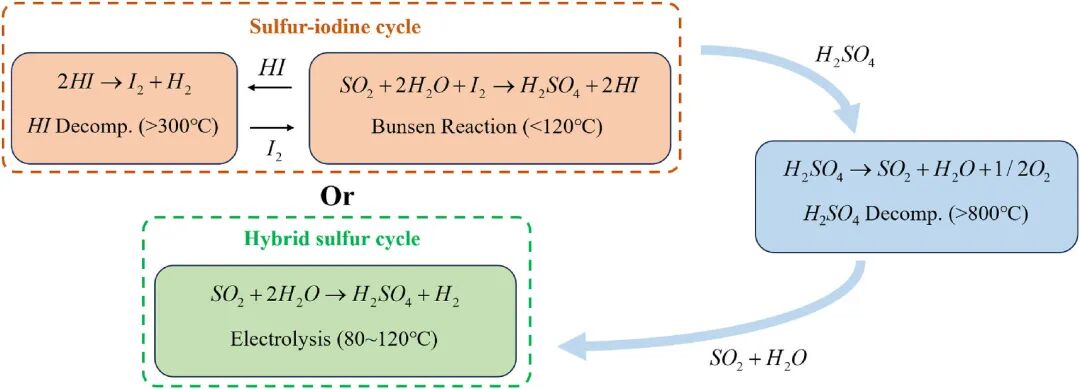
Hydrogen is generally regarded as the energy carrier for the future, but where the hydrogen comes from is always an unavoidable engineering problem. Direct pyrolysis of water requires a high temperature above 2200°C, which is difficult to bear in reality; sulfur-based thermochemical cycle is a compromise route promoted by various countries, which can significantly lower the temperature. The key step in this cycle is the decomposition of sulfuric acid (H₂SO₄ → SO₂ + H₂O + ½O₂, 800–900°C). However, the kinetics are extremely stubborn. It must rely on a catalyst to run, and it must be able to withstand conditions of high temperature, strong corrosion, and high water vapor.
The team of the National Key Laboratory of Clean Energy Utilization, a university research team, used the KUNWU industrial-grade DLP ceramic 3D printer and its ADT-SiC-TH01L photosensitive resin to print porous monolithic honeycomb silicon carbide in one step, and then impregnated and loaded binary metal oxide catalysts. The relevant results were published in the International Journal of Hydrogen under the title "Design monolithic honeycomb SiC catalysts via industrial-grade DLP 3D printing technology for practical sulfur-based thermochemical hydrogen production" Energy” (2026). The results show that the sulfuric acid decomposition rate of Cu–Al/SiC catalyst is stable at about 84%, and that of Cu–Fe/SiC is stable at about 74%. The decomposition rate hardly decays after continuous operation for 24 hours at 850°C, which is much better than the powder catalyst.
Paper title page · International Journal of Hydrogen Energy 2026
1. Why is the "sulfuric acid decomposition" of sulfur-based hydrogen production a hard nut to crack?
The general idea of sulfur-based thermochemical hydrogen production is to use several reactions of sulfuric acid + iodine/water to split water into hydrogen and oxygen, and then separately recover the by-products and circulate them back to the furnace. Among them, the decomposition of sulfuric acid is a necessary step at the high temperature end: first decompose H₂SO₄ into SO₃ + H₂O above 450°C, and then decompose SO₃ into SO₂ + ½O₂ at 800–900°C. Both steps are endothermic, and the overall reaction adiabatic temperature often exceeds 1100°C.
The second step of SO₃ decomposition is thermodynamically feasible, but the kinetics are extremely unfavorable, and it is almost impossible without a catalyst. Existing precious metal catalysts have high activity, but their cost and stability cannot support continuous operation at the industrial level; metal oxides (especially binary systems such as Cu–Al, Ce–Cu, Cu–Fe, Fe–Cr) are a more realistic direction, but they commonly encounter three old problems: particle agglomeration leads to the reduction of active sites, long-term loss of active metals in corrosive atmospheres, and sulfation poisoning and deactivation of catalysts.
Almost all the relevant studies were concentrated on powder catalysts, and the test device had to pile large pieces of iron oxide particles — difficult to form, poor density, long-cycle operation of the sub-bed structure — which would also pollute and collapse. To move towards industrial-grade stabilization of hydrogen, the catalyst must be integrated, designed and capable of carrying the sulphuric acid environment. The team turned to photo-consolidated ceramic 3D printing.
2. Industrial-grade DLP printing of monolithic honeycomb SiC
Monolithic catalysts have two innate benefits in sulfuric acid decomposition: regular flow channels reduce gas resistance, and the skeleton strength can prevent pulverization and collapse at high temperatures. The problem is that SiC is a difficult-to-sinter ceramic, and traditional molding either cannot produce complex geometries, or the cycle is long and the cost is high. DLP (Digital Light Processing) light curing molding can first print the green body and then form the phase in situ in one step. It has large geometric freedom and fast cycle time, and is suitable for making integral honeycomb carriers. The team in this article uses light-curing ceramic 3D printing to achieve this in one step.
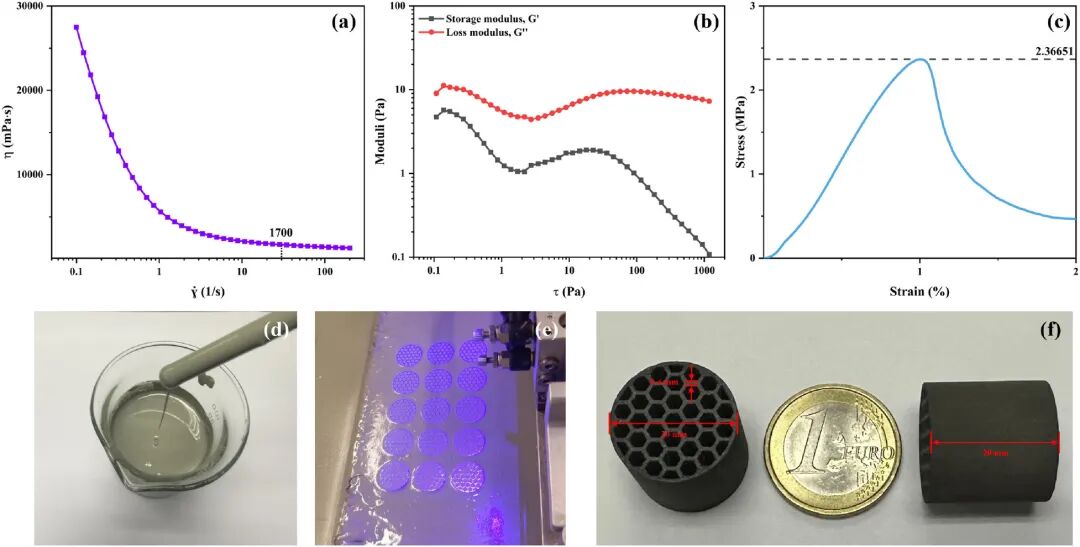
The printing process uses a KUNWU industrial-grade DLP printer, paired with ADT-SiC-TH01L photosensitive resin, which is mixed with high-purity SiC powder (>99.9%) at a mass ratio of 1:4, vacuum stirred for 2 hours to degas; after printing, it is cleaned with ethanol, and then kept at 600°C in a nitrogen atmosphere for 2 hours to debind, and finally kept at 1000°C in a muffle furnace for 4 hours. The ceramicization was completed within hours, and a stable porous honeycomb SiC scaffold was obtained. The integral structure not only ensures regular channels, but also combines the catalyst carrier + reactor skeleton into one.
3. Decomposition rate and 24-hour stability
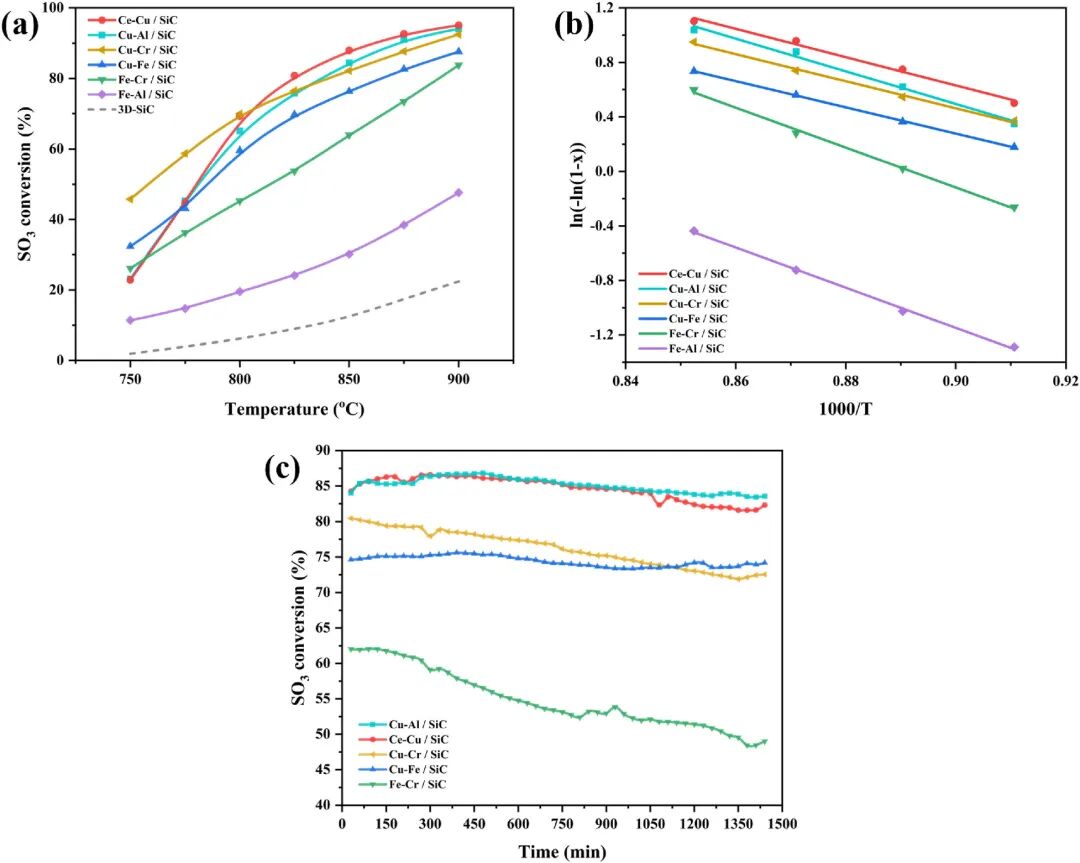
Catalyst evaluation was performed in a tube furnace + 98% H₂SO₄ + N₂ (500 ml/min) in a real acid vapor environment, WHSV 12 g acid·g⁻¹·h⁻¹, temperature range 750–900°C, long-term stability run at 850°C for 24 hours. The following table gives the T₅₀/T₈₀, activation energy Ea and decomposition rate after 24h of six binary catalysts.
| Catalyst | T₅₀ (°C) | T₈₀ (°C) | Ea (kJ/mol) | Decomposition after 24 h at 850 °C |
|---|---|---|---|---|
| Cu–Al/SiC | 781 | 837 | 99.62 | ~84%, negligible decline |
| Ce–Cu/SiC | 780 | 825 | 86.33 | 84.3% → 82.3% |
| Cu–Fe/SiC | 785 | 865 | 79.98 | ~74%, negligible decline |
| Fe–Cr/SiC | 814 | 890 | 121.67 | Significant decline; Cr loss |
| Cu–Cr/SiC | 758 | 840 | 82.61 | Significant decline; Cr loss |
| Fe–Al/SiC | >900 | >900 | 122.53 | Lowest activity; stability not tested |
From the decomposition rate curve (Figure 3 a), the order under the working condition of 825–875°C is: Ce–Cu/SiC > Cu–Al/SiC > Cu–Cr/SiC > Cu–Fe/SiC > Fe–Cr/SiC > Fe–Al/SiC. Among them, Ce–Cu/SiC started the fastest (T₈₀ 825°C), but dropped from 84.26% to 82.32% after 24 hours (due to particle agglomeration and accumulation of sulfation); Cu–Al/SiC and Cu–Fe/SiC really exceeded the industrial-level stability—both showed almost no decay for 24 hours, with decomposition rates stable at 84% and 74% respectively, and deactivation rates lower than 1%; the activity of catalysts containing Cr is significantly reduced due to the loss of Cr during the reaction, and the stability is the worst.
4. Mechanism Highlights and Comprehensive Evaluation
Why are Cu–Al/SiC and Cu–Fe/SiC both stable and reactive? The mechanism comes from two lines: first, the chemically adsorbed oxygen/lattice oxygen content is high and the desorption temperature is suitable (O₂-TPD shows that both still have desorption peaks near 900°C), which gives the catalyst the ability to continuously supply surface active oxygen - which is exactly what is needed for the oxidative decomposition of sulfuric acid; second, the SiC carrier itself is corrosion-resistant, has good thermal conductivity, and is resistant to sulfate poisoning. The Si:C atomic ratio is stable at 1:1 before and after the reaction. Although the active metal is partially lost, the skeleton does not collapse.
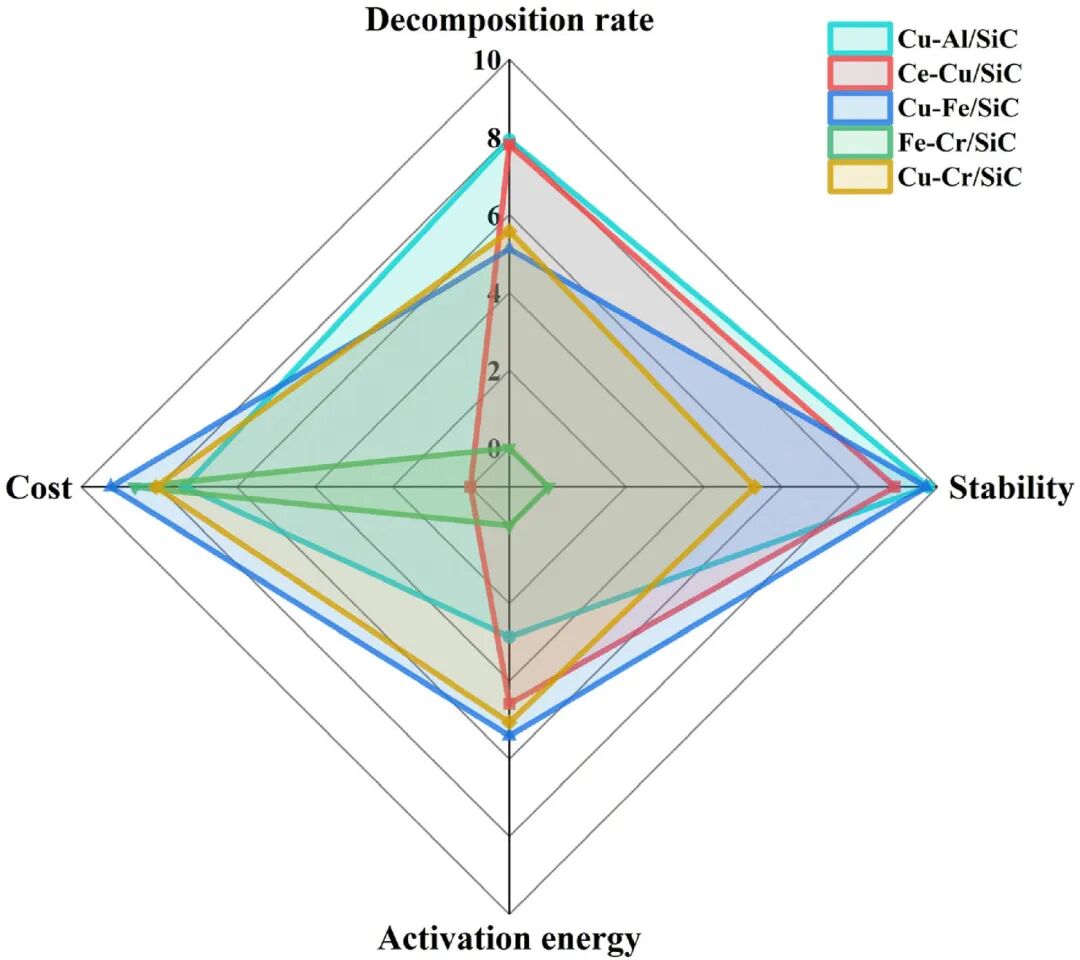
Comparing the six catalysts on the four-dimensional radar chart of decomposition rate/activation energy/stability/cost, the conclusion is very clear: Cu–Al/SiC scored more than 8 points in both decomposition rate and stability dimensions, making it the one with the most balanced overall performance; Cu–Fe/SiC cost only a fraction of it (iron is far cheaper than the loading of copper), making it an economical choice for industrial scale-up; although the initial activity of the two catalysts containing Cr was acceptable, the stability dimension was lowered, mainly because of Cr Loss during the reaction and contaminates downstream. Overall, the monolithic honeycomb SiC + binary metal oxide route has the foundation to move from the laboratory to the industrial continuous hydrogen production site.
Conclusion: From the laboratory to the industrial hydrogen production site
Taken together, the core value of this research is to pull the integrated honeycomb SiC catalyst, a ceramic 3D printing integrated route, out of the limitations of powder catalysts - the regular flow channel solves the bed pressure drop, the skeleton strength solves the powder collapse, and the corrosion resistance and thermal conductivity of SiC itself suppresses the risk of sulfate poisoning of active metals. Once this route is coupled with the heat source of high-temperature solar collectors or high-temperature gas-cooled reactors, the engineering of sulfur-based thermochemical hydrogen production will have a more stable catalyst.
For the direction of high-temperature catalysis and energy catalysis, this set of ideas can also be used for reference: the integrated molding of the carrier + the decoupling of the impregnation load allows the difficult-to-process high-melting-point, high-corrosion-resistant ceramics to first print out the structure and then fill in the active phase. As long as the carrier itself can sustain the target temperature and corrosive atmosphere, the back-end active system can iterate more freely. The key next step is to push such monolithic catalysts from 5-gram laboratory pieces to industrial-scale reactors and verify continuous operation under coupled conditions closer to real heat sources (solar simulations, high-temperature reactors).