Process engineering
A multi-material denture interface
Co-forming different compositions requires control of interface definition, interfacial bonding and shrinkage matching during co-sintering.
This KUNWU editorial note is based on the supplied technical source. Reported results belong to the described study or sample and are not KUNWU equipment specifications.
The artificial teeth and base of removable dentures have traditionally relied on light-curing glue to bond the two separately printed parts together. Microvoids, insufficiently polymerized monomers, and stress concentration points inevitably remain in the adhesive layer. They are prone to debonding and fracture under long-term chewing loads or thermal cycles, which is one of the main risks of clinical rework.
Guangzhou Medical University School of Stomatology and other teams used the ADT-3D-MT-48-25 multi-material DLP printer to mold artificial teeth and bases at one time. The relevant results were published in "Dental Materials" (2026) under the title "Multi-material DLP printing for denture materials: Investigation of surface characteristics, physico-mechanical properties, and cytocompatibility", and systematically verified key indicators such as interface strength, water absorption and dissolution behavior, and cytotoxicity. The results show that compared with the traditional bonding group, the interfacial shear strength of the multi-material integrated molding group is increased from 7.96 MPa to 17.78 MPa, and 100% shows cohesive failure - the interface is no longer the weakest point of the structure.
Paper title page · Dental Materials 2026
Why integrate removable dentures in one build?
Let me ask a simple question first: Removable dentures are available everywhere, why do they have to be "molded in one go" instead of printing them separately and then bonding them? The key is the reliability of the interface. Artificial teeth need high hardness and wear resistance; the base needs sufficient toughness and resilience. In order to meet these two properties, the conventional idea is to "print separately and then stick them together", but the bonding interface is essentially a transition zone between two materials and two polymerizations, and it is easy to leave unreacted monomers, microvoids and stress concentration points.
More troublesomely, these defects become a source of cracks in chewing loads or heat cycles. The assessment by ISO 20795-1, ISO 6872, among others, found that the interface of the traditional bonding group (PT-PB) was only 7.96 ± 2.03 MPa and that the destruction pattern was dominated by adhesive and mixed damage - the interface, which remained the weakest link in the structure.
Printing: two vats and multi-material slicing
In order to complete the artificial teeth and base on the same equipment, the ADT-3D-MT-48-25 multi-material DLP printer was used in the study. Its working logic can be summarized in one sentence: double trough + automatic cleaning + slice merging.
The construction platform moves between Vat 1 (base resin) and Vat 2 (artificial tooth resin), the sponge groove scrapes off excess resin, and the light machine exposes the slices layer by layer. When the same layer contains two materials at the same time, the system will complete the curing in different troughs, and then merge the two layers into a complete cross-section. This step is critical because inconsistent curing at the junction of the two resins will leave defects at the interface that can be the source of subsequent strength and biosafety issues.
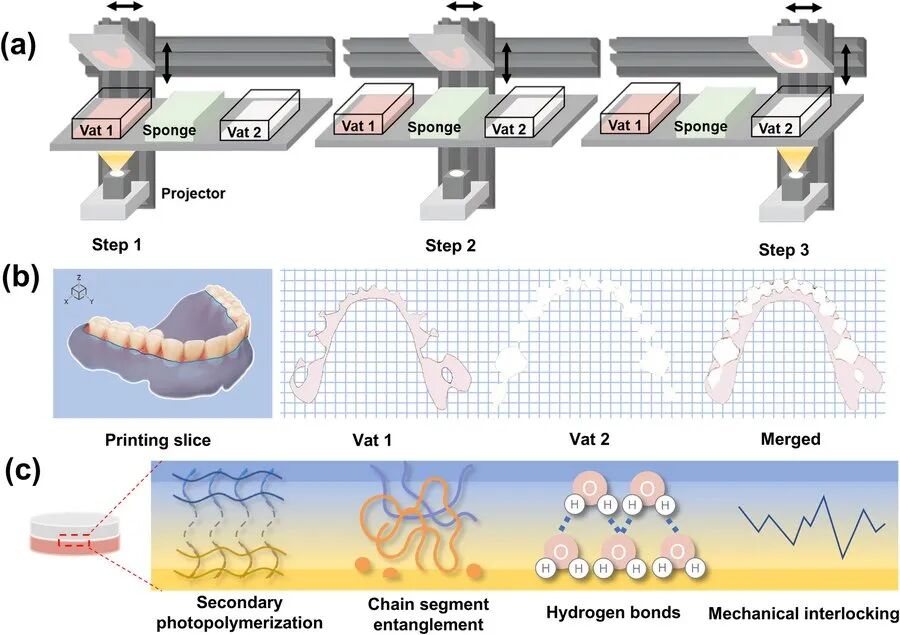
Compared with the traditional process of "printing → cleaning → alignment → bonding → re-solidification", multi-material one-time molding integrates the manufacturing of artificial teeth and bases into the same construction platform. In theory, this could eliminate separate bonding layers and allow the two resins to form a more continuous structure at the interface through secondary photopolymerization, segmental entanglement, hydrogen bonding, and micromechanical interlocking.
Interface strength: bonded versus integrated
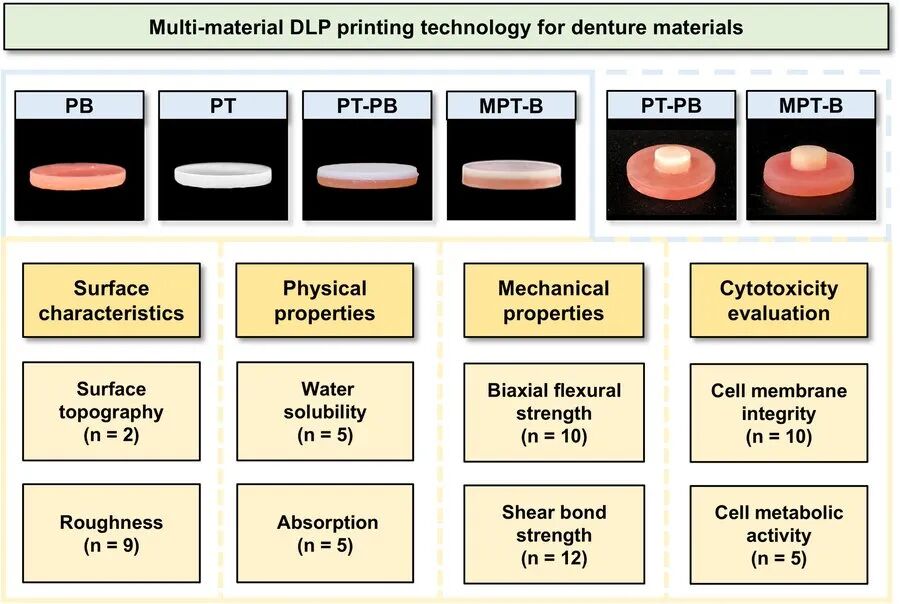
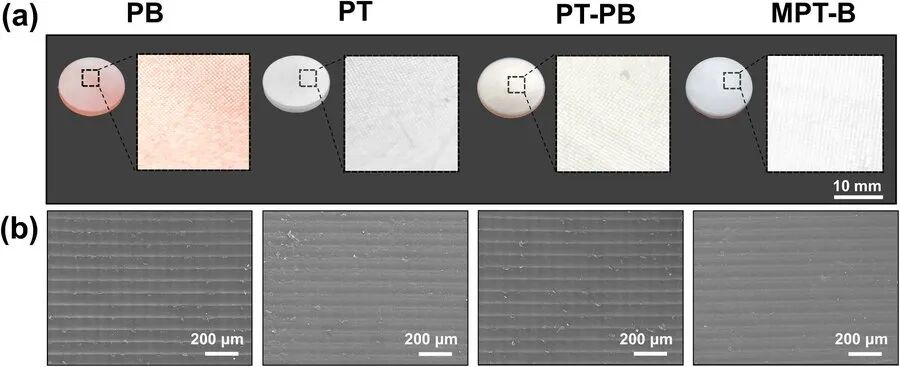
The finished prototype also proves that "the interface has really become stronger." The study conducted a systematic evaluation of surface properties, water absorption/dissolution, biaxial bending and shear bonding strength of four groups of samples.
In terms of shear bonding strength, the traditional bonding group PT-PB is 7.96 ± 2.03 MPa, while the multi-material one-shot molding group MPT-B reaches 17.78 ± 3.22 MPa, an increase of about 123% (p < 0.0001). More importantly, MPT-B all showed cohesive failure - the fracture occurred inside the base material, indicating that the interface is no longer the weakest point of the structure; while PT-PB still showed mainly bonding failure and mixed failure.
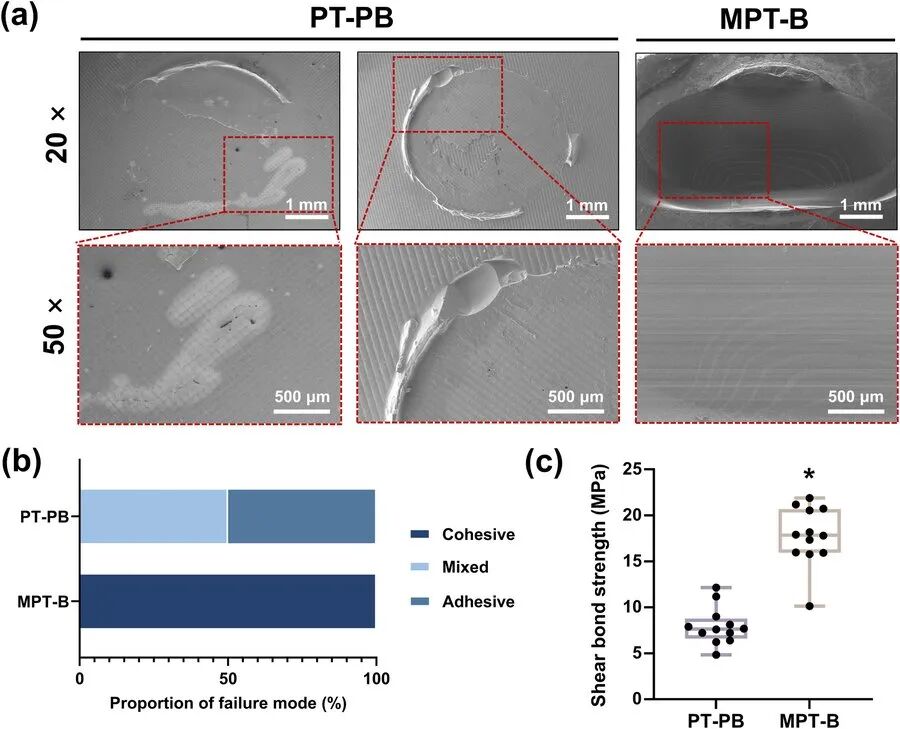
The water absorption and dissolution dimensions also confirm this. The water absorption rate of MPT-B is 5.86 ± 0.68 µg/mm³, which is lower than 9.81 ± 2.99 µg/mm³ of PT-PB; in terms of solubility, MPT-B is -4.07 ± 0.81 µg/mm³ (negative values mean that the weight gain is mainly due to water absorption and less dissolution), while PT-PB is 0.78 ± 0.37 µg/mm³ (positive values indicate the presence of more soluble components at the interface). The interface is more continuous, and long-term dimensional stability and wearing comfort are more guaranteed.
Biosafety: cytotoxicity testing
For dentures that enter the mouth, "strengthening the interface" is not enough, the material itself must be proven to be safe. The study conducted a cytotoxicity evaluation on each group of samples in accordance with ISO 10993-5: the relative metabolic activity of all groups was higher than the 70% threshold, and the LDH release was lower than the 30% threshold. Calcein-AM/PI staining showed normal cell morphology and no obvious cytotoxicity.
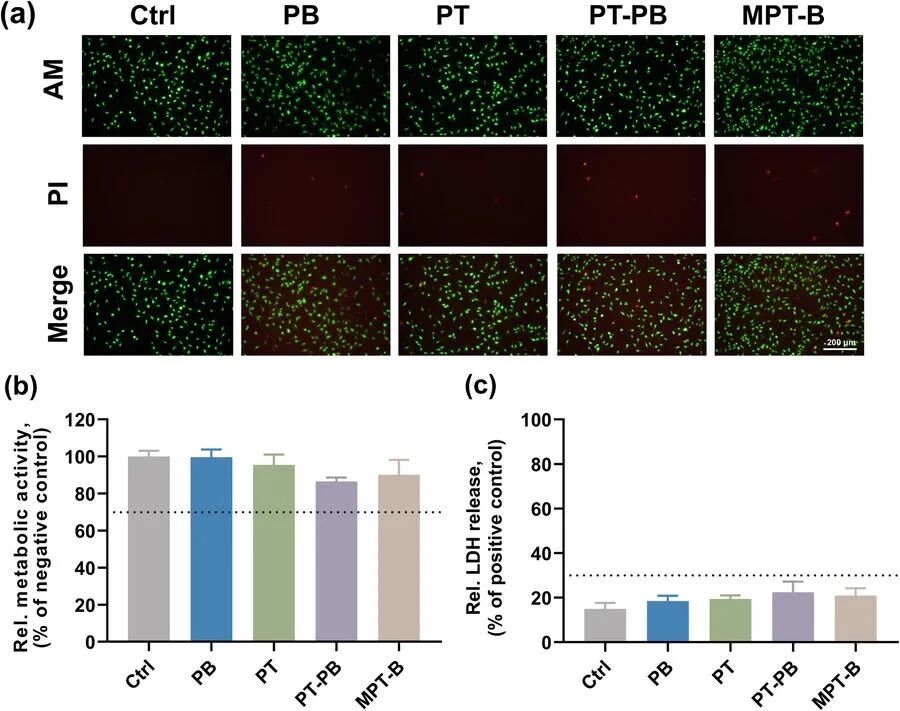
This indicates that multimaterial DLP-printed rodent resins meet the biosafety requirements of medical devices under reasonable post-consolidation conditions. Improved mechanics have not been at the expense of biosafety.
Can manufacturing simplify the denture workflow?
After the structure is built, it still needs to be proven that "it can really be implemented." One-time multi-material molding brings not only an improvement in certain indicators, but also a reconstruction of the workflow: it eliminates the steps of cleaning, drying, gluing, alignment, and secondary light curing between artificial teeth and bases, turning "bonding assembly" into "one-piece molding." The interface strength changes from "adhesive dependence" to "material integrated molding", the fracture mode is dominated by cohesive failure, and clinical risks are more controllable; at the same time, the spatial arrangement of artificial teeth and bases is directly defined by the 3D model, and complex occlusal surfaces, local thickening or hollow structures can be realized more freely.
From room temperature performance to biosafety, the structure of this printed denture is basically flawless - this is the most powerful evidence that "things made by craftsmanship can withstand verification of performance", and it is also a key step for the implementation of DLP multi-material printing in dentistry.
Conclusion: from bonded assembly to integrated forming
Back to the paper itself, its value lies not only in a removable denture with a stronger interface and biosafety, but also in providing a complete manufacturing route from multi-material slicing to one-piece molding that is reproducible and has parameters to follow. From double tank switching (Vat 1 / Vat 2), slice merging, to secondary photopolymerization at the interface, chain segment entanglement and microscopic interlocking, every link is a variable that determines the final performance. The value of high-performance dentures is half in design and half in manufacturing.
For the team that is doing digital denture research and development, this paper itself is a "manufacturing process reference book" that can be used for reference. Heterogeneous structures such as artificial teeth + bases are exactly the type that multi-material DLP printing is good at forming. Friends who are interested in multi-material 3D printing technology are also welcome to communicate with KUNWU, and together we can turn "can design" into "can make".