Materials research
Nano-alumina for controlling high-temperature core deformation
A nano-additive is studied as a route to modify microstructure and creep resistance in a silica-based ceramic core.
This KUNWU editorial note is based on the supplied technical source. Reported results belong to the described study or sample and are not KUNWU equipment specifications.
By adding trace amounts of nano-alumina powder, the shrinkage and creep deformation problems of the 3D printed silicon-based ceramic core at high temperatures are significantly suppressed, providing key technical support for manufacturing more complex aero-engine turbine blades.
Abstract
In order to work efficiently under conditions of high temperatures of thousands of degrees, huge centrifugal force, and complex stress loads, modern turbine blades are filled with precise cooling channels. These channels are like the "blood vessels" of the blades and protect the blades by introducing cold air. The formation of these "blood vessels" relies on a core component that temporarily exists during the casting process-the ceramic core.
Currently, the mainstream method for manufacturing such complex hollow blades is investment casting. Among them, silicon-based ceramic cores have become the first choice due to their good overall performance. However, as blade designs become more and more complex, traditional manufacturing methods (such as hot stamping) have shown signs of fatigue in terms of molding accuracy and cycle time. Digital light processing (DLP) 3D printing technology has become an ideal tool for preparing complex ceramic cores due to its high precision and rapid prototyping capabilities. But a "fatal" challenge ensued: the 3D printed silicon-based ceramic core is prone to severe casting shrinkage and high-temperature creep deformation during the subsequent high-temperature directional solidification casting process, leading to inaccurate dimensions of the inner cavity of the blade, or even direct scrapping.
In this regard, a study in the journal "Materials" provides an ingenious solution: adding trace amounts of nano-alumina.
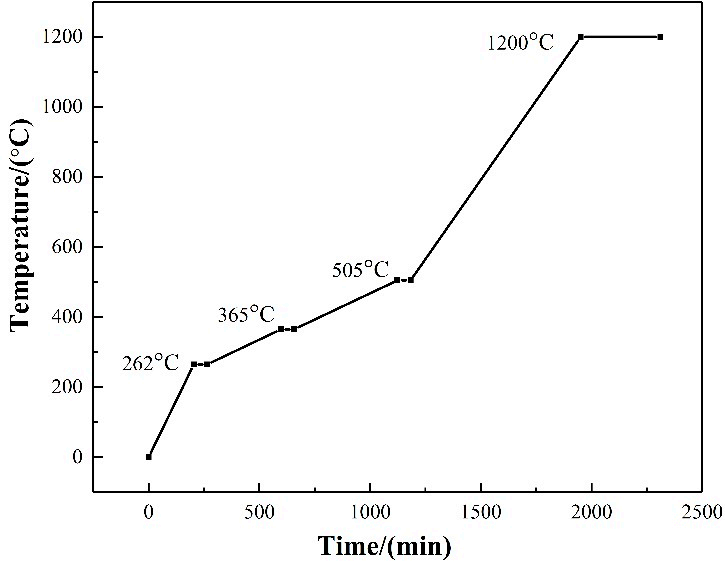
sintering curve
Research background
To understand why 3D printed silicon-based ceramic cores "soften", we have to start with the microscopic world of the material. The main component of silicon-based ceramic cores is fused silica (quartz glass), which itself softens and undergoes viscous flow at high temperatures. During the casting process, the core needs to undergo two high-temperature "baking tests": one is sintering (to gain strength from the core), and the other is casting (contact with high-temperature molten metal).
At high temperatures, two things happen to fused quartz: 1. Densification: the pores between particles decrease and the volume shrinks. 2. Crystallization: The amorphous fused quartz is partially converted into crystalline cristobalite. Cristobalite will undergo severe volume shrinkage (about 1-2%) when cooled, causing the core to crack or deform.
Traditional solutions, such as increasing the sinter temperature or optimizing particle-level matching, while improving the anti-conformity of the core, are often at the expense of porosity rates. The porosity rate, on the other hand, is essential for the removal of the core (which is dissolved chemically) after found. This creates a dilemma: whether to be strong or to be detached?
Methods
The researchers of the paper, who took a different path, chose a high-activity nano-grade aluminium oxide (Al2O3) powder as a corrective agent to be added to the 3D-printed silica ceramic plasma. The additions are very small, ranging from 0 to 1.0 per cent of the total mass.
The core innovation is to use the high specific surface area and chemical reactivity of nano-alumina to react in situ with fused quartz during the sintering process to generate mullite (3Al₂O₃·2SiO₂) or change the network structure of the glass phase, thereby improving the high-temperature deformation resistance of the core without significantly reducing the porosity.
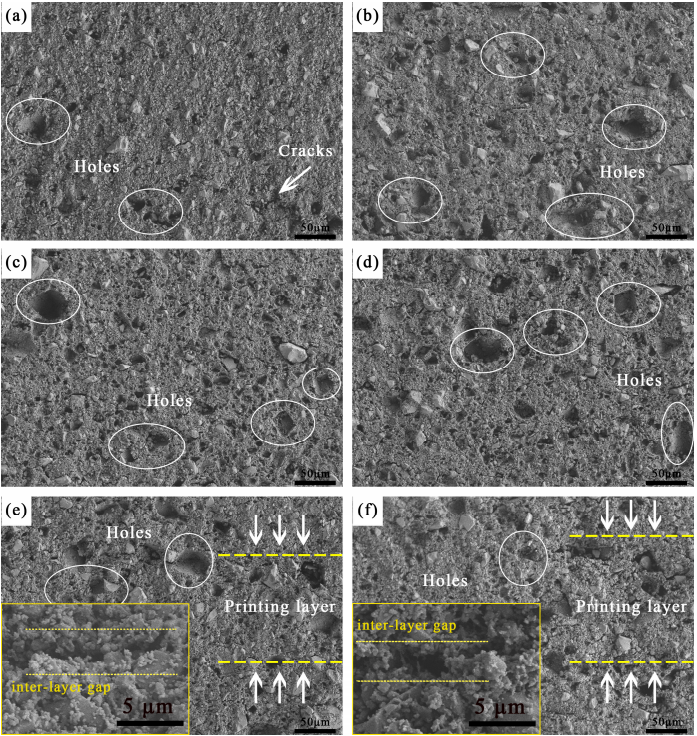
Scanning electron microscope images of the surface of the sintered ceramic core, in which the addition ratio of alumina nanopowder is: (a) 0.0 wt.%; (b) 0.2 wt.%; (c) 0.4 wt.%; (d) 0.6 wt.%; (e) 0.8 wt.%; (f) 1.0 wt.%.
The image above clearly shows the changes in microstructure. The sample without nano-alumina (A-00) is very dense after sintering and has coarse grains. Although this brings high strength, it shrinks greatly and makes core removal difficult. The sample (A-06) with 0.6% nano-alumina added has more small and uniform pores inside, and the grains are also significantly refined. This is direct evidence that nano-alumina inhibits the excessive densification of fused silica and the crystallization of cristobalite.
Results
Changes in microstructure are directly reflected in macroscopic properties. The researchers systematically measured the linear shrinkage, room temperature/high temperature flexural strength, high temperature creep deformation and surface roughness of the core after sintering and simulated casting under different nano-alumina contents.
1. Shrinkage - The sintering shrinkage of the sample without adding nano-alumina is about 3.5%, and the shrinkage after simulated casting is as high as about 7.5%. - For the sample with 0.6% nano-alumina added, the sintering shrinkage dropped sharply to 1.86%, and the shrinkage after simulated casting was only 4.41%. Shrinkage is almost halved!
2. Mechanical properties: increase first and then decrease, and there is an optimal value. - As the nano-alumina content increases from 0 to 0.6%, the room temperature flexural strength increases slightly or remains stable. - But when the content exceeds 0.8%, the strength begins to decrease significantly. The reason is that excess nano-alumina particles can destroy the bond between ceramic layers, leading to particle peeling and interlayer cracking. - In order to compensate for the loss of strength caused by inhibiting densification, the researchers also adopted a simple and effective post-treatment solution: dipping and strengthening with polyvinyl alcohol (PVA) solution. After treatment, the room temperature flexural strength of all samples met the requirements of investment casting.
3. High temperature creep: The resistance to deformation is significantly enhanced. - High-temperature creep deformation is a key indicator of whether the core can maintain dimensional accuracy during the casting process. Experiments show that after adding nano-alumina, the creep deformation of the core at high temperatures is significantly reduced. For example, after being held at 1200°C for 30 minutes, the creep deformation of the A-06 sample is much smaller than that of the A-00 sample.
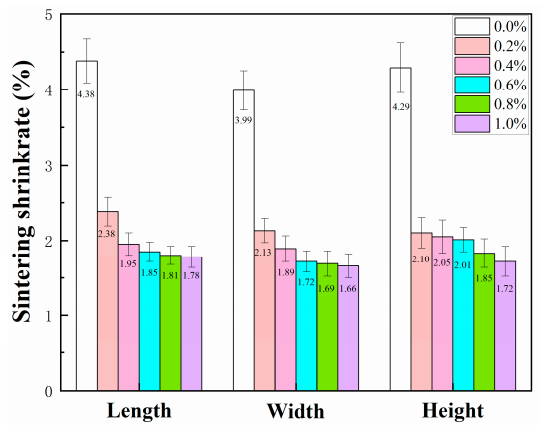
Effect of alumina nanopowder on the linear shrinkage of ceramic cores during sintering at 1200°C.
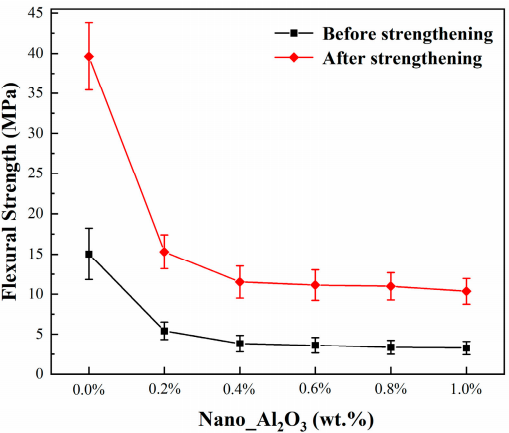
Effect of alumina nanopowder on room temperature flexural strength of sintered ceramic cores before and after strengthening.
Why can nano-alumina have such a magical effect? The researchers revealed the mechanism behind it through X-ray diffraction (XRD) and microstructure analysis:
- Densification inhibition: nano-alumina between fused-silica particles increases interparticle friction and sintering barriers, limiting particle migration and rearrangement and retaining more pores.
- Cristobalite suppression: interfacial reactions change the glass network and increase viscosity and crystallization activation energy, limiting cristobalite formation, cooling-related volume change and crack risk.
- A physical skeleton: some nano-alumina forms mullite whiskers or particles at high temperature, creating a refractory microscale skeleton within the glass phase that resists deformation.
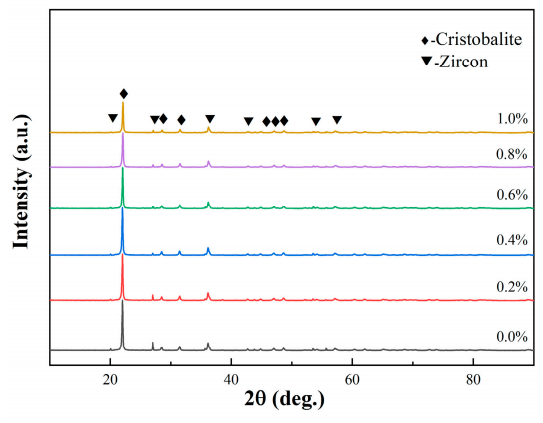
XRD morphology of ceramic cores with different alumina nanopowder contents after heat treatment at 1540°C.
Conclusions
This study gives a clear conclusion: adding 0.6 wt.% nano-alumina powder is the optimal solution for preparing high-performance silicon-based ceramic cores through DLP 3D printing technology. It can significantly reduce shrinkage and high-temperature creep deformation, and at the same time make up for the decrease in strength through simple PVA post-processing, and finally obtain a core with high dimensional accuracy, good core removal performance, and meeting casting requirements.
The significance of this work lies not only in the provision of a specific formulation, but also in the display of a “small-sized” material shift of thought. In the emerging field of 3D printing, the performance of traditional materials is often difficult to meet directly stringent process requirements. By introducing small, high-activity nanophases, the microstructure and high-temperature performance of materials can be “precisely regulated” to resolve the dilemma of traditional methods.
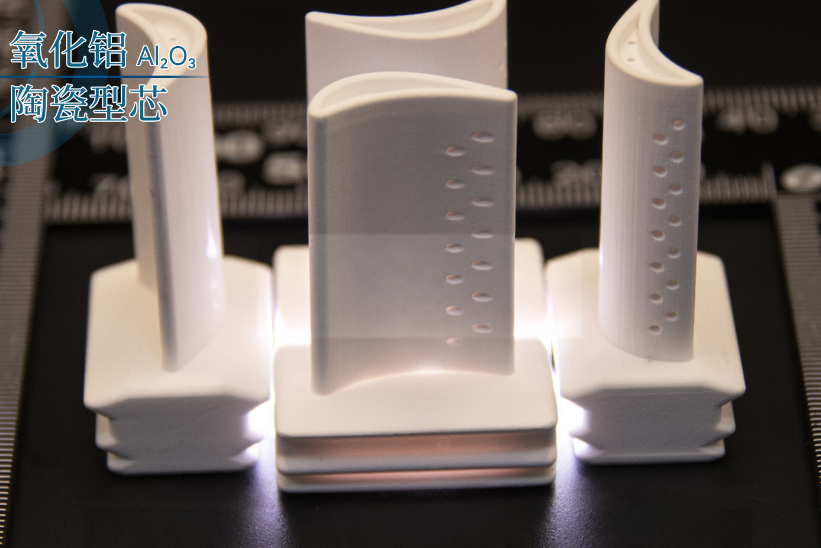
KUNWU printed ceramic core
Paper citation information: Li X, Chen