Printing practice
A zirconia wall near 100 micrometres
The thin-wall demonstration highlights the link between exposure, slurry drainage, green-part handling and final shrinkage.
This KUNWU editorial note is based on the supplied technical source. Reported results belong to the described study or sample and are not KUNWU equipment specifications.
The real difficulty in ceramic 3D printing is not just the material itself, but how to achieve fine structures. For DLP ceramic 3D printing, the requirements for forming accuracy, slurry rheology, and exposure parameter control are higher; and after entering the degreasing and sintering stages, the shrinkage of the material will further amplify the risk of deformation and cracking of the thin-walled structure. Therefore, the 100 μm wall thickness not only tests the forming accuracy of the printing equipment, but also tests the process control capabilities of the entire process from slurry, printing to sintering. Zirconia itself has a high sintering temperature and significant sintering shrinkage, which also makes stable forming of ultra-thin-walled structures more difficult.
The specimen and its fabrication
This case is a high-precision zirconia sample. The following pictures show the wall thickness of the sample, the finished product state after sintering, the size measurement results, and the size comparison with the ballpoint pen tip.
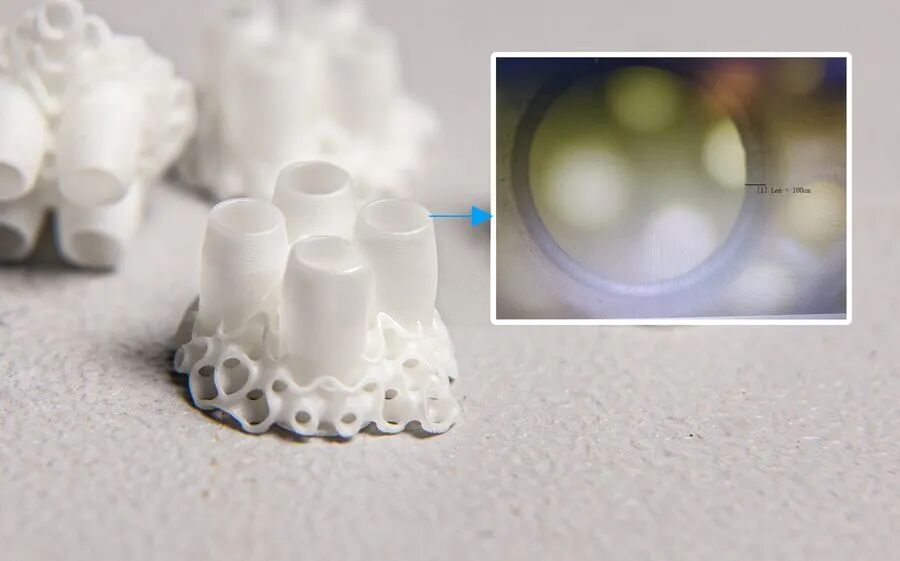
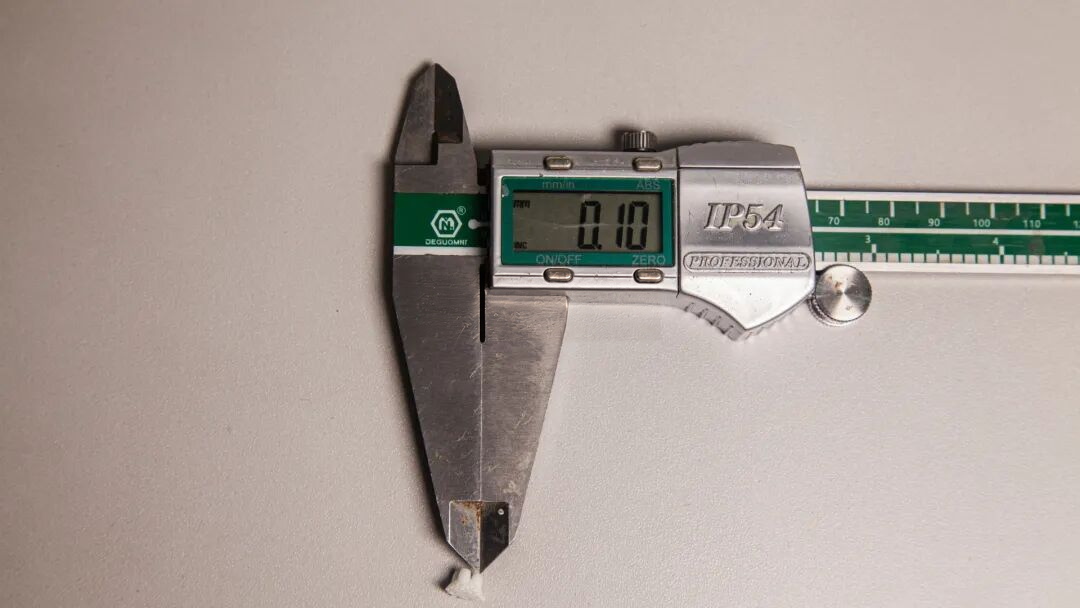
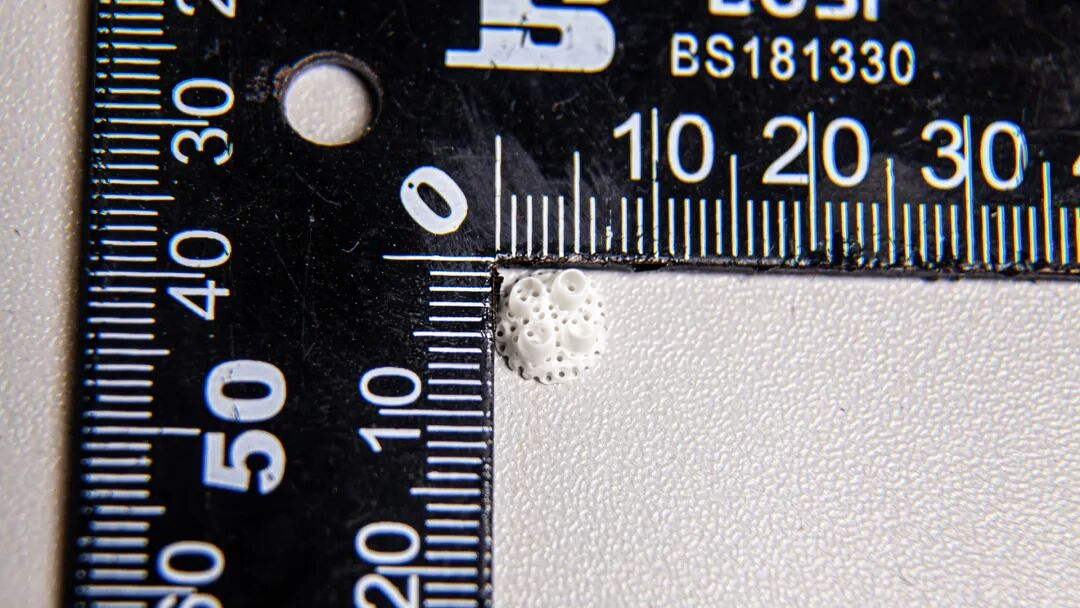
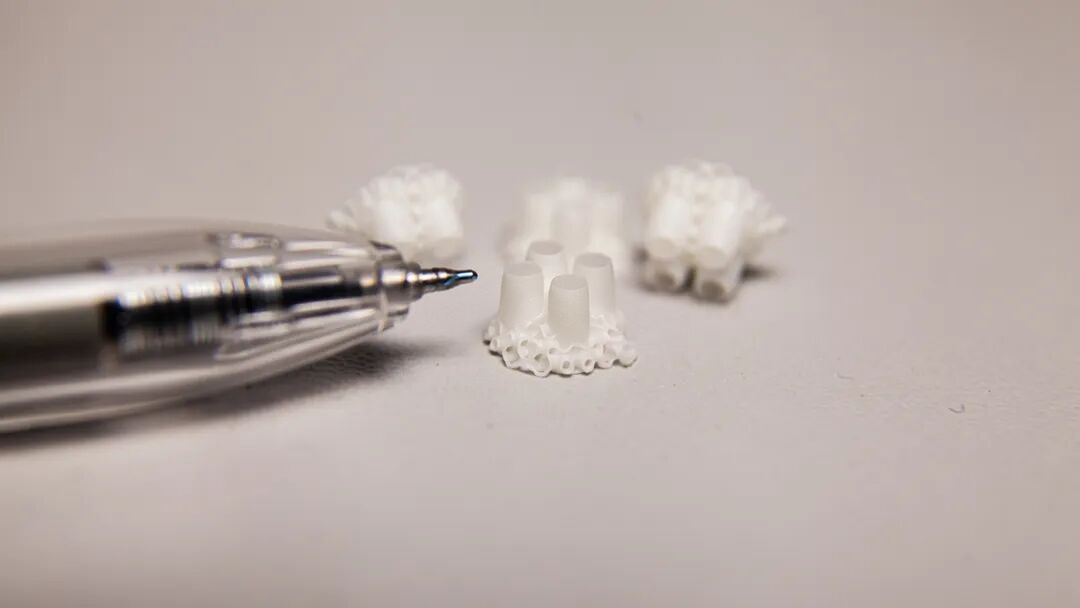
Printing, release and cleaning of 100 μm walls
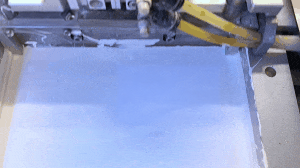
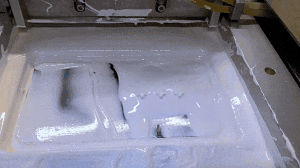
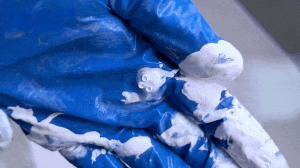
The following animated diagram shows the process from printing, roll-out and cleaning of the oxidizing sample.
Manufacturing challenges at 100 μm wall thickness
Zirconia is a relatively mature material in ceramic 3D printing, and its slurry system and sintering process are also relatively mature. However, forming 100μm wall thickness still requires meeting the engineering challenges inherent in thin-walled structures.
- Thin-wall control: at 100 μm, small deviations in exposure, layer thickness or the curing boundary can cause dimensional error, distortion or missing wall regions.
- Shrinkage control: debinding and sintering cause substantial shrinkage. At 100 μm wall thickness, small differences can create dimensional errors, warping or cracks, requiring controlled heating rates, dwell times and temperature uniformity.
- Thermal-stress concentration: thin walls are sensitive to temperature differences and uneven shrinkage during debinding and sintering, increasing warping and cracking risk.
KUNWU's entire product series can achieve optical precision up to 25 μm. Combined with self-developed slurry system and process control, it provides reliable equipment and process support for the manufacturing of high-precision and refined ceramic structures. The sample in this case is printed with ADT Ceram-D-F144.
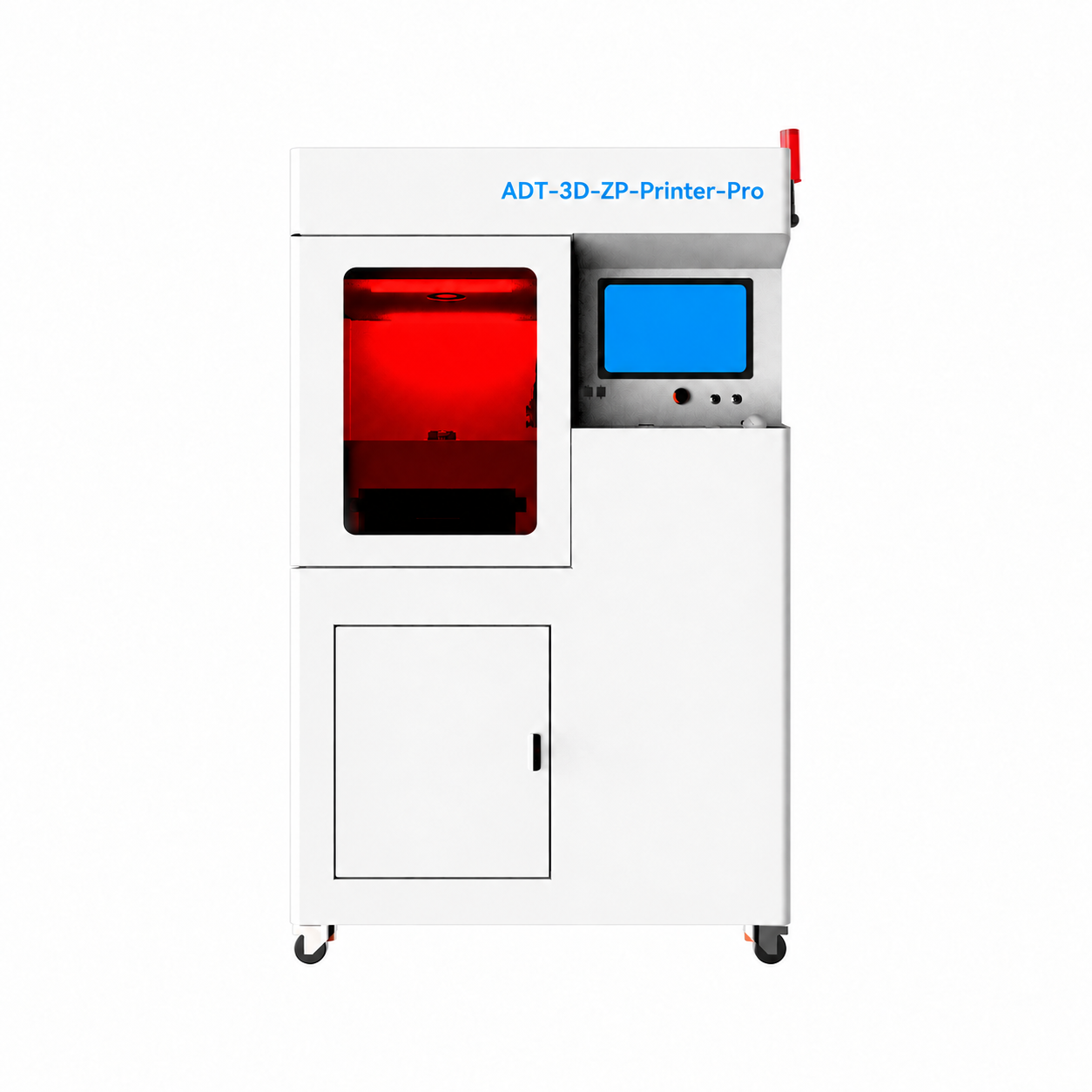
Figure 8 · ADT Ceram-D-F144 printer.