Materials research
Single-source-precursor SiCN microspheres
An emulsion-to-pyrolysis route links microsphere size, shrinkage and strength; biocompatibility claims remain research-stage.
This KUNWU editorial note is based on the supplied technical source. Reported results belong to the described study or sample and are not KUNWU equipment specifications.
Using "homogeneous" fillers to solve the shrinkage and interface problems of 3D printed ceramics, this strategy pushed the strength of SiCN ceramics to 242.1 MPa and confirmed its low biological toxicity for the first time, opening up a new path for biomedical implants.
Research background
In the field of advanced manufacturing, polymer-derived ceramics (PDCs) are regarded as "star materials" in fields such as aerospace, pharmaceuticals and biomedicine due to their low density, excellent mechanical properties and chemical stability. Digital light processing (DLP) 3D printing technology, with its high precision and complex structure forming capabilities, has become an ideal tool for manufacturing PDCs components (such as SiCN ceramics). However, a "stumbling block" that has long troubled researchers is that during high-temperature pyrolysis, PDCs will shrink significantly (up to more than 30%), leading to pores, cracks and even catastrophic failure of components. The traditional solution is to add inert fillers (such as Si₃N₄ whiskers, SiO₂ nanoparticles), but there is an interface mismatch between these "heterogeneous" fillers and the matrix, which may induce new defects.
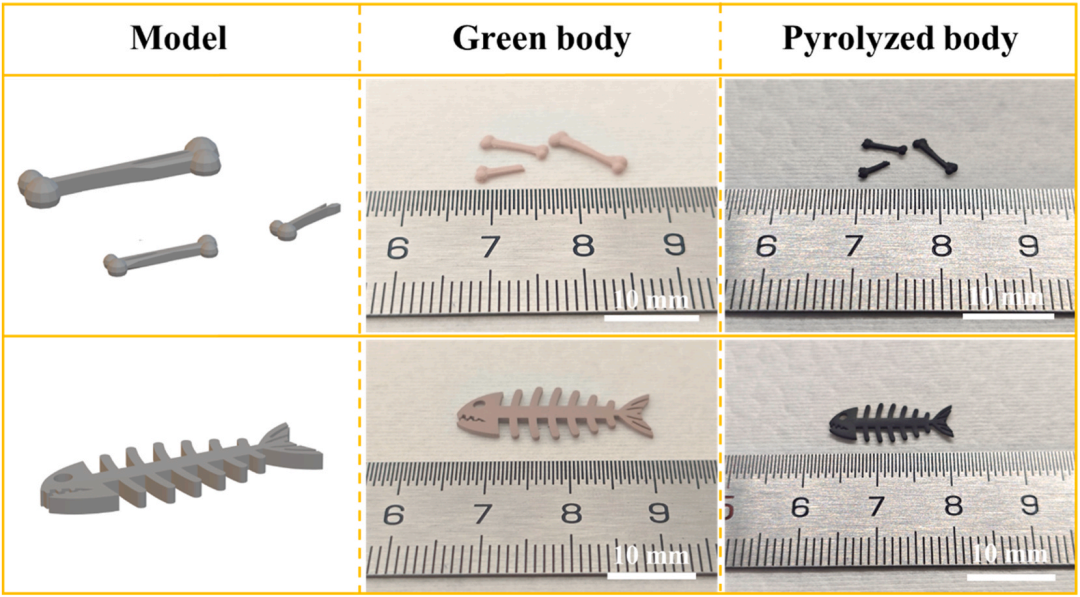
Recently, a study published in Ceramics International proposed an ingenious and concise strategy: using SiCN microspheres homologous to the matrix as fillers. The research was completed by Zhongya Zhang and other scholars. They prepared SiCN microsphere-reinforced SiCN composite ceramics through DLP technology, which not only significantly reduced the pyrolysis shrinkage from 31.8% to 26.2%, but also increased the flexural strength to 242.1 MPa. What is even more exciting is that the composite ceramic exhibits extremely low biological toxicity (relative cell viability 95.8%), laying the foundation for its application in the biomedical field.
Methods
The interface bonding strength between filler and matrix is the key to determining the performance of composite materials. There are differences in thermal expansion coefficients and chemical bonding methods between traditional heterogeneous fillers (such as Si₃N₄ whiskers) and SiCN matrix, which can easily cause stress concentration and interface debonding during the pyrolysis process. The "homogeneous filler" strategy proposed in this study, which uses SiCN ceramic microspheres with exactly the same chemical composition as the matrix, fundamentally eliminates the problem of interface mismatch. Think of it like adding small, homogeneous pebbles to concrete rather than different steel balls - the former "integrate" better with the cement matrix.
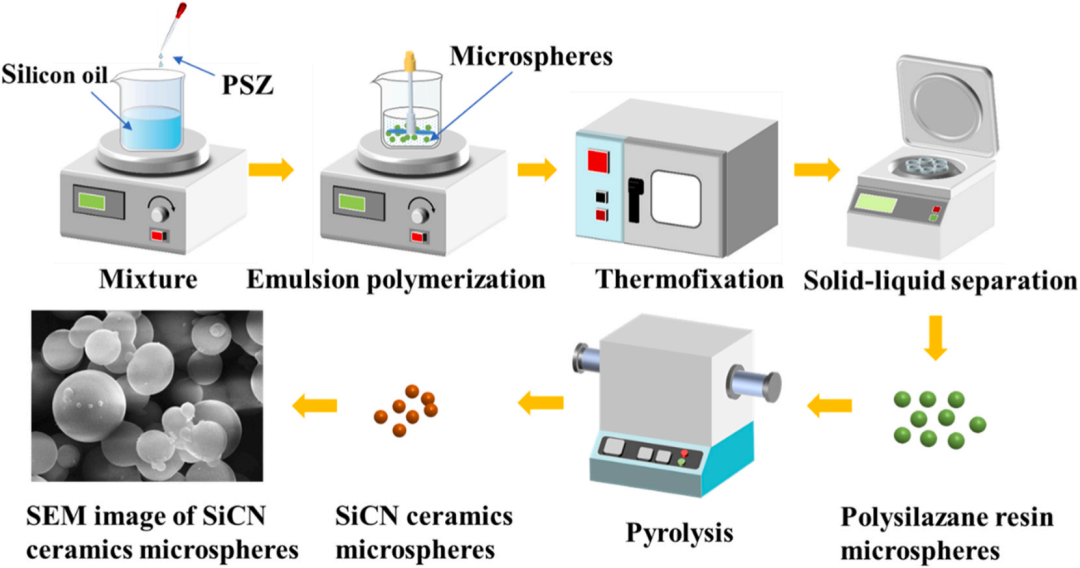
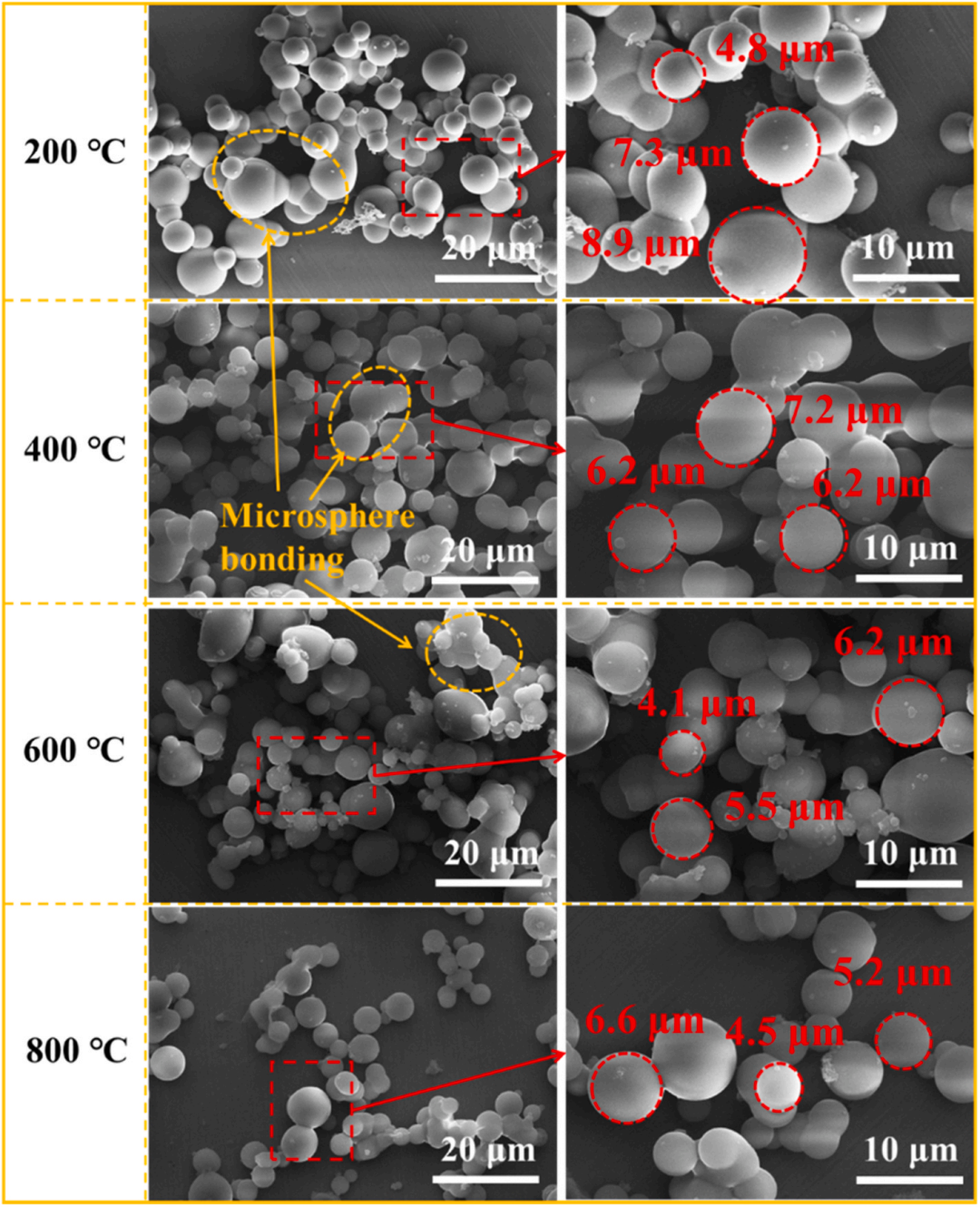
In order to prepare such "homogeneous" microspheres, researchers used polysilazane (PSZ) as raw material to first prepare resin microspheres through an emulsion-thermal curing method, and then pyrolyzed them at high temperature under a nitrogen atmosphere to obtain SiCN ceramic microspheres. The key is that the pyrolysis temperature of the microspheres will significantly affect their performance: if the temperature is too low (such as 200°C), the microspheres will not be fully ceramicized and will not have a reinforcing effect; if the temperature is too high (such as 800°C), the absorption of ultraviolet light by the microspheres will be enhanced, which will interfere with the photocuring reaction during the DLP printing process.
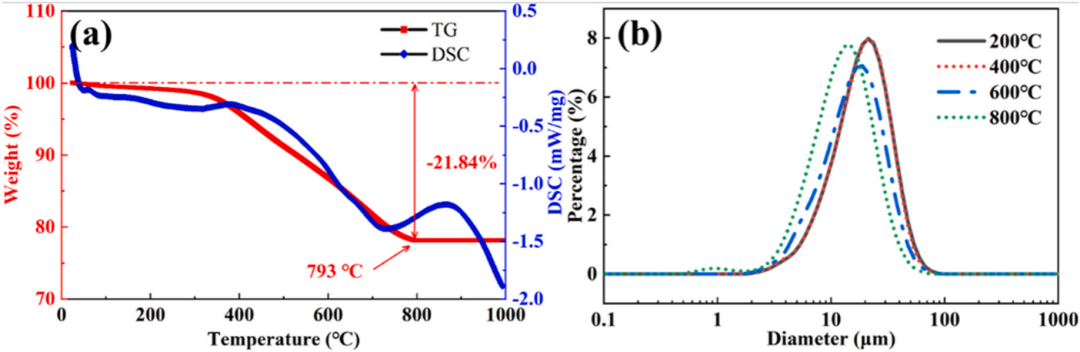
Through UV-visible spectrum analysis, the research team found that microspheres heat-treated at 600°C had the least impact on UV light absorption while ensuring a certain degree of ceramicization, so they were selected as the best fillers. This detail reflects the subtlety of material design: finding a balance between filler performance and printing process.
Results
The experimental data at the core of the paper clearly demonstrate the effectiveness of homogeneous fillers. The researchers added 600°C-treated SiCN microspheres with different mass fractions (0-30 wt%) to the PSZ photosensitive resin slurry. After printing and pyrolysis through DLP, the linear shrinkage and flexural strength of the composite ceramics were tested.
Shrinkage control: As the microsphere content increases from 0 wt% to 30 wt%, the linear shrinkage of the composite ceramics significantly decreases from 31.8±0.2% to 26.2±0.3%. This means that when a 10-centimeter-long part is originally printed, only about 7 centimeters remain after pyrolysis; but after adding 30% microspheres, the remaining length can reach 7.4 centimeters, and the dimensional accuracy increases by about 15%. This improvement is critical for precision components such as dental implants and microfluidic chips.
Enhanced mechanical properties: Even more impressive are the changes in flexural strength. The data shows that the flexural strength first increases and then decreases as the microsphere content increases, reaching a peak value of 242.1±13.1 MPa at 15 wt% content. This is nearly 60% higher than the sample without added microspheres (about 150 MPa). The mechanism of strength improvement is that microspheres serve as "skeletons" and are evenly distributed in the matrix, effectively transmitting and dispersing the load, while inhibiting the initiation and expansion of cracks during the pyrolysis process. However, when the microsphere content exceeds 15 wt%, agglomeration may occur between microspheres, forming stress concentration points, resulting in a decrease in strength.
Biotoxicity evaluation for medical research
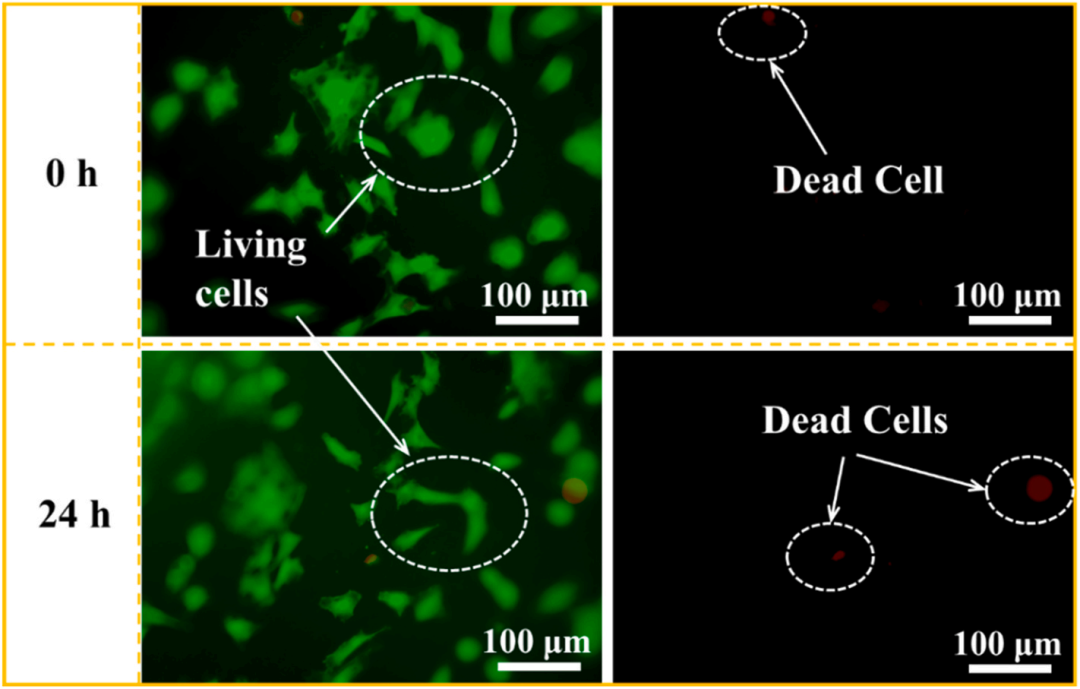
Whether a material can be used in the biomedical field, biocompatibility is the primary threshold. This study is the first to evaluate the biological toxicity of DLP printed SiCN composite ceramics. The researchers used the CCK-8 cell detection method to co-culture human osteoblasts (or other standard cell lines) with SiCN composite ceramics (PSN-15, a sample containing 15 wt% microspheres) to detect cell viability.
The results showed that the relative cell viability was as high as 95.8±0.6%. According to the ISO 10993-5 standard, cell viability greater than 70% is considered non-cytotoxic. The value of 95.8% far exceeds this standard, indicating that the composite ceramic has extremely low biological toxicity, even better than many traditional bioceramics (such as hydroxyapatite sometimes slightly lower in the same test). This result provides key data support for the application of SiCN ceramics in bone implants, dental restorations and other fields.
Fracture surfaces reveal reinforcement mechanisms
In order to deeply understand the microscopic mechanism of improved mechanical properties, researchers used scanning electron microscopy (SEM) to observe the fracture surfaces of composite ceramics. It can be clearly seen from the picture that SiCN microspheres (spherical particles) are evenly embedded in the SiCN matrix, and the interface is tightly combined without obvious gaps or debonding. This shows that the homogeneous filler achieves "seamless fusion".
More importantly, the fractured face shows typical fracture features, i.e. cracks directly through the microball rather than extending along the interface. This indicates a high degree of bonding of microballs with the matrix, even beyond the microballs themselves, forcing the cracks to “cut through” paths, thereby consuming more energy and increasing material break-up resilience. In contrast, traditional heterogeneity fillings often lead to “cracking along the crystal” and the interface becomes weak.
Conclusions
This research cleverly solved the key problems of DLP printing SiCN ceramics - high shrinkage and interface mismatch through the "homogeneous filler" strategy. The main contributions can be summarized as: 1. Method innovation: For the first time, SiCN microspheres homologous to the matrix were systematically studied as fillers, and 600°C was selected as the optimal heat treatment temperature. 2. Performance breakthrough: The bending strength is increased to 242.1 MPa, the shrinkage rate is reduced to 26.2%, and "shrinkage reduction enhancement" is achieved. 3. Application expansion: The low biological toxicity of the composite ceramic was confirmed for the first time, paving the way for its application in the biomedical field (such as personalized bone implants).
In the future, researchers can further explore the effects of particle size, shape and performance, and try to print more complex structures (e.g., multiple-pore racks, biobones). In addition, implantation experiments in animals will be the next key step in verifying their biological compatibility. It is foreseen that this “homometric enhancement” strategy will apply not only to SiCN but also to other PDCs systems (e.g., SiOC, SiBCN) to provide a new paradigm for high-performance ceramic 3D printing.
Article citation information: Zhang, Z., Zhong, C., Xue, J., & Zhang, L. (2026). SiCN microsphere reinforced SiCN composite ceramics formed by DLP and their biotoxicity. Ceramics International. https://doi.org/10.1016/j.ceramint.2026.01.194