Thermal ceramics
DLP-printed alpha-Si3N4/Si3N4w/SiCN substrate with an embedded microchannel
A hybrid of powder, whiskers and a preceramic polymer reduces shrinkage and forms a sealed liquid-cooling channel.
Authorized republication with translated text and the source’s original scientific figures. Numerical results belong to the reported study, not to KUNWU equipment specifications.
- Shrinkage
- 25.6 ± 0.2%
- Fracture toughness
- 4.1 ± 0.1 MPa m1/2
- Channel diameter
- <467 um
Power electronics are moving toward higher power, greater integration and smaller dimensions, increasing the demands on heat-dissipating substrates. More complex devices also require more effective cooling. A team led by Professors Lijuan Zhang and Guangwu Wen at Shandong University of Technology reported ‘Fabrication of alpha-Si3N4/Si3N4w/SiCN ceramic substrate with embedded microchannel by DLP’ in the Journal of the European Ceramic Society. DLP 3D printing was used to prepare SiCN ceramic substrates with integrated microfluidic channels. Optimizing the silicon-nitride whisker fraction in the mixed filler reduced shrinkage and improved fracture toughness.
Original paper: https://doi.org/10.1016/j.jeurceramsoc.2025.118120
Research approach
The study developed an integrated DLP route for SiCN composite substrates for high-power electronic cooling. It followed four stages: material-system design, forming-process development, structural and property optimization, and device-level validation.
For the material system, polysilazane (PSZ) was used as the precursor, with alpha-Si3N4 particles and Si3N4 whiskers as a mixed filler. Their ratio was varied while total loading remained 20 wt.%. The study examined effects on rheology, printability and thermal processing, aiming to limit polymer-derived-ceramic shrinkage while improving mechanical and thermal properties together.
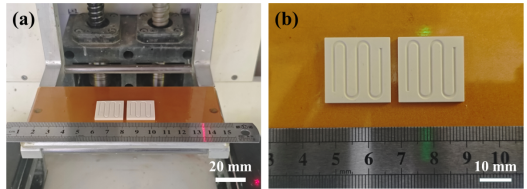
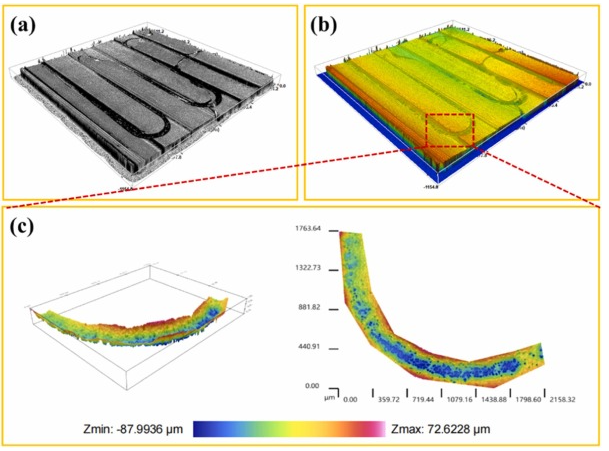
DLP printing used 405 nm illumination, 50-micrometre layers and a 10 s exposure to form complex green bodies. Treatment at 200°C and pyrolysis at 1100°C under nitrogen converted the organic precursor into SiCN ceramic. Internal microchannels and surface circuit grooves were incorporated during printing, avoiding defects associated with sacrificial-template methods.
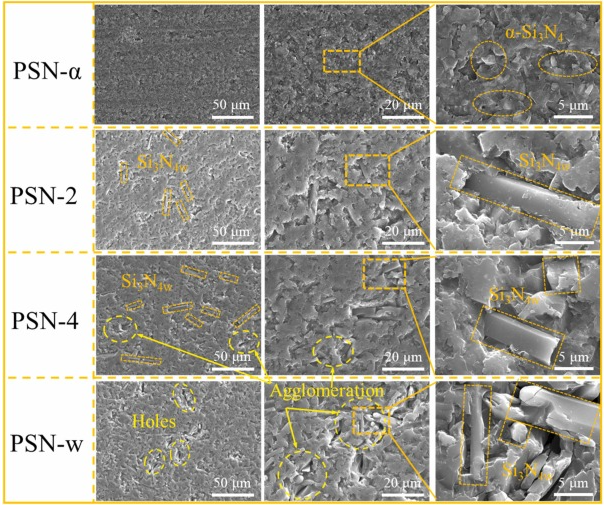
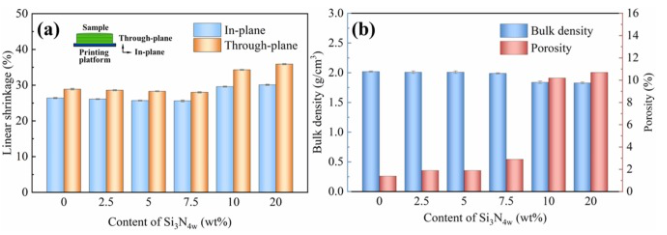
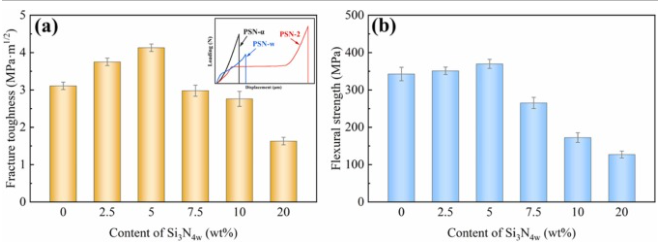
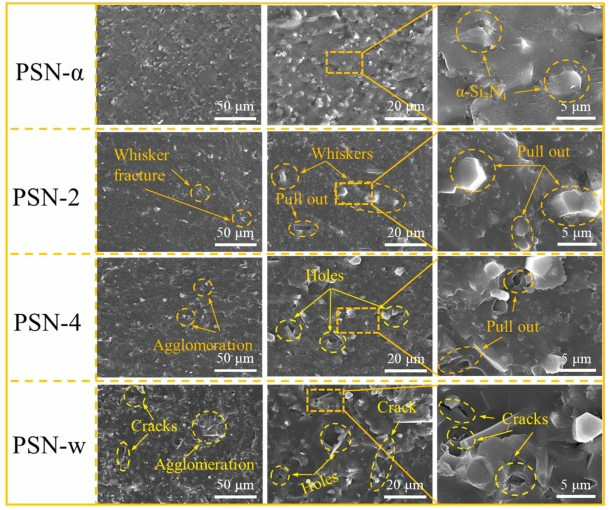
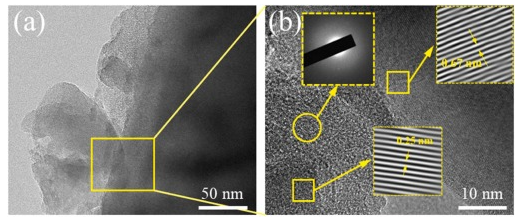
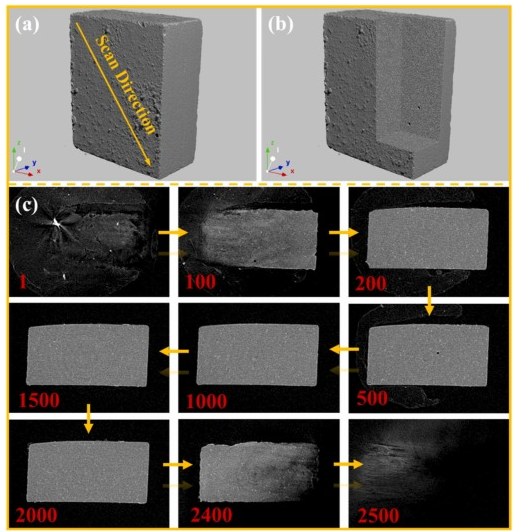
Systematic characterization identified 5 wt.% Si3N4 whiskers as the preferred addition. Whisker bridging and pull-out increased fracture toughness to 4.1 MPa m1/2, while conductive pathways increased thermal conductivity to 14.8 W m-1 K-1. Higher whisker loading caused agglomeration-related pores. Water-quench tests and CT showed crack deflection and distributed cracking, changing catastrophic fracture into progressive damage and improving thermal-shock resistance.
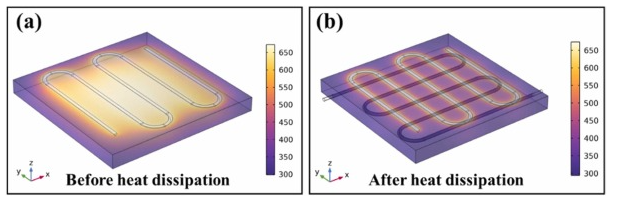
At device level, serpentine microchannels were designed and evaluated through finite-element analysis and experiments. Under liquid-cooling conditions, the modeled maximum substrate temperature decreased from 400°C to approximately 126°C. Airtightness and circulating-flow tests assessed channel integrity and reliability, linking structure, properties and function.
The following original figures present the study’s characterization methods and results.
Conclusions
Optimizing the alpha-Si3N4 particle/Si3N4 whisker filler produced high-performance SiCN substrates with integrated channels. At 5 wt.% whiskers, fracture toughness reached 4.1 ± 0.1 MPa m1/2; the source describes an improvement of approximately 1.32 times relative to the whisker-free material. Flexural strength reached 369.8 ± 12.1 MPa. Thermal conductivity at 800°C was 14.80 ± 0.07 W m-1 K-1, approximately twice that of the matrix.
The critical thermal-shock temperature difference increased to 730°C. The source compares this with 621°C for the whisker-free system and states an increase of 119°C; these source numbers contain an arithmetic inconsistency. Linear shrinkage was controlled at approximately 25.6 ± 0.2%, supporting dimensional control rather than zero-shrinkage manufacturing.
DLP produced substrates with serpentine channels approximately 467 micrometres in diameter, good airtightness and interface integrity. Thermal simulation predicted a reduction in maximum temperature from 400°C to approximately 126°C under liquid cooling.
Overall, the study combined structural complexity, mechanical performance and heat-dissipation functionality, providing a potential manufacturing route for cooling substrates in high-power electronics.