Materials research
Silicon nitride: connecting slurry design with sintering
A research note on ceramic vat photopolymerization and the importance of evaluating the complete process.
This KUNWU editorial note is based on the supplied technical source. The paper's bibliographic details were verified; its experimental values belong to the cited study and are not KUNWU equipment specifications.
- Three-point bending strength
- 209.67 ± 2.51 MPa
- Relative density
- 64.67%
Introduction
Silicon nitride (Si₃N₄) is a high-performance structural ceramic in the fields of aerospace, biomedicine and other fields. However, its high light absorption and high refractive index make it difficult to use light curing to create low-viscosity, high-solid-content slurries. A team from the Additive Manufacturing Research Institute of Shenzhen University (jointly with Taipei University of Technology) published a study in the Journal of Alloys and Compounds, proposing a collaborative optimization strategy for slurry formulation and sintering dynamics, using light curing (VPP) to print complex-shaped Si₃N₄ ceramics, and achieving a flexural strength of 209.67 ± 2.51 MPa and a relative density of 64.67%.
1. Why is Si₃N₄ difficult to print with light curing?
Silicon nitride has high hardness, wear resistance, and thermal stability, making it an ideal candidate for engine components, bearings, and implants. However, most of these applications require complex structures. Traditional injection molding, tape casting, and gel injection molding are slow and expensive. Mold costs are high and cycle times are long, making it difficult to meet demand.
Photocuring (VPP, Vat Photopolymerization) can directly form complex parts without molds, and its accuracy and surface quality are also superior. However, Si₃N₄ faces two problems: first, the surface charge is lower than that of oxide powder, and it is difficult to disperse in the resin; second, it has strong light absorption and a large refractive index difference with the resin, resulting in high slurry viscosity and shallow solidified layer.
Both of them limit the increase of solid content. If the content of Si₃N₄ powder is too high, the viscosity of the slurry will increase sharply and it will be difficult to form. If the content is insufficient, it will be difficult to fully densify after sintering, and both density and strength will be restricted. There is a contradiction between high solid content, low viscosity and deep solidification.
2. Slurry formula: 50 vol% solid content and low viscosity
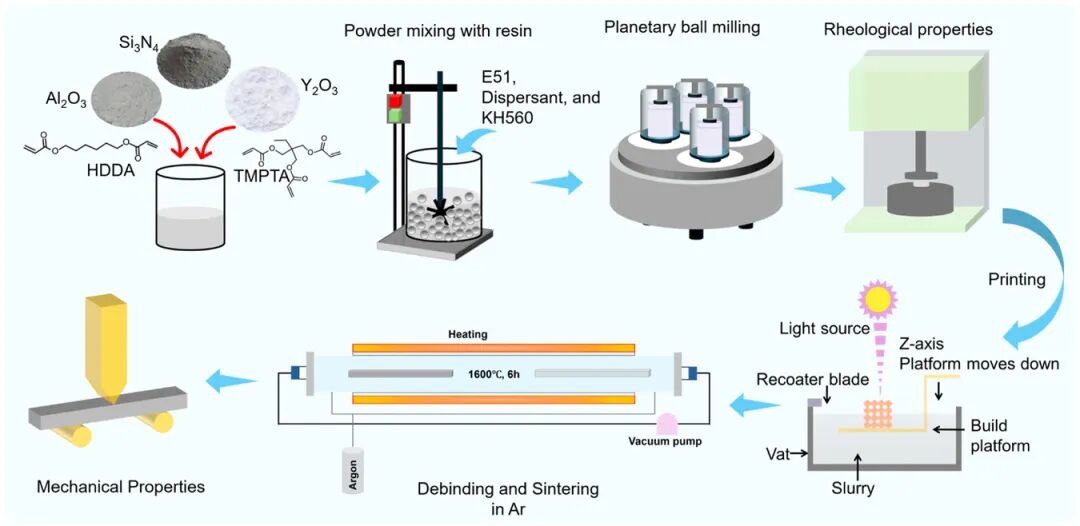
The team's strategy is to let various additives take their own responsibilities. The powder is mixed according to Si₃N₄: Al₂O₃: Y₂O₃ = 90: 5: 5, and the latter two are used as sintering aids; the resin is mixed with HDDA and TMPTA at a ratio of 2:3, and then 1 wt% of KH-560 silane coupling agent is added to improve the interface bonding between the powder and the resin.
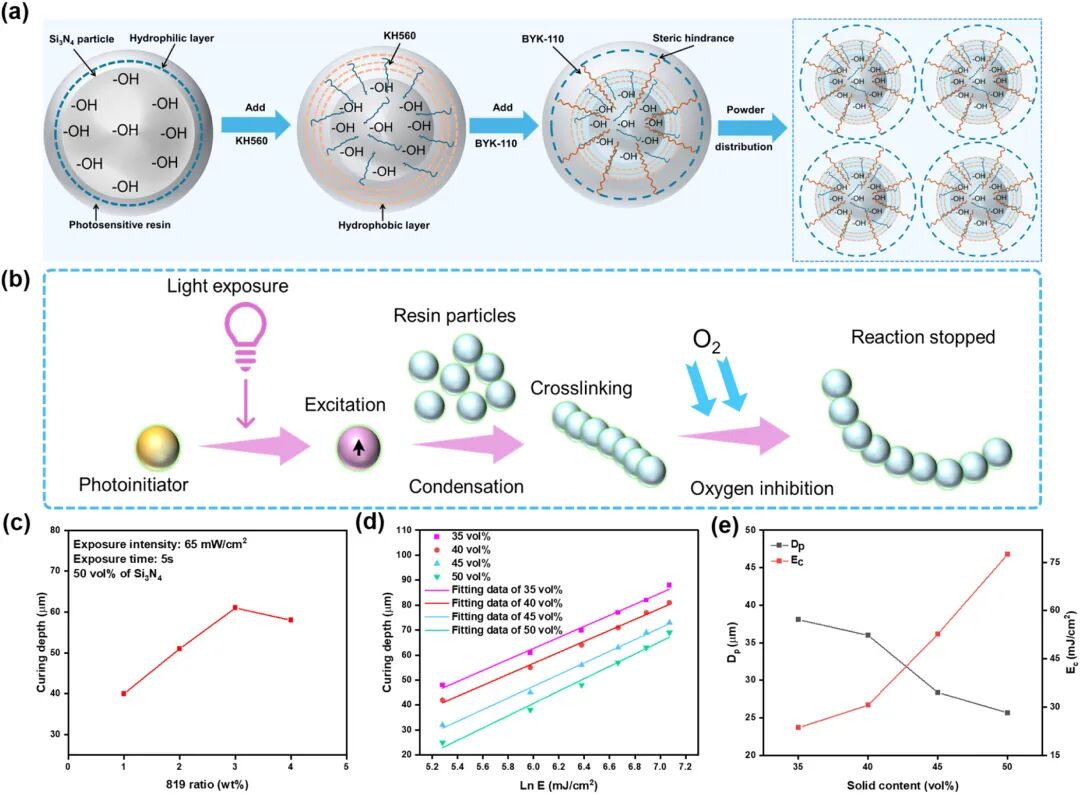
Fragmentation is the first challenge. Team contrasts BYK-111, KOS-110 and BYK-110 have the best drop-in viscos. Its acid ester-based adsorption is attached to the Si3N4 surface, with long chains stretching into the resin to create spatial position resistance and dispersing particles. Usage also has the best value: 2 wt% is the best, and more causes particle bridges, molecular entanglements and no backsliding.
Curing is another challenge. The photoinitiator PI-819 has strong absorption at 350–420 nm. It generates free radicals under light and breaks the C=C bonds in the resin to initiate polymerization. When added to 3 wt%, the curing depth reaches 69 µm. As it goes up, the free radicals are quenched by oxygen (oxygen inhibition), and the cured layer becomes shallower. In addition, 2 wt% E51 epoxy is added as a plasticizer to inhibit sintering cracking.
After the above collaborative regulation, the viscosity of the slurry with 50 vol% solid content dropped to 2.58 Pa·s (30 s⁻¹), which was 93% higher than that of 35 vol%, but lower than the value reported in the literature for the same dispersant. The contradiction between high solid content and low viscosity is resolved at the formulation level.
3. Heating rate: slow down to 0.5 °C/min, and increase the flexural strength to 210 MPa
The formula determines the first half, and sintering determines the second half. The green body is first degreased in two steps (vacuum degreasing + air decarburization) to clean the organic resin, and then sintered at 1600 °C for 6 hours. The team systematically compared four heating rates (T1–T4) of 5, 2, 1, and 0.5 °C/min.
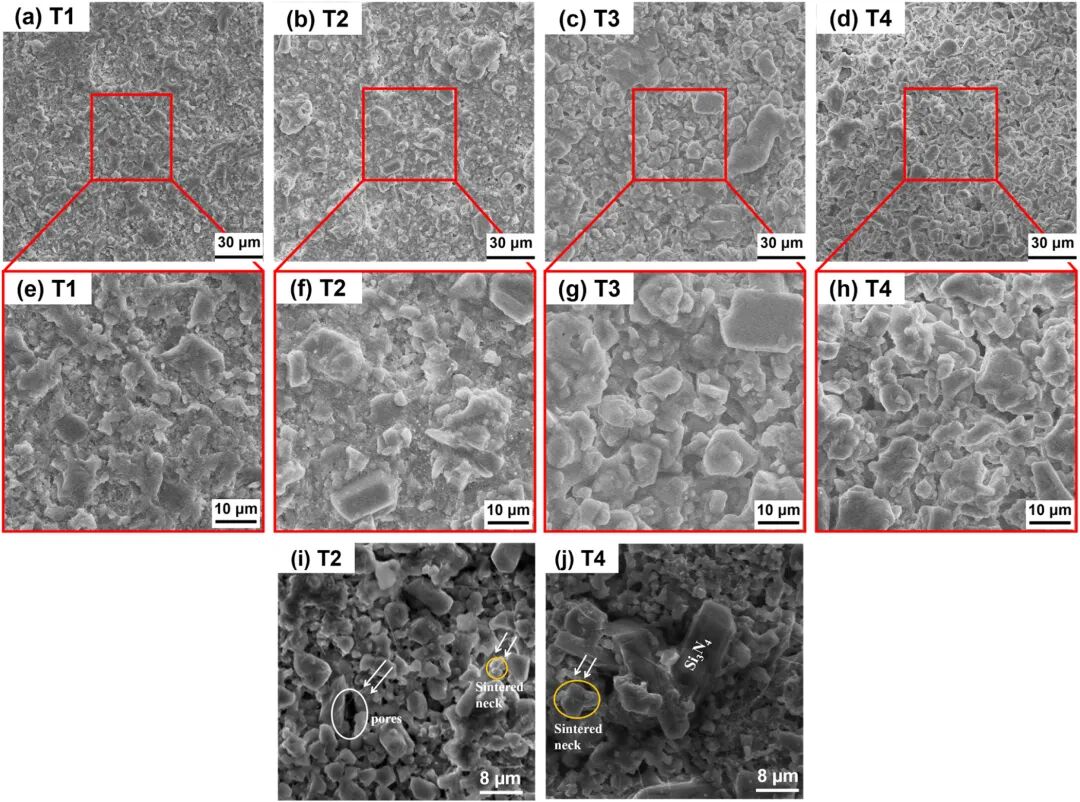
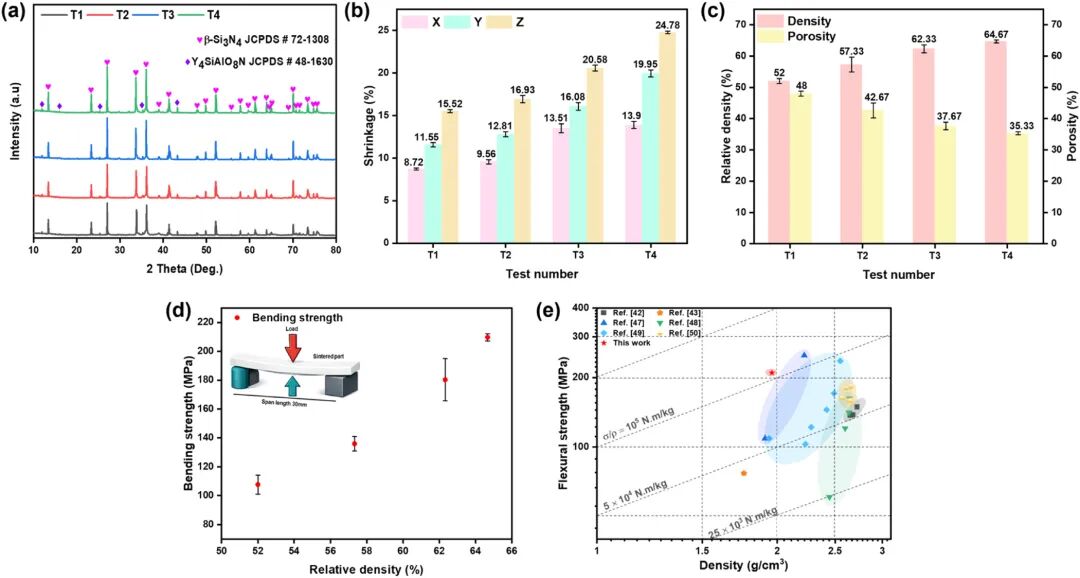
The results show a reverse trend: the lower the heating rate, the more complete the densification. The T4 group at 0.5 °C/min promotes liquid-phase sintering, and the grain size grows from 4.34 µm all the way to 7.37 µm. The sintering aid also generates a second phase Y₄SiAlO₈N (yttrium silicon aluminum oxynitride), which enhances the sintering neck bonding between grains.
In terms of macroscopic properties, the relative density of the T4 group increased from 52% to 64.67%, the porosity dropped from 48% to 35.33%, and the flexural strength reached 209.67 ± 2.51 MPa - the abstract of the paper stated that it was about 95% higher than the fastest group. A lower heating rate gives the material more time to densify, and shrinkage is more controllable.
4. Complex components are formed in one go, with controllable shrinkage anisotropy.
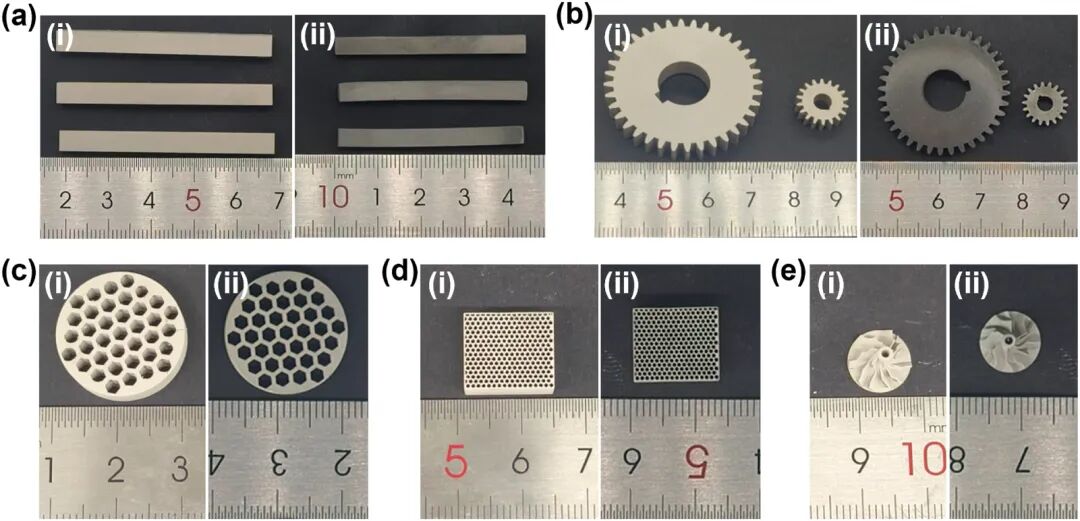
Optimized slurry is used directly to print complex pieces. The paper showed rectangular rods, gear gears, round beehives, square beehives, five types of leaf wheel structure, and the complete shape of the slurry and sinter, indicating that the high-condensity slurry was able to strike complex structures and had no obvious defects after sintering.
Shrink is also worth watching. Slow heating makes densification more complete, and the three-axis shrinkage increases accordingly; the shrinkage in the printing direction (Z-axis) is always the largest - the Z-axis of the 0.5 °C/min group reaches 24.80%, which is significantly higher than the 13.90% of the X-axis and 19.95% of the Y-axis.
The Z-axis shrinkage is relatively large, and the root cause is the layer-by-layer molding of VPP: the slurry is piled up layer by layer, leaving more gaps between the layers in the Z direction than in the X and Y directions. During sintering, these gaps are closed, and the shrinkage is naturally greater. This also reminds that when doing size compensation, the three axes cannot be treated equally, and a separate shrinkage allowance needs to be reserved in the Z direction.
5. Inspiration for 3D printing of structural ceramics
The significance of this work is to optimize, rather than sever, the plasma flow, photo fixation and sintering curves as a whole. Fragmentation and solidification of the formulation end, which ultimately translates from a temperature increase at the sinter end to an increase in density and intensity, is essential.
For structural ceramic printing, this provides a clear idea: often overlooked process parameters such as heating rate are often the key to determining the performance of the finished product. Rather than simply pursuing higher solid content or higher sintering temperature, it is better to return to the overall chain of dispersion, solidification, and sintering to find the optimal match between each parameter.
Silicon nitride has long been regarded as a difficult material for stereolithography printing. This study proves that as long as the slurry formula and sintering system are coordinated in place, high-strength complex ceramic components can also be formed stably. When materials, formulas and processes are designed as a system, ceramic stereolithography printing can truly move from "printable" to "densifiable and stable". This is also the most valuable aspect of this research for structural ceramic manufacturing.
Saqib M, Raza M, Asghar A, Arshad Q, Hussain MI, Ali U, Ali D, Jiang C-P, Chen Z. Vat photopolymerization 3D printing of high-performance Si₃N₄ ceramics through synergistical optimization of slurry formulation and sintering kinetics. Journal of Alloys and Compounds. 2026;1080:190659. DOI: 10.1016/j.jallcom.2026.190659
Sources
Original paper · DOI
Saqib et al. · Journal of Alloys and Compounds · 1080 (2026), 190659