Materials research
Sintering aids for alumina interlayer bonding
Comparing oxide additives shows how liquid-phase sintering and grain-boundary processes alter interlayer bonding and strength.
This KUNWU editorial note is based on the supplied technical source. Reported results belong to the described study or sample and are not KUNWU equipment specifications.
Sintering additives are not only an "accelerator" that reduces the sintering temperature of ceramics, but are also the key to solving the core problem of weak bonding between light-cured 3D printed ceramic layers.
Research background
For a long time, light-cured (VPP) 3D printed ceramics have faced the problem of interlayer peeling. Since the printing process is cured and superimposed layer by layer, the bonding force between layers is often weaker than the material itself. It's like building blocks stuck together with glue, not as strong as a whole piece of wood. This defect directly leads to low mechanical properties of printed parts, limiting their application in high-end fields.
So, is there a way to completely integrate these "building blocks" during sintering? A recent study published in the "Journal of the American Ceramic Society" reveals two possible methods for us-MnO₂–TiO₂ and Nb₂O₅.
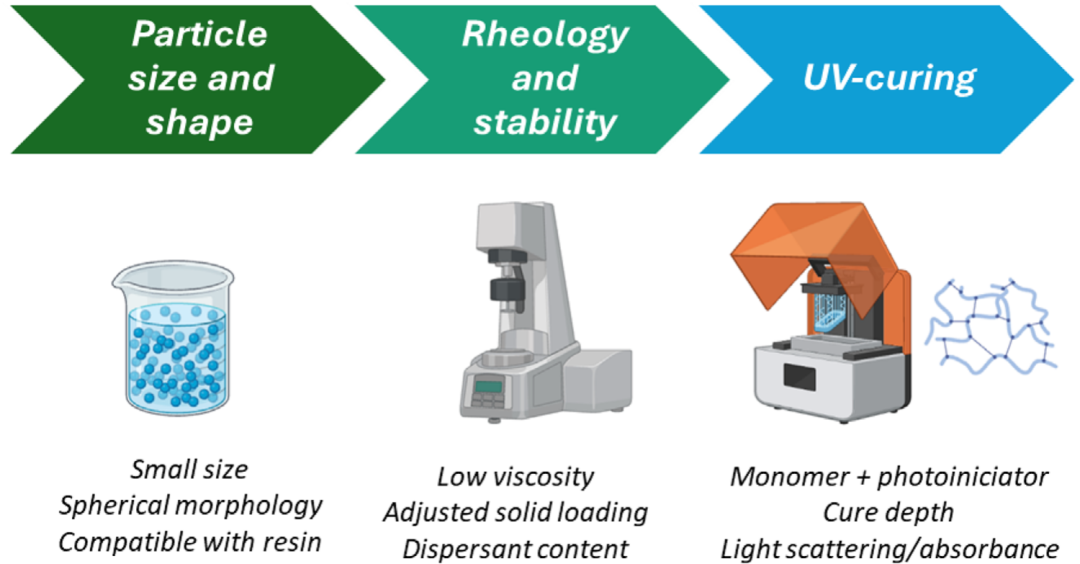
Methods
Alumina (Al₂O₃) ceramic has excellent performance, but it has a "stubborn temper": it requires a high temperature of more than 1600°C to fully sinter and densify. This not only consumes huge amounts of energy, but also places extremely high demands on equipment. In order to "subdue" it, scientists came up with a clever way - adding sintering aids.
These aids form a small number of liquid phases or solid solutions at high temperatures, as if a layer of “lubricant” or “welding” were laid between ceramic particles to accelerate the proliferation of the atoms and thus achieve high density at lower temperatures. The innovation of this study is not only that they want to lower the sinter temperature, but also that they want to see whether these “pharmaceuticals” can cure the “stripping” of 3D-printed ceramics at the same time.
The researchers designed three formulations, all using alumina slurries with solid contents up to 50 vol%, and manufacturing them with more cost-effective LCD-type DLP printers:
- A-50 control: pure alumina without additives.
- A-50-Mn-Ti: 2.0 wt% MnO₂ and 2.0 wt% TiO₂.
- A-50-Nb: 4.5 wt% Nb₂O₅.
In order to understand the mechanism of action of these two materials, researchers first relied on the "map" of thermodynamics - the phase diagram.
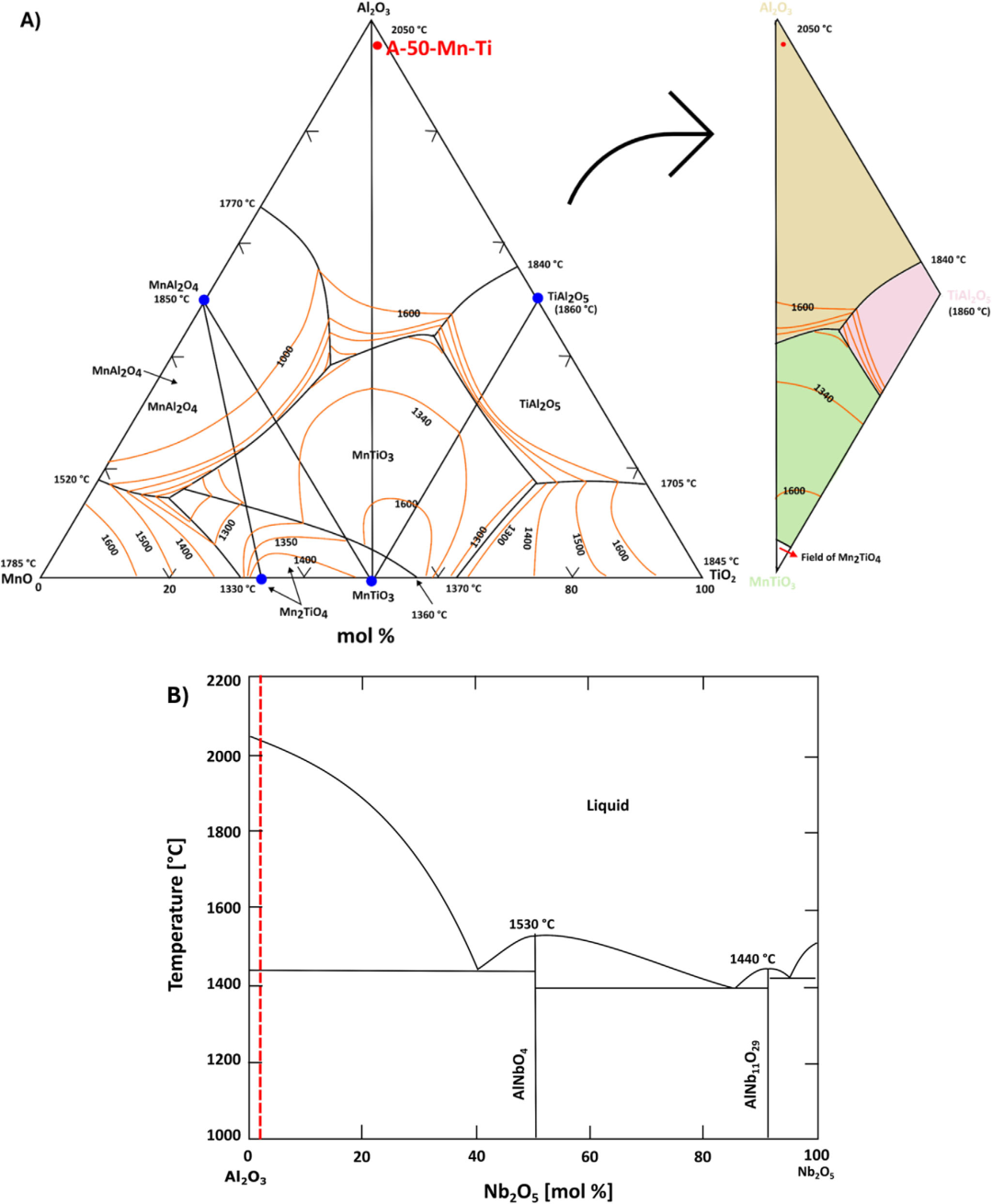
As can be seen in Figure 2, at a sintering temperature of 1600°C, both additive systems produce approximately 4.35 vol% liquid phase. But their "tactics" are completely different: * MnO₂–TiO₂ tends to form liquid phases such as MnTiO₃ and Al₂TiO₅, which can effectively wet grain boundaries and promote particle rearrangement and material migration. * Nb₂O₅ tends to react with aluminum oxide to form AlNbO₄ solid solution, which accelerates diffusion through lattice distortion and point defects.
Results
After degreasing and sintering, the results were exciting.
- Relative density reached 95.9% with MnO₂–TiO₂ versus approximately 93% for pure alumina. Nb₂O₅ also improved density, but less strongly.
- Flexural strength was 80.9 MPa for A-50-Mn-Ti versus about 38 MPa for pure alumina, an increase exceeding 110%. Nb₂O₅ gave approximately 55 MPa.
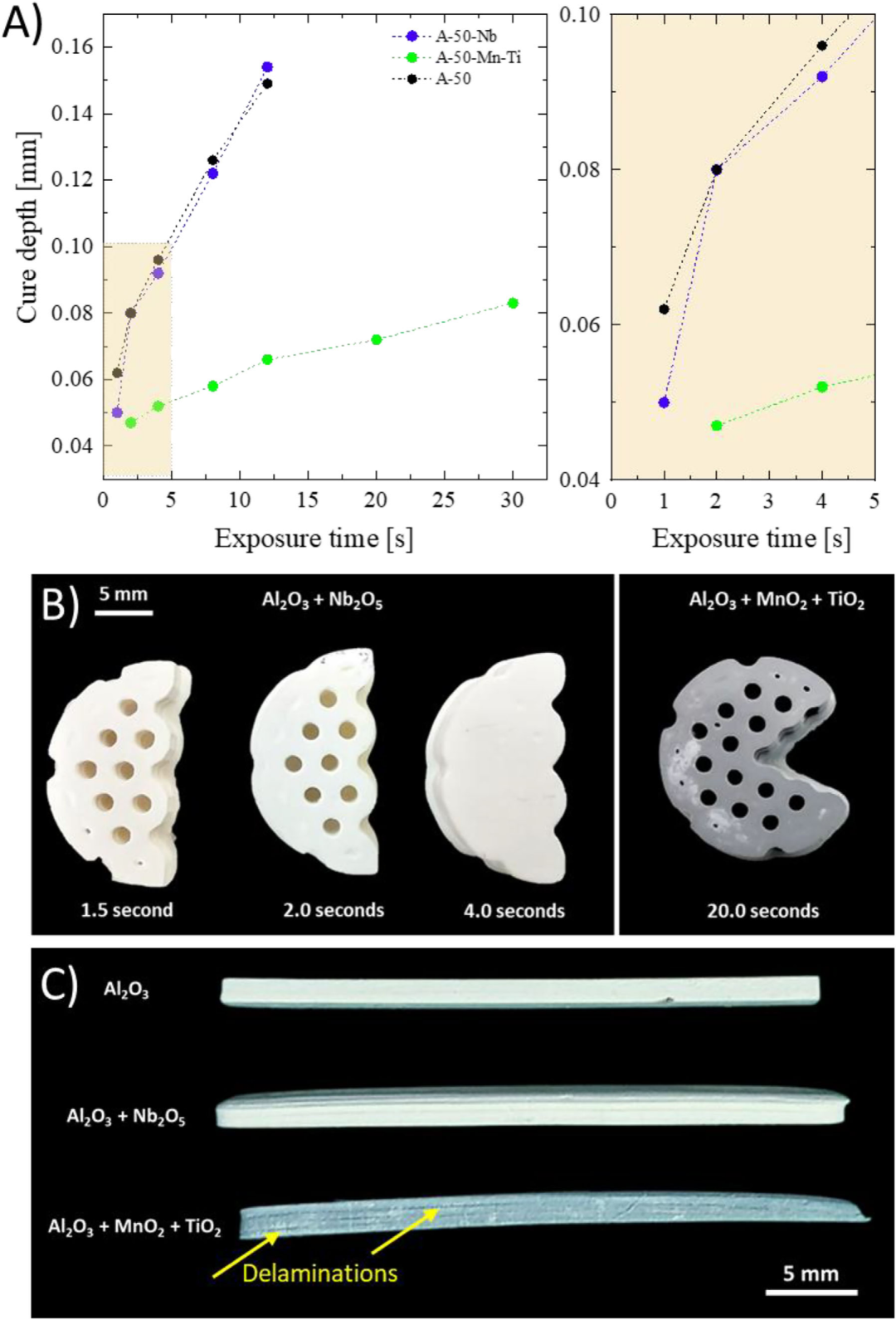
Figure 3. (a) Curing depth of photosensitive suspension; (b) Effect of exposure time on UV light scattering during sample printing (white and gray samples are derived from A-50-Nb and A-50-Mn-Ti suspensions respectively); (c) Printed layer structure of green sample.
More critical is the observation of microstructure. On the fracture surface of the pure alumina sample, the researchers found obvious traces of interlayer peeling—layers of ceramic flakes were clearly discernible, which were “scars” left by the printing process.
However, in the samples with added MnO₂–TiO₂, the situation is completely different. The fracture surface is dense and uniform, and the interface between layers is almost invisible. The liquid phase formed by the sintering aid is like "glue", tightly welding the stacked ceramic particles together to form an integrated microstructure.
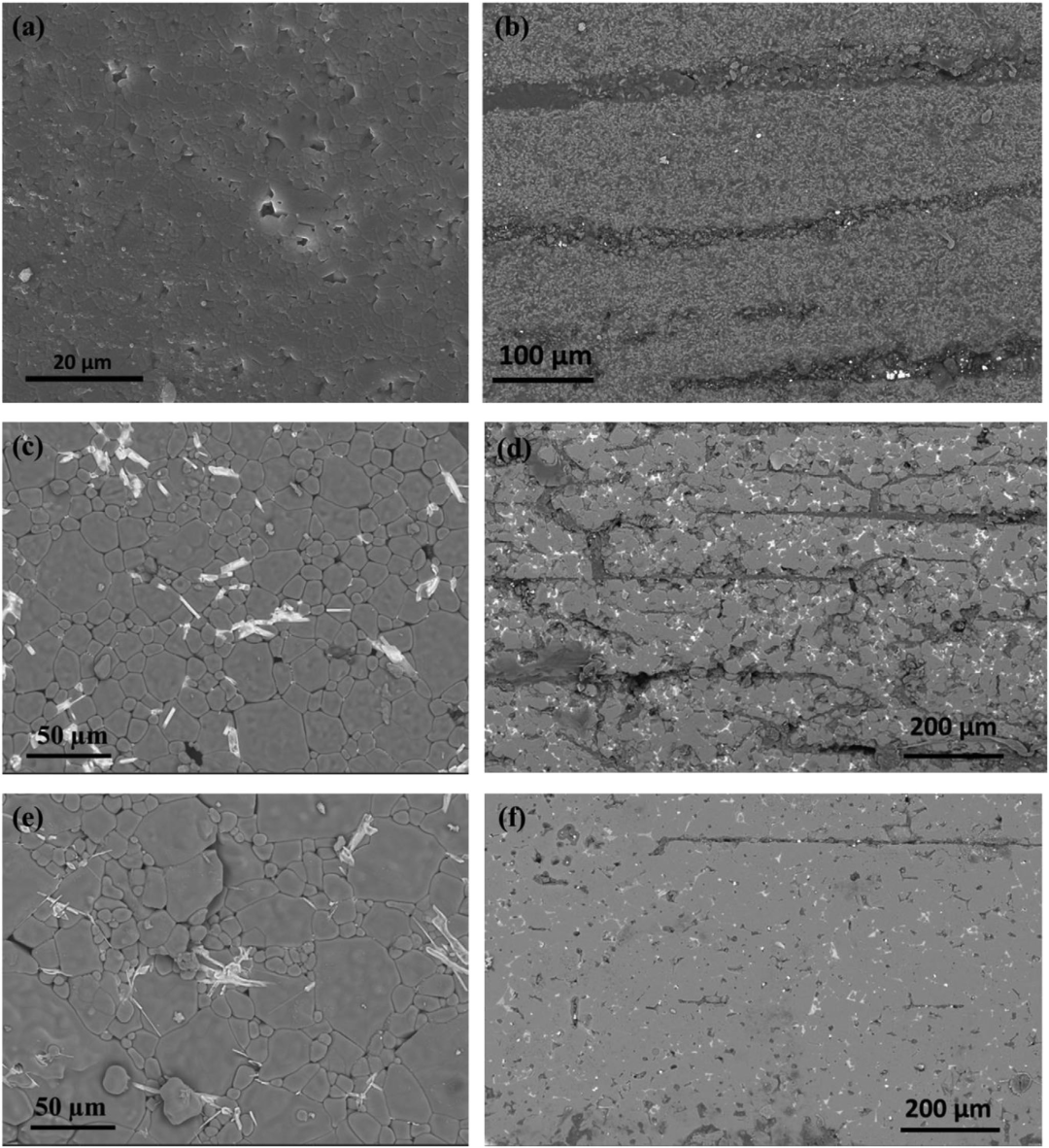
Figure 4: SEM micrographs of ceramic parts fired using slurry: (a and b) A-50 (control); (c and d) A-50-Nb; (e and f) A-50-Mn-Ti. All samples were pre-sintered at 1600°C for 2 h.
This fundamental improvement in microstructure is the direct cause of a significant increase in resistance. Although Nb2O5 has also contributed to decryption, the improvement of inter-layeral integration has been less significant than that of Mno2-TiO2 because of the less efficient mechanisms of proliferation of solid solvent formation than liquid sintering.
Conclusions
The study clearly indicated that:
- Additive selection matters: higher density alone does not ensure reduced delamination. The MnO₂–TiO₂ liquid phase promotes sintering and improves interlayer continuity in the reported system.
- Compared with solid-state diffusion, a liquid phase can fill small interlayer gaps and pores more uniformly and rapidly, improving integrity and mechanical properties.
- The study used an LCD-based photopolymerization printer, illustrating how formulation design may enable capable ceramic parts on more accessible equipment; it does not establish a universal production-cost advantage.
Paper citation information: Verza J R, Camargo I L, Luz A P. Effect of MnO₂–TiO₂ and Nb₂O₅ on the Fabrication and Properties of Alumina Ceramics Produced via Vat Photopolymerization[J]. Journal of the American Ceramic Society, 2026, 109(5): e70820. DOI: 10.1111/jace.70820.