Process engineering
A successful print is not yet a successful sintered part
Defects may appear only during debinding and sintering, so success criteria must cover final density, cracks, distortion and dimensions.
This KUNWU editorial note is based on the supplied technical source. Reported results belong to the described study or sample and are not KUNWU equipment specifications.
Light curing alone cannot control the whole process chain
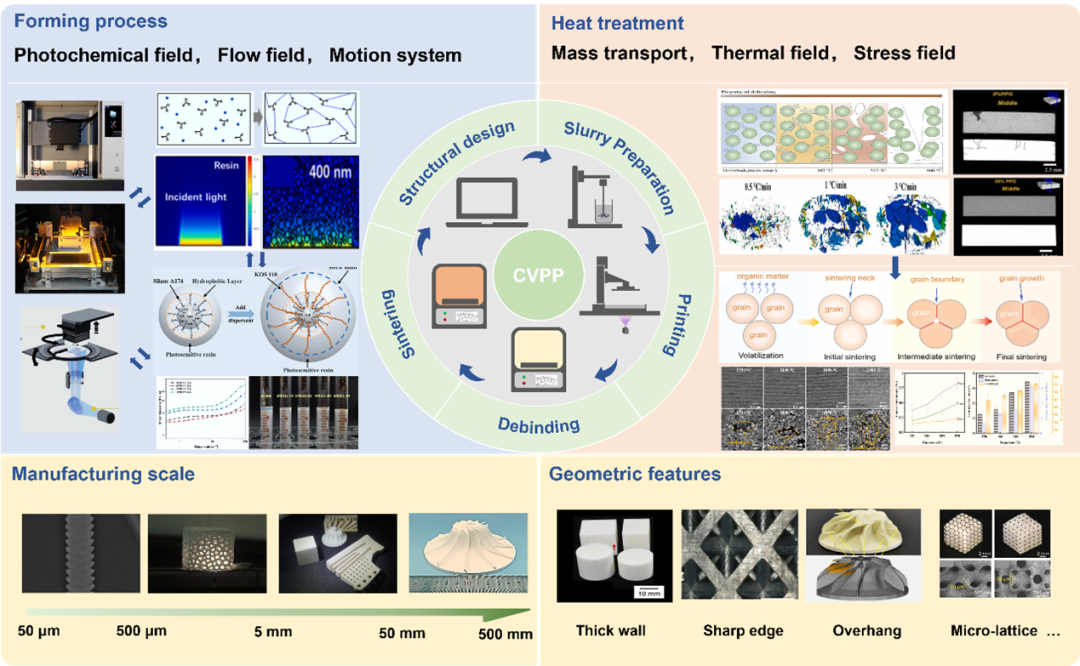
The logic of ceramic photopolymerization (VPP) seems simple: UV light irradiates the photosensitive slurry containing ceramic powder layer by layer, and the resin cross-links to "freeze" the particles in place, stack them into green bodies, and then degrease and sinter them into dense ceramic parts. The molding accuracy can reach micron level, and the structural design freedom is far superior to traditional injection molding and gel injection molding.
But "forming successfully" is just the beginning. The real test is in the heat treatment stage: degreasing requires burning off a considerable proportion of the organic binder that accounts for the volume of the green body, and sintering requires densifying the particles at high temperatures. Both steps are accompanied by severe volume shrinkage and stress redistribution. The appearance of the green body is intact, but after sintering, it cracks, warps, and thin walls collapse—this dilemma, summarized by the industry as "printable-but-not-sinterable" (printable but not sinterable), is the number one bottleneck hindering the industrialization of ceramic light curing.
The root of the problem is that ceramic photocuring spans a huge span from nanoscale powders to centimeter-scale components. Four types of physical fields, including light fields, fluid fields, thermal fields, and stress fields, are coupled throughout the entire process. Tiny defects in any link will continue to accumulate and amplify step by step along the process chain. This means that optimizing a certain process at a single point (such as only adjusting the slurry formula, only optimizing the sintering curve) often treats the symptoms but not the root cause.
The ring deserves to be developed alone. Once the resin is mixed into ceramic particles, the situation is no longer as simple as pure photo fixation: the greater the refraction rate of ceramics, the greater the difference between the two, the greater the dispersion of input light on the particle surface. In the typical photo fixation bands (365 to 405 nm) and common powder particle sizes (100 nm to 10 nm), the main occurrence of ceramic suspended fluids is the dispersion of mi. It spreads the light to the side, the depth of solidification declines exponentially, and the width of solidification is "widening", resulting in partial stabilization and a direct decline in the accuracy of the biological horizontal dimensions. This is the physical root of high-precision ceramics, which are harder to hit than pure resins, and of many process optimizations (e.g. reduction of solid content, matching of refraction rates, adjustment of exposure compensation) around it.
Four intrinsic defects and their combined effects
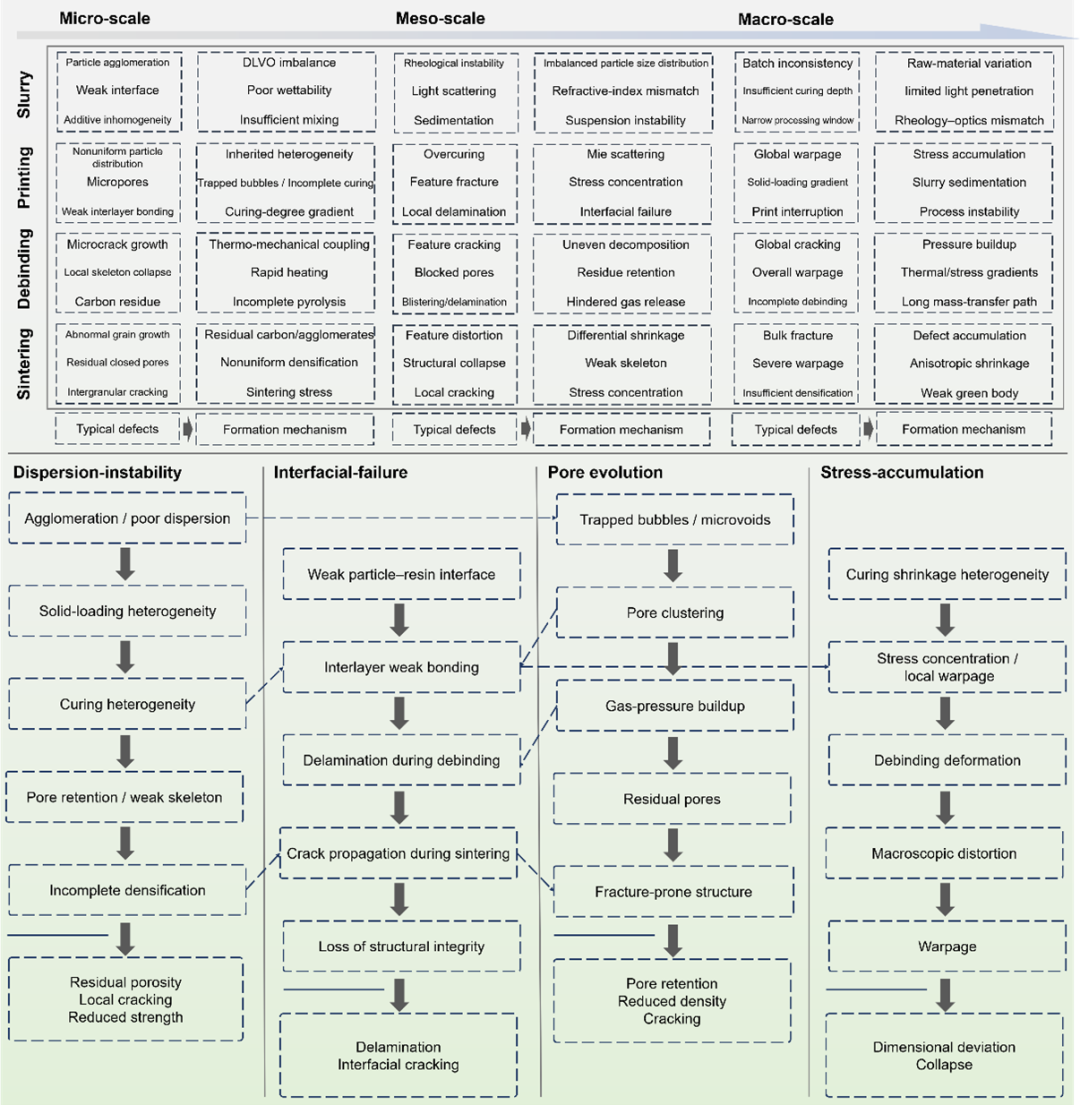
To understand why sintering fails, we must first recognize where the defects come from. A recent systematic review published in "Progress in Materials Science" classified the native defects of ceramic photocuring into four categories. They are not independent of each other, but are coupled with each other and promote each other.
First, the powder is unevenly dispersed. If the ceramic particles are agglomerated in the resin and the local solid content is unevenly distributed, regional solidification differences will occur during the printing stage; during the degreasing and sintering stages, these uneven areas will evolve into closed pores and loose skeletons, directly reducing the density and mechanical properties.
Second, the interface combination is weak. The interfacial bonding force between ceramic powder and photosensitive resin is already weak. In addition, due to insufficient wetting between printing layers and incomplete local curing, the bonding strength between green layers is inherently insufficient. It is easy to delaminate and debond during degreasing, and cracks rapidly expand along the weak interface during sintering, eventually causing overall delamination.
Third, stomata defects. The stirring of the slurry and the laying of the scraper will entrap tiny bubbles; during the degreasing stage, the organic matter decomposes and releases gas. If the discharge is blocked, the internal air pressure will continue to rise and permanent holes will be formed. During sintering, pores become a source of stress concentration and continue to generate microscopic cracks.
Fourth, stress accumulation. The thermal-mechanical coupling effect of light-curing volume shrinkage, inter-layer shrinkage difference, and temperature rise and fall will continuously accumulate local stress during the entire process of printing, degreasing, and sintering. In the initial stage, there is only a slight deformation. After continuous amplification, overall warping and dimensional deviation will appear. In severe cases, the component will directly collapse.
The point is that these four types of deficiencies do not arise independently. Airholes increase stress concentration, which in turn destroys interface integration, and the uneven dispersion of powder causes simultaneous anger holes and interface defects. They're co-deteriorating, forming a snowball-type magnification chain. This is the root cause of the failure to cure sintering by optimizing single processes.
A framework: resist, prevent, release and exploit
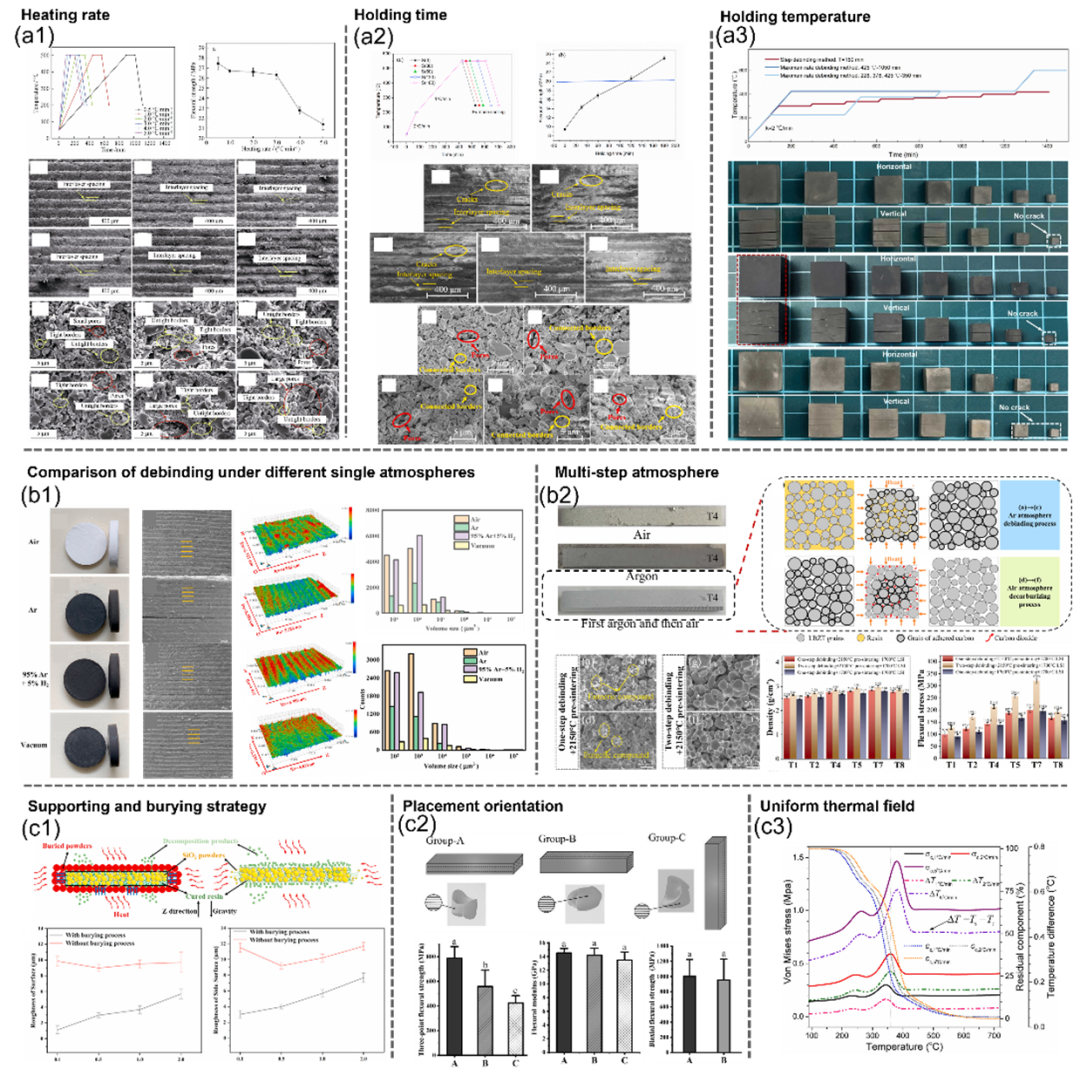
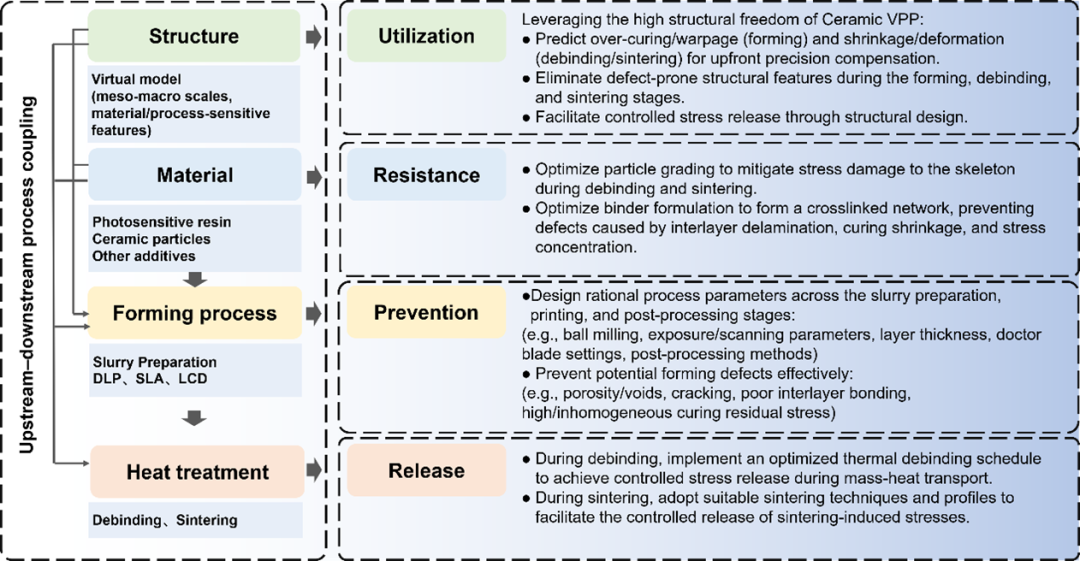
Since defects evolve coupledly across processes, the solution must cover the complete process chain. This review proposes a "four-level full-process collaborative optimization" strategy, which corresponds to the four links of slurry, molding, heat treatment, and digital design.
| Stage | Strategy | Measures | Defects addressed |
|---|---|---|---|
| Slurry | Resist | Graded powders raise solids and lower viscosity; low-shrinkage resin reduces interlayer stress; sintering aids lower densification temperature | Uneven powder dispersion |
| Forming | Prevent | Match exposure and layer thickness to optics; graded grayscale exposure reduces cure gradients; non-contact supports limit thin-wall pulling | Pores and weak interfaces |
| Heat treatment | Release | Staged debinding relieves gas pressure; multiple dwells aid uniform density; powder-bed firing evens temperatures in thick walls | Accumulated stress and warping |
| Design | Exploit | Direction-dependent shrinkage compensation; fillets reinforce sharp thin-wall corners; through-channels vent debinding gases | Dimensional shrinkage errors and cracks |
Table 1 · Four-level collaborative optimization strategy for the entire ceramic photocuring process chain
The first level of "resistance" falls on the slurry end. Powder properties run through the entire process from molding to sintering and are the basis for damage resistance. Multi-scale gradation (matching of large and small particles) can not only increase the solid filling rate, but also reduce the slurry viscosity and improve printability; use a photosensitive resin system with low polymerization shrinkage to weaken interlayer stress from the source; and then adapt sintering aids to reduce the temperature required for densification and alleviate high-temperature deformation. Uniformly dispersed powder can also suppress local stress concentration during the degreasing stage.
The second level of "prevention" contains defects at the source during the printing stage. The exposure dose and single layer thickness must match the optical absorption characteristics of the slurry, and find a balance between the molding accuracy and the bonding strength between layers; grayscale gradient partition exposure can eliminate the difference in curing gradient between layers; adapting the scraper and non-contact support scheme can reduce the pull damage of thin walls and microstructures; supporting cleaning processes can remove residual slurry and avoid hidden dangers of pores.
The third level "releases" the stress in the heat treatment process. Degreasing is not done in one go. A stepwise heating program must be designed based on the thermal decomposition curve of the resin to allow the organic decomposition products to be slowly discharged to avoid sudden rises in internal air pressure and cracking the components. Multi-stage insulation zones are set up for sintering to promote uniform densification of particles and reduce regional shrinkage differences. For large-walled, porous and complex parts, a powder burial process must be used to balance the global temperature field and suppress overall warpage.
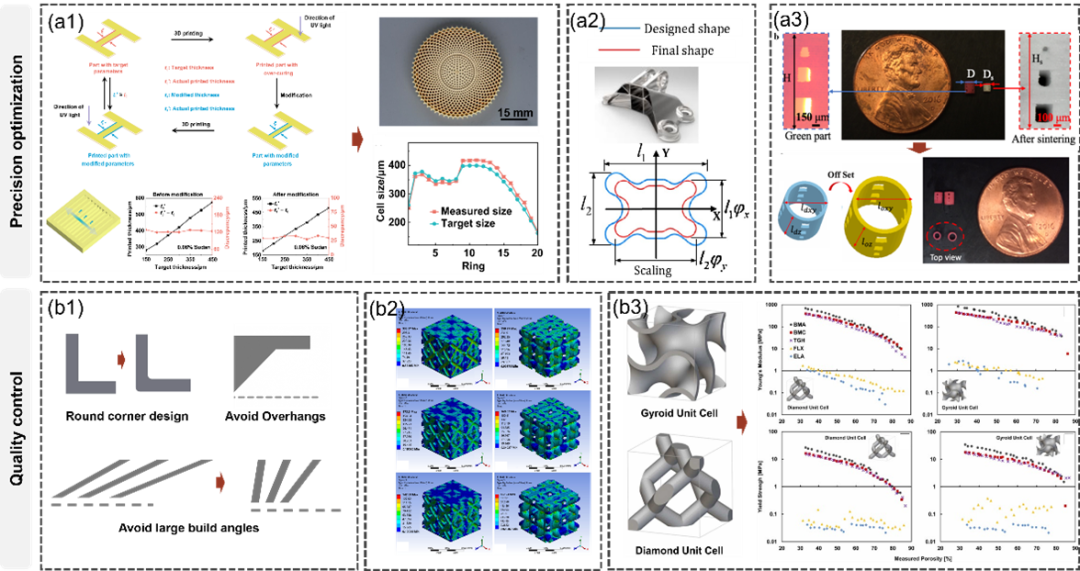
The fourth level of "utilization" puts effort into the design stage. This is the most unique advantage of ceramic photocuring - since it can print any complex structure, the shrinkage and stress concentration caused by sintering should be predicted in advance during three-dimensional modeling. Design rounded corners and local reinforcement for stress concentration areas such as sharp corners and thin walls; set differentiated shrinkage compensation coefficients for different wall thicknesses and pore areas; design through-type continuous channels to leave a smooth escape path for degreasing gas. Defects are not fixed after burning, but avoided during modeling.
Four application directions, different process priorities
This whole chain synergetic framework is widely applied. The main chain of printing-defamation-burning is shared across different applications, but the focus of the process varies.
Biomedical use is one of the fastest growing directions for ceramic photocuring. Calcium-phosphorus-based (HAP, TCP) bone repair scaffolds require precise control of the size, shape, and interconnection of through-pores to match bone tissue ingrowth. Zirconia dental all-ceramic crowns require both high density and high fracture toughness. The difficulty here is that there is a natural conflict between porous structure and densification. The more connected the pores are, the easier it is for local collapse of sintering - "utilization" (pore design) and "release" (segmented sintering) in the four-level framework are particularly critical.
Aerospace focuses on large-sized, thin-walled, high-temperature-resistant components, and alumina and silicon carbide are the main materials. Thin-walled parts are easily warped due to their own weight and stress during degreasing, and they rely on "prevention" (non-contact support) and "release" (buried burning balanced temperature field) to cope with this problem. The sintering temperature of this type of high-temperature resistant ceramics is generally high, and the uniformity of the temperature field is the key to success.
Electronic heat dissipation and new energy pay more attention to the fine molding of micro-channels and porous functional structures. Porous ceramic parts for batteries and fuel cells require precise and controllable pore structures, and electronic heat dissipation microchannels are extremely sensitive to wall thickness uniformity. Such structures often have extremely thin wall thicknesses and extremely small feature sizes, which place higher requirements on slurry rheology ("resistance") and exposure accuracy ("prevention").
From isolated optimization to whole-chain coordination
With ceramic light curing today, the real competition is no longer "who has higher precision" or "who has faster layers", but who can truly connect the five links of slurry, printing, degreasing, sintering and design. No matter how perfect the green body is, as long as it fails to pass the sintering stage, all the previous precision molding will be reset to zero.
That is precisely the logic of KUNWU's adherence to the integrated programme of "Equip + Materials + Stem Process" — ceramic 3D printing was never delivered as raw, but as a reliable product after burning. From aluminium oxide, oxidation to hydroxyl phosphate limestone, silicon carbide, the DLP 3D ceramic printing platform at KUNWU has verified more than 30 material systems, with a standardized light-sensitive slurry and mature sintering process parameter pack, allowing each ceramic 3D printer to export final ceramics that are not just precise geometrical shapes, but also sinterable, decryptionable and landingable.
Over the next three years, the most interesting breakthrough point for the solidification of ceramic light is probably not a slight adjustment in the parameters of a particular process, but rather a combination of "resistance-preventive-release-use-use" levels, so that printing and burning are no longer isolated islands, but rather a connected, predictable and re-emergible chain of processes.
References
Ye Y, Tian Z, Jiao C, et al. Ceramic vat photopolymerization: a multiscale perspective. Progress in Materials Science, 2026. DOI: 10.1016/j.pmatsci.2026.101767