Materials research
Porous SiC with improved thermal-shock resistance
The work examines how composition and porous architecture jointly affect SiC stability under rapid thermal cycling.
This KUNWU editorial note is based on the supplied technical source. Reported results belong to the described study or sample and are not KUNWU equipment specifications.
The dilemma of DLP-printed microporous SiC
SiC ceramic has high strength, wear resistance, and oxidation resistance. It can also withstand the impact of rapid cooling and rapid heating, which makes it have important application value in the fields of gas filtration, catalyst support, and high-temperature heat exchange. Such applications often require materials to be "porous", especially interconnected micron-sized pores with controllable size, which can be breathable/liquid-permeable without sacrificing too much load-bearing capacity.
There are many traditional pore-making methods. The polymer sponge replication method can easily form high-porosity connected pores, but the pore structure is limited by the template; the direct foaming method is highly efficient, but often leads to uneven structure due to unstable foam; the freeze-casting method can create directional pores, but it is inevitably structural anisotropy and sublimation cracking. It is difficult for these methods to simultaneously take into account "flexible molding of complex structures" and "precisely controllable hole size and hole morphology".
DLP (Digital Light Processing), as a surface exposure light-curing technology, has high molding accuracy and great design freedom. It is theoretically suitable for direct printing of complex porous ceramics. But if you really want to make the holes 10 microns, a problem arises: SiC particles scatter ultraviolet light too strongly, which can easily cause over-curing at the hole boundaries, blurring the hole boundaries or even completely blocking them; in addition, it is difficult to thoroughly clean the uncured resin in the small holes, making it even more difficult to form open and connected channels. Micron-level hole creation has become a technical difficulty in DLP printing of porous SiC.
What the team wants to do is very clear: Can they find a "pore-forming agent" that can not only avoid the two problems of strong scattering and residual resin, but also stably and controllably leave uniform pores in the ceramic? What they chose was polymethyl methacrylate, also known as PMMA microspheres.
PMMA microspheres: pore formers and rheology modifiers
PMMA's ability to do the job depends on two hard conditions: "high sphericity + complete thermal decomposition". It has two major functions, allowing the team to call it "Dual effect" in the text.
The first function is to improve the slurry and facilitate printing. The refractive index of PMMA (about 1.49) is almost the same as that of photosensitive resin (about 1.50), while SiC is as high as 2.65. The difference in refractive index between the particles and the resin is the source of light scattering. After the introduction of PMMA, the equivalent refractive index difference of the entire system is greatly reduced, weakening scattering, allowing ultraviolet light to penetrate deeper. It was actually measured that under the same exposure time, after adding 60 vol% PMMA, the curing depth increased from 75 μm to 91 μm. At the same time, the spherical microspheres also reduce the mechanical bite and friction between SiC particles like "balls". The slurry viscosity dropped from 2309.6 mPa·s to 1183.2 mPa·s, and the 60-hour sedimentation rate also dropped from 15.0% to 5.8%. The slurry is thinner, more stable, and solidifies deeper, significantly improving printing performance.
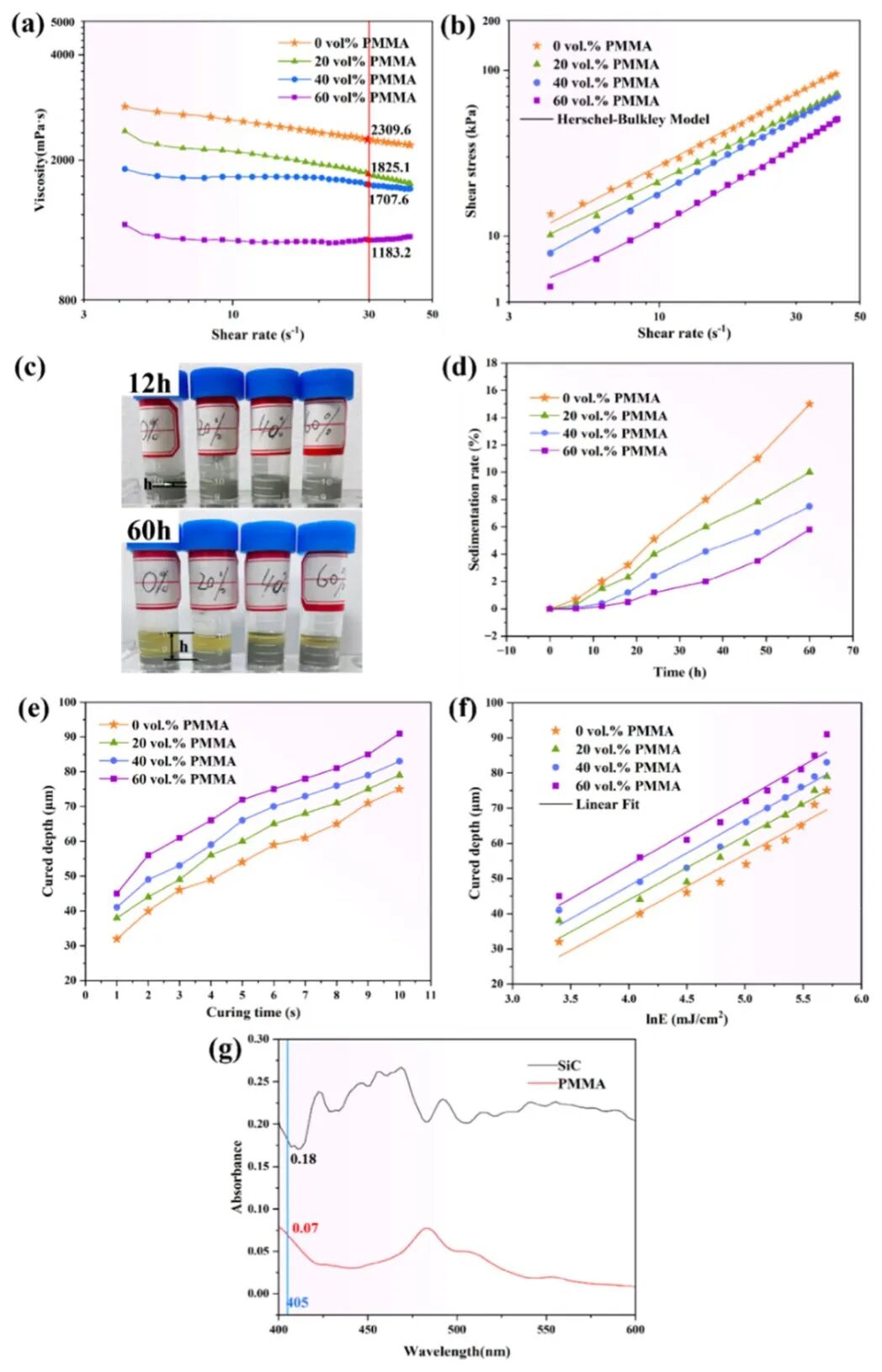
The second function is its core function-making holes. PMMA microspheres can be decomposed almost completely during degumming (accumulated weight loss reaches 96.5%), leaving spherical channels directly in situ, without relying on "light scattering" or "resin washing", which are prone to problems in DLP. This solves the technical difficulties mentioned at the beginning.
Higher open porosity and controlled two-scale pores
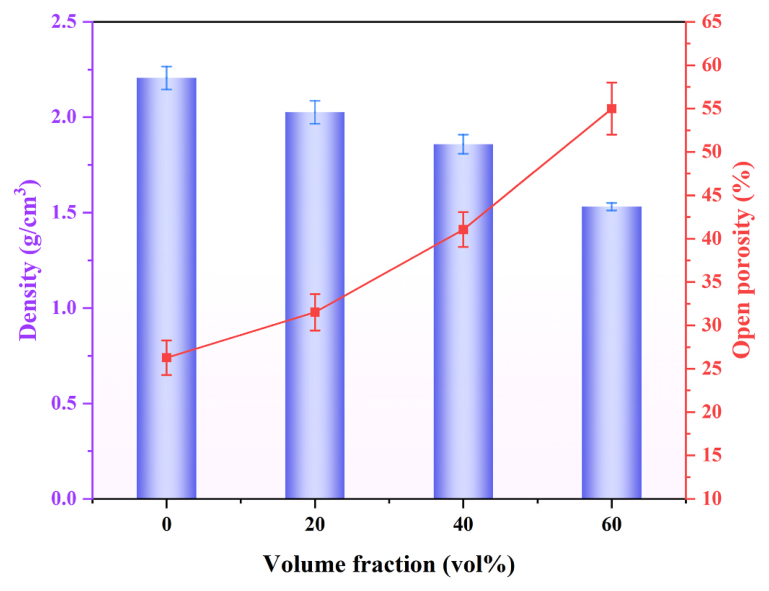
The improvement of rheological properties lays the foundation for printing, and the real core value of PMMA lies in its hole-making function. Adjusting the PMMA content from 0 to 60 vol%, the porosity and density changes of the material are very intuitive. The porosity more than doubled from 26.27% to 54.98%; the bulk density dropped from 2.21 g/cm³ to 1.53 g/cm³. In other words, by controlling the amount of PMMA added, the porosity can be accurately adjusted within a wide range, which gives designers sufficient design freedom.
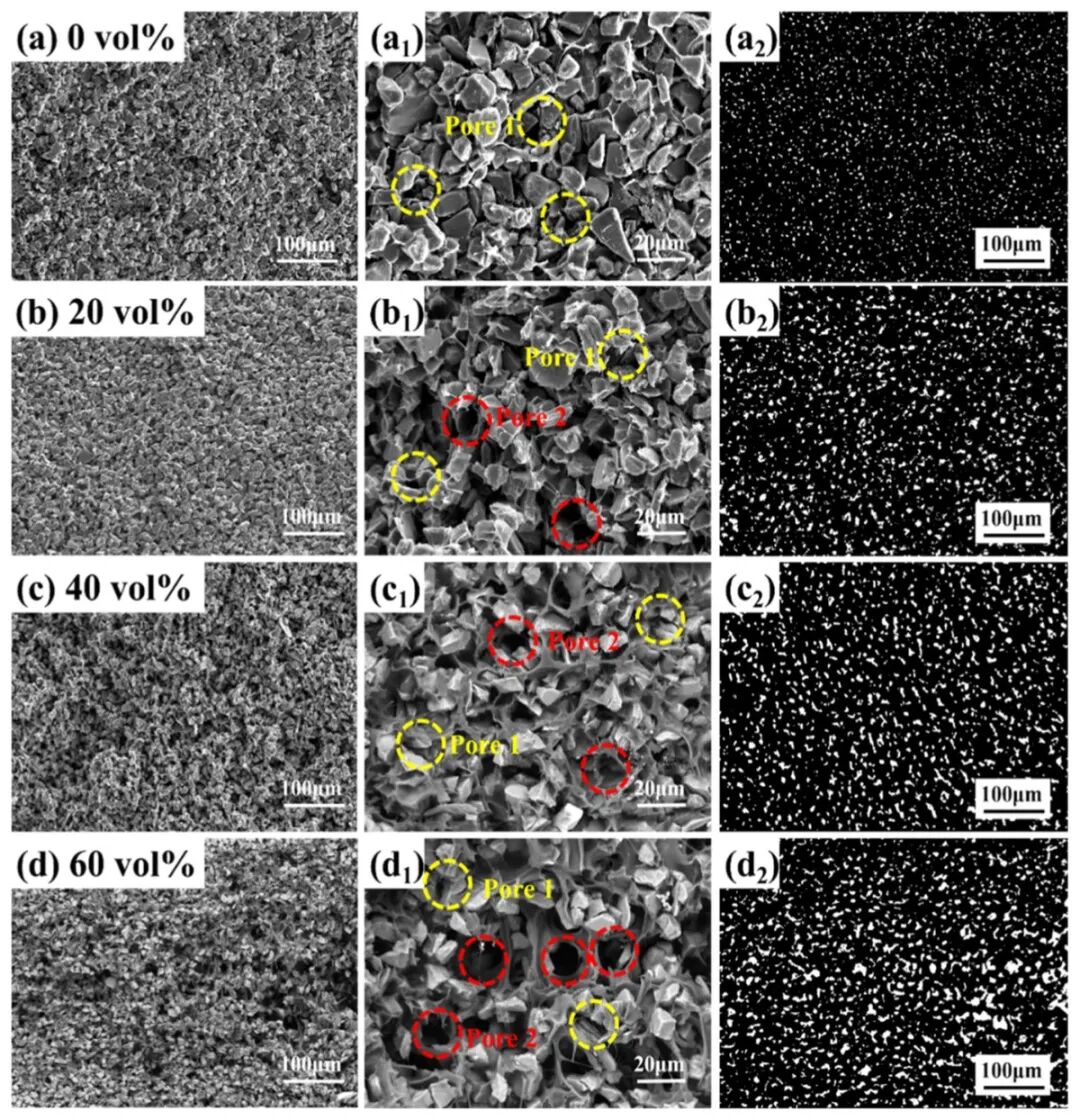
More importantly, microstructure. The team used ImageJ to identify SEM images, and found two parallel holes in the system: the small hole between the particles of the matrix and the large hole in the spherical form left by PMMA, which formed the "two-scale" hole structure. Large holes with a diameter exceeding 8 μm increased from 0.03 per cent to 19.71 per cent and the average area increased from 56.46 μm2 to 109.64 μm2. Even with a high increase of 60 vol per cent, the spherical hole maintains a good geometric integrity without structural collapse, which is supported by rigid skeletons from the SiC particles.
Thermal shock: optimum 20 vol%, ΔTc = 338.3 °C
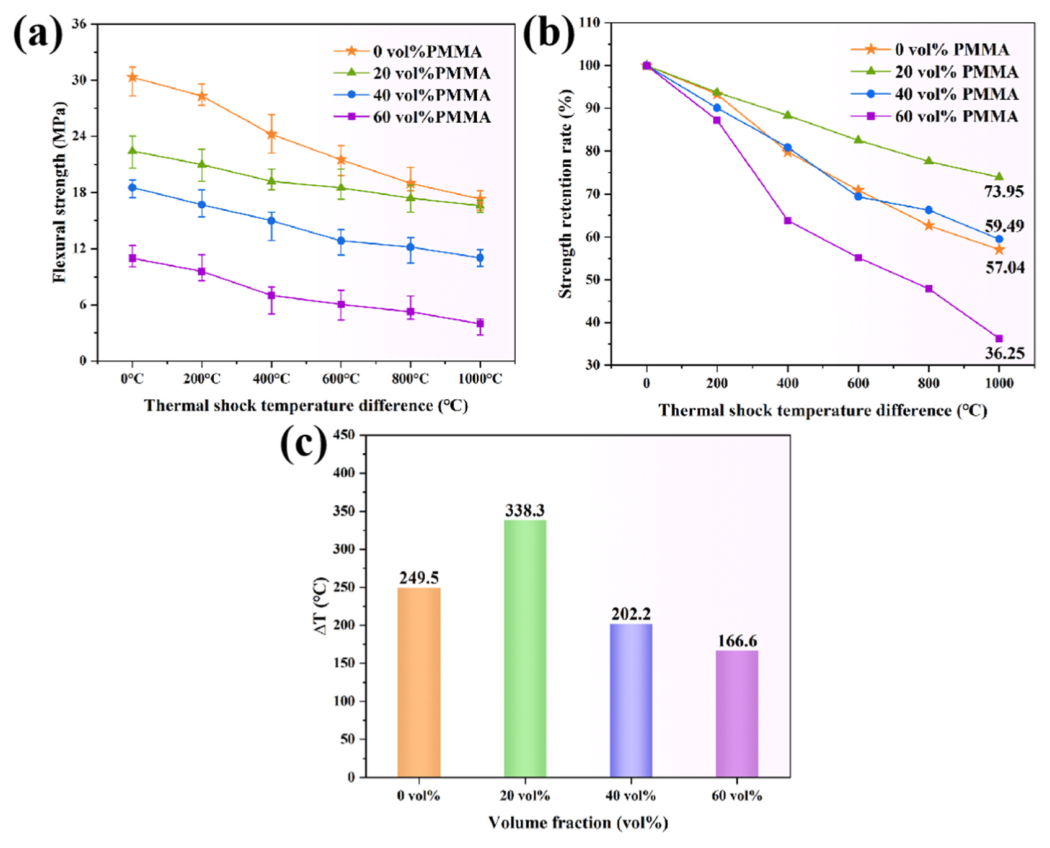
Making holes is the means, making the materials usable is the purpose. A key service indicator of porous SiC is thermal shock resistance, which is the temperature difference impact that the material can withstand without failure. The team uses "critical temperature difference ΔTc" to measure it, which is the temperature difference corresponding to when the bending strength retention rate drops to 90%. The higher the ΔTc, the better the thermal shock resistance.
The results show non-monotonic changes: more porosity is not better. The sample containing 20 vol% PMMA had the highest strength retention at all test temperature differences, reaching a ΔTc of 338.3°C and retaining 74% of the strength after impact at 1000°C. However, further increasing to 60 vol% is the worst, with ΔTc decreasing significantly and the strength retention rate once falling to 36.3%.
Compared with the mainstream preparation methods, the positioning of this process route is also very clear: the opening rate of the hot pressing method is usually 8.7–27.3%, ΔTc 328.9–361.2°C, the tape casting method is about 10–30% and 426.9°C, and the dry pressing method falls in the 300–400°C range. The DLP + PMMA pore-making method in this article achieves a ΔTc of 166.6–338.3°C in a wider porosity range of 26.3–55.0%, indicating that it combines flexible control of high porosity with comparable thermal shock resistance.
Mechanism and engineering implications
Why is there an optimal value of 20 vol%, but too much is harmful? The team gave an explanation based on the fracture mechanism: moderate porosity can blunt the crack tip, induce crack deflection, and relieve thermal stress like a "cushion pad"; but once the holes are too dense and too dense, the holes are connected to form large defects, which instead form stress concentration, cracks rapidly expand along the pore network, and the material fails quickly. This inflection point of "gain first and then degrade" falls exactly at 20 vol%.
Putting the value of this work from an industrial perspective, there are three points worth noting. First, it opens up the key link of "printable + hole-making". PMMA can be used as both a rheological additive and a hole-making template, eliminating the need for additional process steps. Second, the porosity can be accurately adjusted in a wide range, continuously adjustable from 26% to 55%, covering the real needs of lightweight design and performance trade-offs. Third, the morphology is still intact under high porosity, which provides a feasible path for balancing high porosity and high thermal shock resistance. Most of its benchmark porous SiC mainstream processes (hot pressing, tape casting, and dry pressing) are forced by the narrow porosity range or complex processes.
Of course, we must also look at it objectively: the absolute strength of the 20 vol% sample is not high, and there is always a trade-off relationship between porosity and strength; the "controllability" of dual-scale pores is currently more reflected in the porosity level, and there is room for improvement in fine single-point control of pore diameter. Overall, this combination of "PMMA pore creation + DLP" provides a solid sample-level demonstration for the engineering application of porous SiC ceramics, and is worth paying attention to as a reference for peers in high-temperature filtration and heat-resistant components.
References
Dong Y, Liu Y, Zhang Y, et al. Fabrication and thermal shock resistance of porous silicon carbide ceramics prepared via DLP 3D printing using PMMA microspheres as pore-forming agents. Ceramics International, 2026. DOI: 10.1016/j.ceramint.2026.07.426