Catalysis and electrochemistry
3D Ti4O7 grid electrode for active-chlorine electrosynthesis
How DIW printing and an electric field reoriented Ti4O7 facets and brought active-chlorine generation close to an industrial anode benchmark.
Authorized republication with translated text and the source’s original scientific figures. Numerical results belong to the reported study, not to KUNWU equipment specifications.
- Active-chlorine generation rate
- 0.19 mg min-1 cm-2
- Flow-by reactor
- 0.33–0.35 mg min-1 cm-2
- Residence time
- 2.9–8.9 s
A team from Dongguan University of Technology, Guangdong University of Technology and Harbin Institute of Technology published ‘Strain-induced faceting of Ti4O7 for active chlorine electrosynthesis’ in Nature Communications (impact factor cited in the source: 18.1). Ceramic 3D printing was used to fabricate three-dimensional Ti4O7 grid electrodes. The manufacturing route employed KUNWU DIW equipment, model ADT-3D-LB-Printer-0050, and the thermosetting polyurethane resin system ADT-DIW-S01L. Conventional active-chlorine production relies on expensive noble-metal dimensionally stable anodes (DSA), whose selectivity is difficult to optimize. Here, direct ink writing created an ordered three-dimensional electrode, and electric-field treatment reoriented its crystal facets, bringing the active-chlorine generation rate of noble-metal-free Ti4O7 close to that of industrial DSA. This article follows the complete route from slurry preparation and printing to reactor validation.
1. The challenge: what anode does active-chlorine electrosynthesis need?
Industrial active-chlorine production relies primarily on chlor-alkali electrolysis. Dimensionally stable anodes coated with noble metals such as ruthenium and iridium have long dominated this process. These anodes face three pressures: global chlor-alkali electrolysis consumes more than 150 TWh of electricity annually; DSA degrades through metal dissolution in highly corrosive chloride electrolytes (5 M Cl-, pH < 3); and, crucially, chlorine evolution (CER) and oxygen evolution (OER) often occur simultaneously on its surface, making active-chlorine selectivity difficult to maintain.
Noble-metal-free Ti4O7 has a high oxygen-evolution potential (>2.5 V versus SHE), suggesting that it could separate CER from OER. However, untreated Ti4O7 predominantly exposes the low-energy (1 -2 0) facet, where chloride adsorption and activation are slow. Its active-chlorine production rate is therefore much lower than that of DSA. The study asks how to obtain sufficient CER activity without doping Ti4O7 with noble metals.
2. From slurry to electrode: the DIW process chain
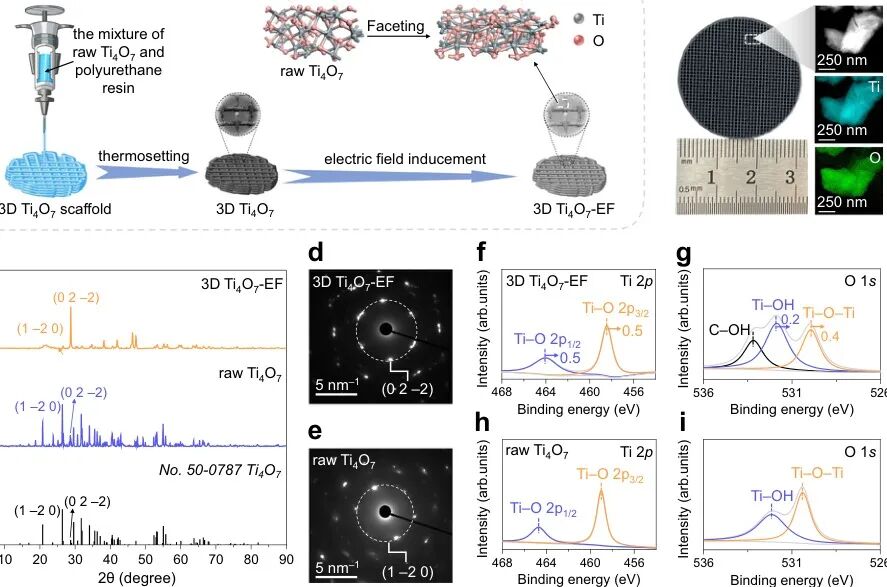
The team selected direct ink writing (DIW) as the shaping method. The process comprises slurry preparation, direct writing and induced post-treatment. Ti4O7 nanopowder was first mixed with the thermosetting polyurethane resin system ADT-DIW-S01L to produce an extrudable, shear-thinning ink. Layer-by-layer deposition along a predefined grid produced a three-dimensional green body with uniform strand width and controlled spacing. After printing, the sample was thermally cured at 70°C to crosslink and fix the resin, then treated in an electric field of 20 V cm-1 to obtain the 3D Ti4O7-EF electrode.
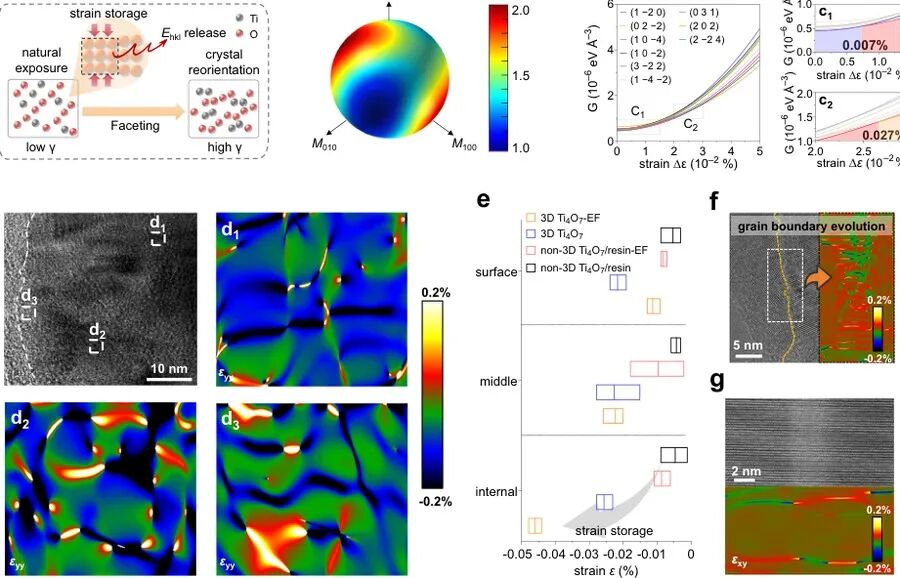
The value of the ordered three-dimensional structure lies in energy storage. Volume shrinkage during resin curing elastically deforms the grid, storing mechanical energy as a persistent strain field. Through dielectric polarization and electroactive-surface-area effects, the applied field increases the stored compressive strain from approximately -0.026% to -0.046%. Release of this strain energy changes the thermodynamic pathway for Ti4O7 facet growth.
3. The catalytic improvement from facet reorientation
XRD and HRTEM confirmed that electric-field treatment changed the dominant exposed facet from the naturally occurring (1 -2 0) plane to the higher-energy (0 2 -2) plane. This was not simply a thermal-treatment effect. Curing-induced shrinkage after DIW printing, together with field-driven ion migration, established a strain-storage, release and reorientation pathway that enabled controlled faceting of low-symmetry Ti4O7 crystallites.
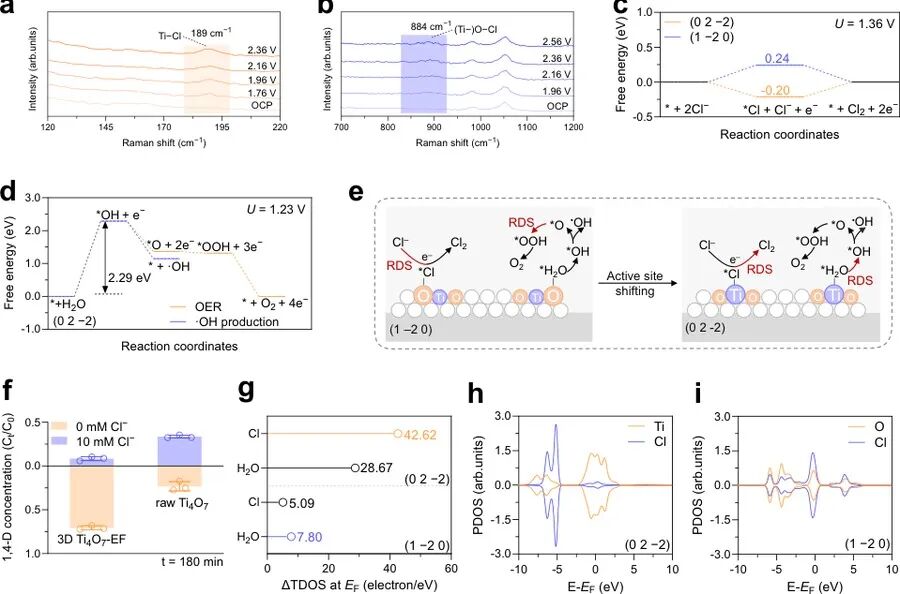
In situ Raman spectroscopy and DFT calculations further revealed the active-site migration mechanism. On the original (1 -2 0) facet, the catalytic sites were oxygen atoms, with weak chloride adsorption as the rate-determining step. The field-induced (0 2 -2) facet switched the active sites to titanium atoms, substantially lowering the chloride adsorption and activation barrier while weakening competing water activation, thereby separating CER from OER.
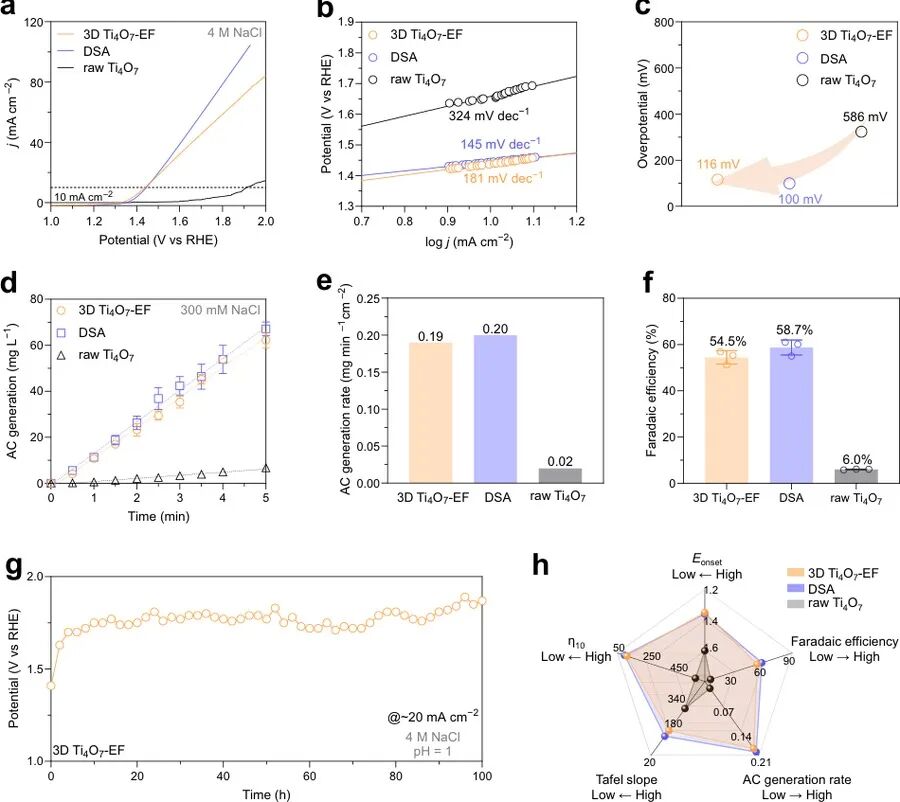
Performance was measured in 4 M NaCl at pH 1 (Figure 4). The active-chlorine generation rate of 3D Ti4O7-EF reached 0.19 mg min-1 cm-2, comparable to industrial DSA at 0.20 mg min-1 cm-2 and nearly ten times untreated Ti4O7 at 0.02 mg min-1 cm-2. Its Tafel slope was 145 mV dec-1, compared with 181 for DSA and 324 for untreated material. At 10 mA cm-2, the overpotential was approximately 116 mV, versus 100 mV for DSA. Faradaic efficiency reached 58.7%, exceeding the DSA value of 54.5%. The potential showed almost no decay after 100 hours of continuous operation, supporting the durability of the facet-reorientation effect.
4. From electrode to reactor: engineering validation of on-site chlorine production
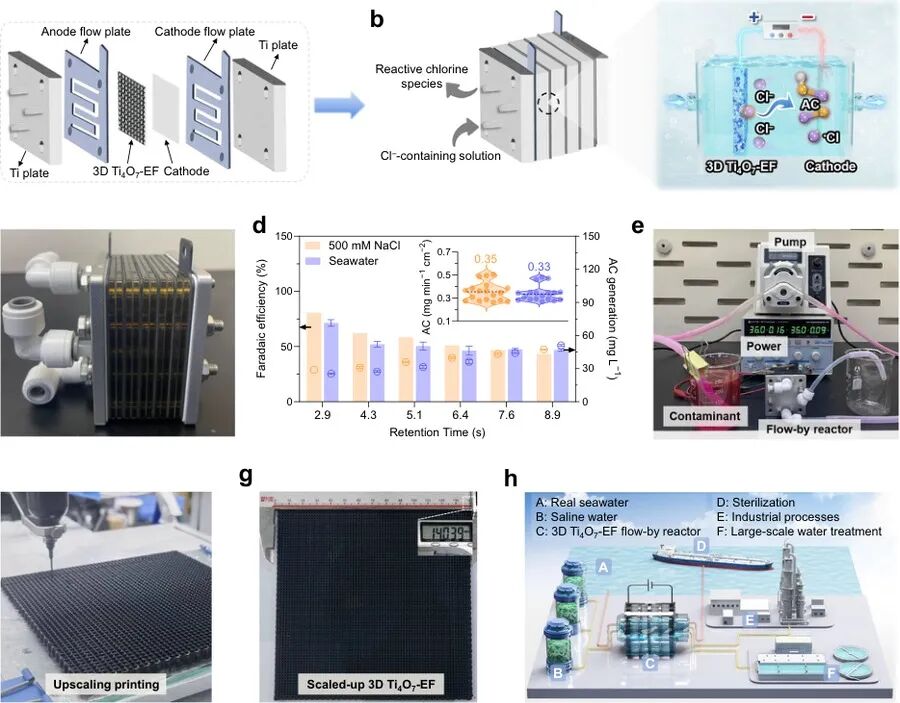
To move the laboratory findings toward practical operation, the team integrated 3D Ti4O7-EF electrodes into a flow-by reactor and tested continuous flow using simulated brine and real seawater. At residence times of only 2.9–8.9 s, active-chlorine generation reached 0.33–0.35 mg min-1 cm-2, exceeding the industrial DSA benchmark. The results indicate potential for on-site disinfection, chlorination chemistry and pollutant degradation.
Structural scalability is another feature of the approach. DIW toolpaths allow grid spacing, thickness and electrode geometry to be adjusted, providing a flexible manufacturing basis for reactors with different flow rates and electrolyte concentrations.
Conclusion: turning a process by-product into a design variable.
The most interesting aspect is a previously overlooked design route: curing shrinkage and electric fields during additive manufacturing can become deliberate tools for strain engineering. Printing shrinkage is normally treated as an error to compensate. Here, the team used it to induce facet reorganization and regulate activity. Transforming an apparently unfavorable process effect into a controllable design tool is itself a transferable research strategy.
The approach offers at least three lessons for materials and equipment research. First, ceramic 3D printing is progressing from geometric freedom toward coordinated design of structure, strain and activity: shape is no longer the sole objective, and printing can influence internal crystal orientation and defects. Second, including strain fields—traditionally regarded as process noise—as design variables may open new possibilities for high-performance noble-metal-free electrodes in electrocatalysis, electrolysis and seawater desalination. Third, combining disciplines can be more powerful than a single-technology breakthrough. Linking materials mechanics, electrochemical characterization and additive manufacturing can shorten the path from mechanistic discovery to reactor validation.