Dental materials
Build angle and bacterial adhesion on 3D-printed dental zirconia
A laboratory comparison of DLP and material jetting shows that surface texture depends on the process–orientation combination.
Authorized republication with translated text and the source’s original scientific figures. Numerical results belong to the reported study, not to KUNWU equipment specifications. This is laboratory or preclinical research, not a clinical recommendation or evidence of a medical device’s clinical efficacy.
- Build angles
- 0° / 45° / 90°
- Groups and specimens
- 6 × 25
- S. gordonii incubation
- 2 h
The study found that printing technology and build angle significantly affect the surface properties and initial bacterial adhesion of 3D-printed zirconia restorations, suggesting a route toward implant-abutment designs that reduce plaque formation.
In digital dentistry, zirconia 3D printing is moving from an alternative toward broader adoption. Its mechanical strength, biocompatibility and aesthetic qualities make it attractive for implant abutments, crowns and bridges. However, microbial colonization remains a threat to the long-term performance of these restorations.
After a zirconia abutment is placed in the oral environment, its surface can be colonized by early bacteria such as Streptococcus gordonii. These organisms attach, aggregate and secrete extracellular matrix, contributing to complex plaque biofilms associated with peri-implant inflammation, bone loss and restoration failure. Surface roughness is often assumed to increase bacterial adhesion—but is the relationship that simple?
A team led by Professor Ping Li at Guangzhou Medical University published ‘Effects of additive manufacturing technology and build angle on surface characteristics and microbial adhesion of 3D-printed dental zirconia: a laboratory study’ in BMC Oral Health. Using KUNWU DLP ceramic-printing equipment as described in the source, the team examined how additive-manufacturing technology and build angle jointly affect zirconia surfaces and initial S. gordonii adhesion. The study offers a perspective on reducing plaque formation through process selection.
Comparing the printing technologies
Two additive-manufacturing technologies were compared:
Material jetting (MJ).
Material is deposited and cured layer by layer, in a process analogous to inkjet printing. The layer thickness was 10 micrometres, supporting fine surface detail.
Digital light processing (DLP).
A projected image cures an entire layer at once. The study used 30-micrometre layers; the process is fast but can produce staircase texture.
Each technology was tested at build angles of 0°, 45° and 90°, producing six groups with 25 specimens each. Laser scanning microscopy measured surface roughness, water contact angle assessed wettability, and colony-forming-unit counts together with SEM quantified S. gordonii adhesion.
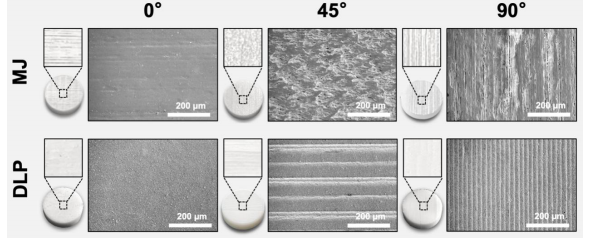
Roughness and wettability: rougher does not always mean more adhesion
Two-way analysis of variance showed significant interactions between manufacturing technology and build angle for both areal roughness (Sa) and water contact angle.
The roughest group
was DLP-45°, with prominent staircase-like layer texture.
The smoothest group
was DLP-0°. Although DLP is often associated with rougher surfaces, the source explains that the 0° orientation aligned layers with the substrate and gave the best finish in this comparison.
The most wettable group
was MJ-45°, with the smallest contact angle. The source suggests that this combination may create nanoscale features favorable to liquid spreading.
Crucially, the study did not observe a consistent correlation between roughness and bacterial adhesion. A simple ‘rougher surface, more bacteria’ rule therefore does not describe these results. Some rougher groups carried fewer bacteria, indicating that chemistry, wettability and nanoscale morphology may matter more than roughness alone.
Lower-adhesion combinations: MJ-45° and DLP-0°
Which printing strategy reduced initial bacterial adhesion most effectively?
Colony-forming-unit counts showed a clear pattern:
The two lowest-adhesion groups
were MJ-45° and DLP-0°.
The highest-adhesion group
was DLP-45°.
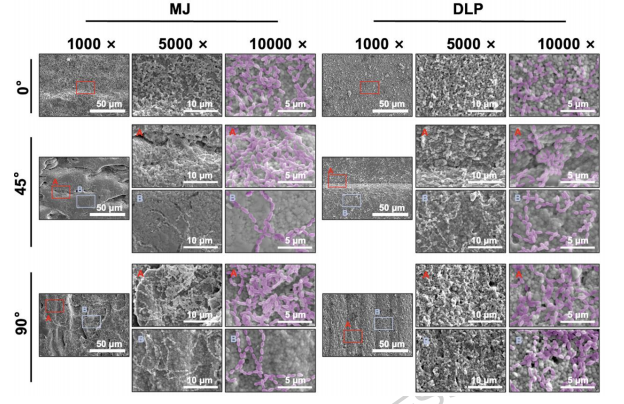
SEM made the contrast visible. Bacteria were sparsely distributed on MJ-45°, with limited aggregation. DLP-45° was densely covered, showing an early biofilm-like layer.
The source discusses a possible implication for subgingival implant abutments: MJ at 45° or DLP at 0° might limit early colonization. It describes this metaphorically as an initial antibacterial protective layer. This laboratory comparison concerns adhesion; it does not establish intrinsic bactericidal activity or clinical infection prevention.
Outlook: from laboratory results to clinical relevance
The study does more than identify two favorable parameter combinations. It demonstrates interactions between manufacturing, surface properties and biological response, emphasizing that biological consequences belong in process design alongside accuracy and productivity.
Limitations include the use of one bacterial species and an in vitro model. The oral microbiome contains hundreds of species. Future work should examine coaggregation and biofilms involving organisms such as Fusobacterium nucleatum and Porphyromonas gingivalis, longer culture periods and biofilm maturation, and animal or human studies to determine clinical relevance.
The work opens a process-based approach to infection-aware digital restoration design. When choosing a build angle in CAD, a clinician or engineer may consider not only external geometry but also how the surface could interact with the oral microbial environment.
Wu K, Wan T, Liu F, et al. Effects of additive manufacturing technology and build angle on surface characteristics and microbial adhesion of 3D-printed dental zirconia: a laboratory study. BMC Oral Health. 2026;26:73. DOI: 10.1186/s12903-025-07379-z.